Advanced Civilization Support

Advanced Civilization Support
We have often mentioned before the evidence that our planet was designed to support life. More than that, it was designed to support advanced life. It was even designed for advanced civilization support.

You can see evidence for advanced civilization support in the minerals of Earth’s crust—minerals that are essential for machinery and electronics that enable technology. One thing which perhaps you have not considered is how the size of our planet also supports advanced civilization. Among the achievements of science is space flight. The ability to use rockets to leave Earth’s surface makes it possible for us to place satellites in orbit. Those satellites include:

*Communication satellites which make possible nationwide and international television, news, sports, telephone, and video conversations.
*Global positioning satellites giving us GPS which we use for many purposes including airplane, ship, and personal navigation plus farming and safety uses.
*Weather satellites giving us advance warning of storms and helping to keep us safe.
*Observational satellites that allow us to study and learn more about our planet.
*Telescopic satellites which enable us to study our solar system and the universe.

We often fail to realize how important those satellites are for our advanced civilization. Also, the ability to use rockets to leave Earth’s surface allows us to send out space probes to explore our solar system and universe.

What does the design of our planet have to do with our ability to leave the surface? The answer relates to gravity. Astronomers have been looking for habitable planets orbiting other stars. They believe that they have found many of those exoplanets. However, the planets that are more likely to be located in habitable zones (where liquid water can exist) are much larger than Earth. A much-larger rocky planet would have much more mass and therefore much more gravity. Launching a rocket into space from such a planet would be much more difficult, if not impossible. Even airplane flight and the flight of birds could be affected by increased gravity.

A planet with a diameter 70 percent greater than Earth’s diameter would have ten times the mass. The advantage of having much more gravity would be that a planet like that could hold a thicker atmosphere which could give more protection from harmful cosmic rays and incoming asteroids. The disadvantage of a thicker atmosphere would be that it might also block useful solar rays. However, getting a rocket off the ground and into space could be prohibitive. It would require a much larger rocket which would require more fuel. That would require an even larger rocket to carry the extra fuel. The weight of the larger rocket and fuel would require an even larger rocket requiring even more fuel. This quickly spirals out of control.

So what is the conclusion? We live on a planet that is large enough to hold an atmosphere that protects us but small enough that we can to break the bond of gravity to go into space. A smaller planet would not have the atmosphere we need. A larger planet would not allow us to explore beyond our planet or even to send up satellites that help to make advanced civilization possible. As Goldilocks might say, “God made it just right.”
–Roland Earnst © 2018

Buzz Aldrin and UFOs

Buzz Aldrin and UFOs
An article in the British tabloid Daily Star on April 8, 2018, claimed that new tests on Buzz Aldrin confirm that he contacted an alien on his trip to the Moon in 1969. The story supposedly came from an Ohio scientific group called “The Institute of BioAcoustic Biology and Sound Health.” That group claims to have a “top secret” test to determine what the subject actually experienced or saw. They gave no explanation of the test or why it overrules what the subject says.

The reason we even mention this is because atheist journals and even in major newspapers like USA Today have cited it. NASA has pointed out that four panels separated from the Apollo 11 spacecraft in flight, and they would have followed the same general trajectory as the spacecraft. Buzz Aldrin said in a Reddit chat session, “I feel absolutely convinced that we were looking at the sun reflected off of one of these panels.” He has denied having any contact with aliens. The BioAcoustic group claims that audio tests have shown hidden truths in Aldrin’s speech.

We have repeatedly pointed out that the question of whether there is life on other planets, is not a biblical or apologetic issue. The Bible doesn’t say that this is the only place where God has chosen to create life. However, it has become increasingly obvious that if there is alien intelligent life in space, it is too far away to be of any consequence to us. In spite of that, the media continues to push the idea that life in space somehow contradicts the Bible and supports atheism.

There is an adage that when a person doesn’t believe in something they will believe anything. That seems to apply here. Our focus needs to be on solving Earth’s problems, not attempts to divert attention to poorly supported scientific claims of alien intervention.
–John N. Clayton © 2018

Bluetooth and Christianity

Bluetooth and Christianity
Here is an interesting story about history, technology, and Christianity. It seems that these days every device uses a technology called “Bluetooth.” Our phones, computers, tablets, sound systems, drones and security systems use Bluetooth to communicate with headphones, speakers, keyboards, mice, printers, and controllers. To most people, Bluetooth is a mystery, but it works amazingly well. What many people don’t know is the connection between the name Bluetooth and Christianity.

Bluetooth technology gets its name from Danish King Harald “Bluetooth” Gormsson. Before I get to why his name got connected to the technology, or how he got his nickname, let me tell you about King Harald’s life.

King Harald’s reign lasted from about 958 to 986. He built fortification and the first bridge in Scandinavia. He brought together the people of Scandinavia in a way that they had never been connected before. He united areas that are now Denmark, Germany, Sweden, and Norway. King Harald converted to Christianity in the 960s and brought that faith to the people of Denmark for the first time. In honor of his parents, he erected a monument known as Jelling Stone in the Danish town of Jelling. The inscription on the stone (shown in the picture) says:

“King Harald bade these memorials to be made after Gorm, his father, and Thyra, his mother. The Harald who won the whole of Denmark and Norway and turned the Danes to Christianity.”

How did King Harald get the nickname Bluetooth? It was probably because he had an obvious discolored tooth. Why was the modern technology named after a tenth-century Danish king? In 1997 Jim Kardach of the technology company Intel needed a name for a new technology that could unify communications protocols. He had been reading a book that told about the way King Harald Bluetooth had unified Scandinavia. Kardach decided that Bluetooth would be a good name for the technology.Bluetooth Logo The Bluetooth logo consists of a combination of Harald Bluetooth’s initials H and B from the Scandinavian alphabet of his day.

I like to think of the fact that Bluetooth brought Christian faith to a pagan land. Perhaps that helped him to bring diverse people together. I think we can learn something from that. Every time we use a Bluetooth device (which is perhaps every day) let’s remember King Harald with the blue tooth and see what we can do to bring people together by sharing the message of Christ. Bluetooth and Christianity can go together. Bluetooth technology and the devices using it can help us to spread the message of Christ’s love.
–Roland Earnst © 2018

Dawkins-Remolina Debates in Colombia

Dawkins-Remolina Debates in Colombia
If you have followed this ministry for a while, you will recall that in the summer of 2017 John Clayton spent several weeks in Colombia giving many presentations on evidence for the existence of God. He was invited to speak there preceding debates between atheist Richard Dawkins and Catholic priest Gerardo Remolina. Remolina is a leading scholar at the Jesuit Pontifical Xavierian University in Bogota, where the first debate took place. We received a newspaper account of the first debate, and we hope to eventually have a chance to review reports of the Dawkins-Remolina debates at Medellin and Cartagena.

It was interesting that in the first debate there was almost nothing said about the existence of God. Remolina suggested that the age of the universe was 14 billion years and that the age of the Earth was around 5 billion years. Dawkins said he agreed but stated that 40% of the American public thinks the Earth is less than 10,000 years old. Dawkins said that is equivalent to believing that the North American continent is only 8 meters wide. Dawkins continued to maintain that belief in God is due to ignorance on the part of believers, and Remolina made no response to Dawkins claims.

Dawkins stated the atheist belief that life evolved mechanically and that the Bible was a collection of diverse myths. Remolina agreed that Adam and Eve are a myth but said that the myth is a structure of thought and does not pretend to explain anything. Dawkins claimed that the Bible was not historical because there is no evidence of the events it describes. Remolina could have given massive evidence for the historical validity of the Bible, but instead, he stated that science uses myths. He quoted Carl Sagan’s statement that the “Big Bang” was a myth because science cannot duplicate it in the laboratory. Dawkins attacked the Catholic tradition of original sin ridiculing the teaching that children are born sinful.

We are reading a translated newspaper report which may be incomplete. The fact is, however, that the debate was about Catholic traditions and opinions of Dawkins on the history of life. The fundamental arguments for the existence of God–cosmological arguments, teleological arguments, moral arguments, ontological arguments, and philosophical arguments–were barely mentioned and evidence was not presented by either side. We hope that later Dawkins-Remolina debates will approach the real questions and the weight of the evidence29. Stay tuned.
–Roland Earnst & John N. Clayton © 2018

Minimalist View of History and the Evidence

Minimalist View of History: City of David
Atheists and skeptics have waged war against the Bible, with the history of Israel as one of their main targets. Philip R. Davies wrote a book in 1992 titled, In Search of Ancient Israel which is widely quoted by biblical minimalists. The minimalist view of history is that the Bible is a doubtful source for information about ancient Israel. They consider it to be unreliable. In Dr. Davies’ book, he states what he maintains are three possible views of Israel:

There may have been a “historical Israel,” but it is not really accessible to us because the Bible text is largely unreliable.

“Biblical Israel” is only a late construct of the biblical writers.

“Ancient Israel” is a modern scholar’s construct, that is, also not real but fictitious.

The answer to all of these claims is to ask for an unbiased examination of the evidence. Assuming the Bible text is unreliable is a closed-minded approach to the issues involved. We have maintained in this “layman’s journal” for nearly 50 years now that if you look at who wrote the Bible, to whom, and why, it is clear and accurate. We have also shown that there are examples of statements in the Bible that are testable. We deal with that in our video series which is available on DVDs, or you can watch it at no cost on our DoesGodExist.tv website.

Archaeological data supports many of the factual statements of the Bible and new data has become available in the twenty-first century. The picture shows the “City of David” archaeological site in Jerusalem. Language and translation problems are certainly an issue, but to say the Bible is inaccessible or unreliable demeans what scholars can do.

There is plenty of evidence to refute the minimalist view of history. We can trust the Bible, but there are times when we have to dig into what it says to understand what it means.
–John N. Clayton © 2018

IQ and Intelligence

IQ and Intelligence
My first master’s degree was in psychometry, which is the study of tests and measurements. I worked under Dr. David Segel who was a pioneer in that field. One of the interesting things I learned in my studies was that IQ and intelligence are two different things. Many people use the terms interchangeably, but IQ (Intelligence Quotient) is a measure of your ability to perform on a certain kind of test. My mentally challenged son Tim scores very poorly on a Stanford Benet IQ test and very well on a Wechsler Bellevue IQ test. The Stanford Benet test measures an individual’s ability to manipulate and control shapes and spaces. The Wechsler Bellevue is a verbal test. The two tests measure different things, and Tim’s scores were wildly different depending on the type of test.

IQ and intelligence should not be confused. Webster’s dictionary defines intelligence as “the ability to learn and understand,” which has nothing to do with any test. IQ is radically affected by access to education, healthcare, food, living conditions, and the kind of test used. The average IQ in Kenya in 1948 was 72, and today the average is 97. A 25 point gain is not an indication of a change in intelligence, but rather a change in the ability of the people to better answer the questions on the chosen test.

It isn’t possible to compare the intelligence of humans on the basis of race or to compare humans with animals. Some animals do very well on some IQ tests. Koko, the gorilla that we have mentioned in previous issues of our journal, scores a 95 on some IQ tests according to articles in several popular magazines. Crows have high intelligence in solving certain types of problems. A food morsel floating on water in the bottom of a graduate frustrates children under eight years old because the can’t figure out how to get to it. A crow, however, will add pebbles to the graduate until the food floats up to a place where the crow can reach it. Who has the most intelligence?

Human uniqueness is not in our intelligence. It is our spiritual nature that sets us apart and allows us to do things such as art, music, worship, etc. Mentally challenged humans do these things, but intelligent animals do not. Animals may be intelligent and even score high on some IQ tests, but they do not have the capacity to feel guilt, to be sympathetic, or to create. IQ and intelligence aside, humans are unique because of our spiritual nature. We are created in the image of God, and that uniqueness is embodied in what the Bible calls “the soul.”
–John N. Clayton © 2018
Data from Popular Science, Spring 2018.

Hershel Shanks and the Dead Sea Scrolls

Hershel Shanks and the Dead Sea Scrolls
In 2017, Hershel Shanks retired. He was the founder of the Biblical Archaeology Society and the editor of Biblical Archaeology Review for 42 years. Shanks is important to those of us interested in apologetics because he caused the contents of the Dead Sea Scrolls to become available to the general public. He also has been useful in getting material supporting belief in the Bible as the Word of God into the hands of the public. A recent example is evidence that David was, in fact, the historical figure the Bible depicts–a belief biblical minimalists have challenged.

The Dead Sea Scrolls were discovered in the late 1940s, and thousands of fragments were housed in the Palestine Archaeological Museum which is now called the Rockefeller Museum. A scroll publication team with an editor-in-chief supervised the assembling and reproduction of the scrolls. However, virtually no reproductions had been made available so research on the contents of the scrolls not possible.

When the Dead Sea Scrolls were unavailable for study, skeptics attacked the Bible, and the media carried all kinds of claims about what the scrolls contained. One story was that the scrolls said that Jesus was “the great teacher of the Essenes.” Some people made claims that the scrolls showed that apocryphal books should be validated as part of the biblical canon. Shanks began a public campaign to make the scrolls available to researchers, students, and the general public. Hebrew University professor, Emanuel Tov, became the editor-in-chief of the publication team and during his tenure over 100 scholars contributed to the release of the scrolls’ contents.

Hershel Shanks published a preliminary edition of the unpublished Dead Sea Scrolls in 1991, and a landslide of demands for full disclosure of all of the documents followed. Today the Dead Sea Scrolls are housed in a special building in Jerusalem called “The Shrine of the Book.” They are also available to view in high definition for free on the internet. To see them click here.

The scrolls provide great support for belief in the Bible as the Word of God. You can read many articles that we have published over the years showing archaeological support for the Bible on our journal archives at doesgodexist.org.
–John N. Clayton © 2018
Reference: Biblical Archaeology Review, March/April/May/June 2018, Vol. 44, numbers 2 & 3, page 24.

Astronomy Picture of the Day: APOD

Astronomy Picture of the Day
One of my favorite free websites is NASA’s Astronomy Picture of the Day (APOD). Every morning I begin my day by looking at what new image is on that site. Since there is an explanation of the image, this is also an opportunity to learn about objects in space and how those objects might fit into our understanding of the universe. The picture from April 17, 2018, is called “M57: The Ring Nebula.”

M57 is known as a “planetary nebula,” but the glowing material does not come from planets. Scientists believe it is the outer layers expelled by a star very similar to our Sun. It went through a process that we see happening in space where stars explode and seed space with heavy elements produced by the explosion. What is left of the star is the tiny dot at the center of the nebula. That dot is a very dense remnant of the core of the star that is spinning very rapidly obeying the laws of physics as it does so.

This is not creation. The material this explosion produced is not coming from nothing. It is the product of previous materials that were produced at the moment of creation by a process that we cannot duplicate or even adequately describe in scientific terms. The process of fusing hydrogen to heavier elements, seeding space with all of the material produced, and reforming the material to make terrestrial life possible is outside of our capacity to observe. To some extent, it can be described with mathematical equations. The astronomy picture of the day on the NASA site continues to detail the process that produced our world and all we see around us.

God is not limited by time or space or our capacity to understand. In Job 38:4 God challenges Job to deal with “the foundations of the Earth.” In Proverbs 8:22-27 wisdom speaks about the planning and design God made before the Earth came to be (verse 23). Wisdom speaks about the preparation of the heavens (verse 27).

When we look at the astronomy picture of the day on the NASA website, we are not seeing the present. We are looking into the past. M57 went through the process of seeding its neighborhood with heavy elements 2,000 years ago, and we witness that event today. Virtually everything on the NASA website, and in astronomy, is in the past. Seeing these things allows us to wonder at the power, wisdom, and majesty of God. It reinforces David’s statement in Psalms 8:3-4: “When I consider your heavens, the work of your fingers, the moon and stars which you have ordained, what is man that you are mindful of him and the son of man that you visit him?”
–John N. Clayton © 2018

Insect Migrations and Earth’s Ecosystems

Insect Migrations and Earth's Ecosystems
It is spring in the Northern Hemisphere, and one of the joys of spring is seeing the amazing migrations of birds as they move north from their wintering grounds. We watch the birds without thinking of the logistics that are involved in millions of birds moving over fast distances. How do you feed these hordes of living things? Their needs are even greater than usual because of the energy required for the long flights. We may not realize the importance of insect migrations that occur at the same time. What collateral benefits does this system create?

Dara Satterfield of the Smithsonian Institution in Washington, D.C. says, “Trillions of insects around the world migrate every year, and we’re just beginning to understand their connections to ecosystems and human life.” This migration not only feeds birds, but they pollinate wild plants and gobble agricultural pests.

We have written in our quarterly journal about the spring migration of monarch butterflies from Mexico to North America. In Europe and Africa, the migration is even more amazing and complex. Each spring the painted lady butterfly travels from Africa across the Sahara desert and the Mediterranean Sea into Europe and then retraces that journey in the fall. Because their life expectancy is so short, it takes six generations of butterflies to accomplish this migration. The butterflies avoid the extreme heat of North Africa in the summer, but they arrive in Africa just in time to feed from the flowers in the fall. Those butterflies are vital to the balance of living things in Europe.

Some of the insect migrations are very important to human food production. The marmalade hoverfly eats aphids during the larvae stage, and as adults they pollinate plants. The volume of insects is seen most clearly in the Pyrenees and Alps. Millions of hoverflies use the winds blowing through the mountain passes to get from one place to another. Scientists have been monitoring this migration because of its economic importance to agriculture in Africa and Europe. There is also a hoverfly migration in the western United States, but it has not been studied.

The size of these insect migrations is hard to comprehend, and we fail to understand the complexity of this system. Studies in the southern United Kingdom estimate that 3.5 trillion insects migrate over that area every year. Without those insect migrations, ecosystems on this planet could not exist.

Those of us who believe in God’s design of the creation see this as one more evidence that the simple statement “In the beginning God created the Heaven and the Earth” is a massive oversimplification. We truly can “know there is a God through the things He has made” (Romans 1:20).
–John N. Clayton © 2018

Lyrid Meteor Shower Peaks

Lyrid Meteor Shower
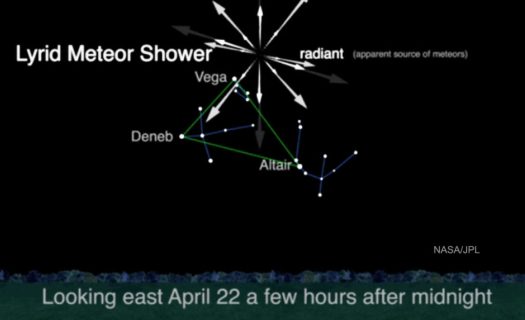
For viewers in the Northern Hemisphere, the early morning hours of Sunday, April 22, will be the best viewing time for the 2017 presentation of the Lyrid meteor shower. From mid-April this year to about April 25 the “shooting stars” are visible with as many as a dozen or so per hour. However, on Sunday morning there will probably be up to 20 per hour.

The Lyrid meteor shower comes around every year in April. There are ten significant meteor showers each year, but the last one was the Quadrantid meteors in early January. Now, at last, with the weather a little warmer we have another chance to watch the sky.

The Lyrid meteor shower gets its name from the fact that it seems to radiate from the constellation Lyra, the harp. No, they are not “shooting stars.” The Lyrid meteors are actually fragments broken off from Comet Thatcher which passed by in 1861. That comet makes a pass through our solar system every 415 years or so.

The Comet Thatcher has been passing through and leaving bits behind for a long time because Chinese sky watchers saw the Lyrid meteor shower in 687 B.C. Apparently they were impressed because they recorded that “stars fell like rain.”

Of course, the ancient Chinese didn’t know what caused the event. We know that it’s the result of those comet pieces falling into our atmosphere, being heated by the friction of the air, and burning up. Our atmosphere does more than just give us oxygen to breathe. It also protects us in many ways. One of those protections is that it causes most objects falling from space to burn up before they reach Earth’s surface. That friction requires heat-shield protection for returning Astronauts, but those of us living on the Earth’s surface can be glad to have an atmosphere to protect us. Recently a Chinese space station the size of a bus fell into our atmosphere and disintegrated before reaching the ground. You don’t need a telescope to see the pockmarks on the Moon’s surface from asteroid impacts because the Moon has no atmosphere.

Speaking of the Moon, it will be in its first-quarter phase and will not set until about 2 A.M Sunday morning. For that reason, viewing the Lyrid meteor shower will probably be best between 2 A.M. and the first light of dawn. However, if you miss it then, you still have a few more days, but the meteors will be fewer and farther between. If you see the Lyrid meteor shower, let it be a reminder of the fact that God has designed a planet that provides for our needs and protects us while we enjoy its beauty.
–Roland Earnst © 2018