Blood Clotting Design

Blood Clotting Design

A couple of days ago, I accidentally sliced the tip of my finger with a sharp knife. It bled a lot for a while, but in a short time, the bleeding stopped. The bleeding probably helped cleanse any debris from the wound, but I didn’t want the bleeding to continue. If our blood did not clot, we could bleed to death from even a small injury. Blood clotting design, or coagulation, is a very complicated process that scientists have studied for years.

The process begins when a puncture to your skin injures a blood vessel exposing blood platelets to the collagen beyond the blood vessel’s lining. The platelets immediately bind to the collagen and each other, forming a temporary plug. This starts a whole series of complex chemical reactions involving proteins and enzymes called clotting factors.

A cascading series of a dozen steps must take place for coagulation to complete. The result is the creation of fibrin strands which strengthen the platelet plug and stop the bleeding. If any single factor of the clotting process is missing, the clot does not form, and the bleeding continues.

Hemophilia is a genetic defect that omits a clotting factor. It disrupts the process of blood clotting design such that people with hemophilia may bleed uncontrollably from even a small wound. This is an extremely simplified summary of the coagulation process involving a dozen factors requiring specific proteins and enzymes that must happen in a particular order. For more details, click HERE.

Without blood clotting, humans and other mammals could not have survived. All of the clotting factors had to be present at the beginning of mammal and human life, meaning that the coagulation process could not develop gradually by chance. The fact that our blood clots when we are injured is another evidence of design by an intelligent Creator.

— Roland Earnst © 2020

Chemical Abortion Medications by Mail

Chemical Abortion Medications by Mail

Some high school and college girls brought to our attention several advertisements for “medication abortions” using an “abortion pill.” A pro-life group called Students for Life Action tells us that Planned Parenthood is sending the chemical abortion medications by mail. This is an attractive means of securing an abortion for a young woman who doesn’t want anyone to know about her pregnancy.

In reality, the abortion “pill” is not a single pill, and taking it is not like taking an aspirin. The chemical abortion involves two different medications. The first is mifepristone which initiates the abortion. The second misoprostol which causes cramping and bleeding to empty the uterus. Cramping and bleeding can last several hours or even several days, and some bleeding and spotting can go on for several weeks.

The promoters of medical abortions are telling people that there is “an abortion pill.” They are not telling them how it works and how traumatic the procedure is. It is easy for a boyfriend to trivialize the chemical abortion process, but cramping, bleeding, vomiting, diarrhea, fever, and dizziness are all common side effects of the use of the two pills.

It is essential to understand that abortions of any kind kill a baby. The child has its own DNA. Morning sickness is the woman’s body telling her that there is a foreign body inside her. The use of chemicals to kill the baby is dangerous to the mother and can have many side effects. Saying that a woman has the right to decide what will happen to her body is true, but she needs to make the decision long before a child is growing inside her.

Selling chemical abortion medications by mail is not a good solution for unwanted pregnancies. God has given us rules for sexual conduct, and the rules work, if we follow them. We oppose abortion at all levels. We believe that education by God through His Word is the only way men and women can make good choices and avoid the pain and consequences of bad decisions.

— John N. Clayton © 2020

Reference: Students for Life Action, PO Box 96923, Washington DC 20090-6923

Pandemic Pods and Education

Pandemic Pods and Education

Home Schooling has expanded dramatically as public schools struggle with how to open in the face of the pandemic and the difficulties of online classes. Now parents are organizing into “pandemic pods” where they form groups of five to ten children and hire a teacher for that group.

For working parents, this may seem to be an answer to the school situation.
The problem is that only families with enough money to hire a good teacher will be able to form these pandemic pods. This sends us back to a segregation issue. Families who join together are likely to be families with similar social backgrounds. This arrangement excludes families living in poverty.

As a public school science teacher in South Bend, Indiana, I saw firsthand another issue that should be considered. I would see students transferred during the school year from a nearby large Catholic high school to Riley High School, where I taught. These were always kids who were discipline problems. One of my friends who taught at the Catholic school told me that their ultimate threat was, “If you don’t behave, we’ll send you to Riley.”

We must remember that these are kids who need an education. Virtual learning and online classes work for highly-motivated students who want to cooperate. What about the kid who is not motivated, has a bad family situation, doesn’t want to be in school at all, and is poor? The coronavirus has given people another excuse to separate their kids from those who are different, racially, socially, and/or morally.

Those making decisions about schools must recognize the importance of educating our children. Parents must make their child’s education a priority. Education isn’t just facts, but it’s also how to get along with people who are different from you. The pandemic pods idea might work if they contain heterogeneous student populations supported by tax money and available equally to all. Allowing parents to segregate children to free themselves from the responsibility of educating them is not an answer.

For those who choose homeschooling, the Does God Exist? ministry has materials that can be helpful in areas of faith and science. Through the years, many homeschoolers have used our video series, which is available to watch free on DoesGodExist.tv or to purchase at THIS LINK. Also, our website DoesGodExist.org has various links and mail-in courses. For science, our Facebook page has daily postings telling about various animals and plants.

— John N. Claton © 2020

Reference: The Week magazine for August 7, 2020

God of Hope in Troubled Times

God of Hope in Troubled Times

We live in a time of chaos and uncertainty. One of the things that make humans different from all other living things on this planet is that we require hope. Animals do not require hope to be in a state of good health. They live moment-by-moment as long as their immediate needs are met. If an animal has food, shelter, and perhaps companionship, they need nothing else. Humans are different; we wither away in the absence of hope. Christians receive that from the God of hope.

Catherine Madera describes why we need hope: “Hope connects us to the future and prevents us from becoming stuck in past history or present challenges. It projects out, like a beam of light, illuminating things on the horizon to look forward to. Hope is defined as a feeling of trust and expectation, a desire for a certain thing to happen.”
(From Guideposts Strength and Grace, August/September 2020, page 58)

Romans 15:13 says, “May the God of hope fill you with all joy and peace as you trust Him, so that you may overflow with hope by the power of the Holy Spirit.” Even with discouragement, depression, illness, loss, frustration, and failure, we can trust in God and that His Spirit will eventually work things out for our good (Romans 8:28).

God doesn’t just give hope; He is the God of hope. This is one of the great blessings of being a Christian. We can always have hope that answers will come, and having that hope gives us a measure of joy, peace, and contentment–even in troubled times like these.

— John N. Clayton © 2020

Science and COVID-19

Science and COVID-19

There are many lessons to be learned from the COVID-19 pandemic. One of the most tragic of these lessons has been the vilification of science. Many politicians and preachers have acted as if science is something to be opposed and feared. Many of our national leaders view science as an enemy of the economic welfare of the United States. Some preachers have portrayed science as an attempt of Satan to shut down the Church and prevent Christians from meeting together. What is the truth about science and COVID-19?

The first problem here is a failure to understand what science is and how it works. Webster’s Dictionary defines science as “systematic knowledge.” Knowledge is simply an understanding of facts. God gave Israel into the hand of the Babylonian king Nebuchadnezzar. One of the first things Nebuchadnezzar did was to separate the best of the children who were “well-favored, and skillful in all wisdom and cunning in knowledge, and understanding science” and take them to Babylon (Daniel 1:3-4). This led to Daniel becoming a huge asset to Israel.

The Psalmist repeated over and over that scientific information builds faith.
Psalms 19:1 says, “The heavens declare the glory of God, and the sky shows His handiwork. Day unto day utters speech and night unto night shows knowledge.” Psalms 119:66, and 139:6 praise knowledge. Proverbs 1:22 and 1:29 talk about people who hate knowledge. Colossians 2:3 tells us that God has within Him all the treasures of wisdom and knowledge. Peter admonished Christians to escape corruption and add to their faith virtue and knowledge (2 Peter 1:5-6).

In 1 Timothy 6:20, Paul tells Timothy to “keep that which is committed to your trust, avoiding profane and vain babblings and oppositions of science falsely so-called.” There is a vast difference between knowledge and babblings or oppositions. Science deals with the facts of the COVID-19 virus. How we respond to what we know of the facts is up to each of us.

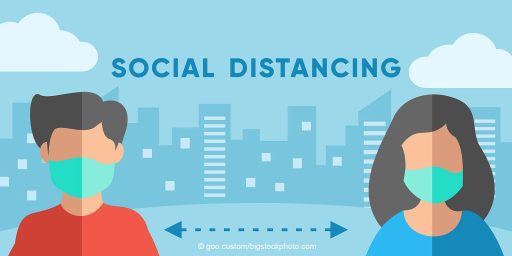
Science tells us to practice social distancing or wear a mask. The motivation behind rejecting those health practices are worldly pleasures and greed. Trying to test God by expecting Him to void the logical consequences of our actions is like handling snakes or drinking poison.

God never promised Christians immunity from all the problems in the world. If that were the case, people would become Christians to avoid problems, not because they love God. We need to use our God-given intelligence to make good decisions with the knowledge we have about science and COVID-19.

— John N. Clayton © 2020

Social Distancing in Animals

Social Distancing in Animals

It is interesting how difficult it seems to be for humans to practice social distancing to control disease. Scientific American published an article about social distancing in animals. Disease control is a basic need for all animals, but only humans create vaccines. So how do animals in the wild prevent the spread of disease?

Research on spiny lobsters shows that lobsters infected with a virus called Panulirus argus give off a smell in their urine that causes other lobsters to leave the area. Because of the economic value of lobster populations, much research has gone into understanding how this social distancing works.

A particular fungus spreads its spores by physical contact between ants. Other ants keep infected ants away from the colony and especially away from the queen and the nurse ants that take care of the brood to protect the ant population from the threat. Researchers have discovered social distancing in animals such as finches, guppies, mandrills, and mongooses. They all have procedures to isolate infected individuals and prevent the spread of disease.

Interestingly, God’s design for life includes social distancing in animals to stop viruses and fungi from spreading among their populations. Humans should not only be concerned about distancing from infected humans, but also from those animals that can spread diseases that affect humans. Trying to have animal pets that can carry diseases that threaten humans seems to be something we should all reconsider.

— John N. Clayton © 2020

Data from the August 2020 issue of Scientific American (page 37).

Suicide is the Other Pandemic

Suicide is the Other Pandemic

We hear all the talk about “flattening the curve” concerning the COVID-19 pandemic. There is another pandemic without a direct viral cause, and the curve of that pandemic keeps getting steeper. Suicide is the other pandemic.

Since 1999 the suicide rate in the United States has risen over 33%. Suicide is now the second leading cause of death in the U. S. among people ages 10 to 34. Males have a higher suicide rate than females, and both show a rate increase of over 2% a year. The Center for Disease Control tells us that among young people between the ages of 10 and 19, suicide attempts increased 8% every year between 2006 and 2015.

The experts are giving all kinds of explanations for why this is happening. Some blame the use of digital devices, with cyberbullying being a significant factor. Research shows that there is a one-to-one connection between unemployment and suicide rates, and the collapse of the economy in the COVID-19 pandemic has caused massive unemployment.

We would suggest that the growth of atheism and the rejection of God is a major factor of why suicide is the other pandemic. Christianity teaches that the body is the dwelling place of the Spirit (1 Corinthians 3:16). The Sermon on the Mount in Matthew 5-7 and the description of the judgment in Matthew 25:34-39 make it clear that Jesus expects his followers to use our lives in a productive way. In Philippians 1:21-26, Paul made it clear that he wanted to leave this life and go and be with Christ, but he knew God wanted him to help address the problems of the Church and humanity.

If I base my life’s decisions on being the most fit and realize that I have no hope of ever being the fittest, ending this life seems like the logical thing to do. Atheism and agnosticism offer no motivation to continue living. If I know I cannot find pleasure as I once did and the future looks bleak, why would I want to continue to live? Life has no ultimate purpose without God, and suicide is a way out.

Job’s wife told him to curse God and die (Job 2:9). If you do not have a purpose in life, that option can look very attractive. When you read Job 42:1-6, you see Job coming to a full understanding. He realized that he is part of something so grand and powerful that he can only vaguely understand it. We, too, may not fully understand what God is doing through our lives, but destroying ourselves so that God can’t use us is a huge mistake with catastrophic results. (See 1 Corinthians 3:11-23.)

— John N. Clayton © 2020

Data from Scientific American, August 2020, page 23.

Real Men and the Tough-Guy Image

Real Men and the Tough-Guy Image

“Real men don’t play it safe” so many males, including world leaders, don’t accept wearing a mask and social distancing. That is the basic idea of an article by Peter Glick in the August issue of Scientific American. He says that many male leaders are more concerned about projecting a tough-guy image than protecting the common good. He mentions Brazilain leader Jair Bolsonaro, U.K. leader Boris Johnson, and Donald Trump and Mike Pence. When Captain Brett Cozier of the aircraft carrier Theodore Roosevelt didn’t radiate the tough-guy image, he was relieved of his command. Meanwhile, female leaders in Germany and New Zealand have had better success in the pandemic than their male counterparts.

This is one more example of how “survival of the fittest” produces competition, promotion of self, and struggles for dominance rather than compassion, empathy, and promoting the common good. It is also why women appear to tend to be more capable promoters of Christianity. As women start competing with males, they tend to demonstrate a great many of the same weaknesses.

Any weakling can turn their back on the needs of the “weak and unfit.” Our experience as the parents of a multiply-handicapped child is dominated by compassionate women who had great empathy and a servant mentality. The number of males who were able to give of themselves to promote disabled adults was pathetically small. As society has rejected the teachings of Christ and embraced a value system based on evolutionary theory, our cliches show our values: “show no weakness,” “I can fix it,” “dog eat dog,” “watch your back.”

It takes incredible strength to be a committed, active Christian. When you read Matthew 25:34-40, you see Jesus commending people not because they were the strongest or the most attractive or successful. He commended them for doing things that an evolutionist would reject, such as giving food and drink rather than using it as a control device. Christ commends them for taking in a stranger, visiting the sick, and clothing the naked. The whole notion of turning the other cheek, going the second mile, and loving your enemies (Matthew 5:38-48) opposes “survival of the fittest” mentality. Are we strong enough to be Christians, or are we trying to earn the title of “real men?”

— John N. Clayton © 2020

The article “Masks and Emasculation” is on page 10 of the August 2020 issue of Scientific American or you can read it online HERE.

What Your Body Does in a Day

What Your Body Does in a Day

Own Olbricht sent us this summary of what your body does in a day. We thought it was worth considering the fantastic abilities of the bodies God has given us.

*Every day your heart pumps approximately 2,000 gallons of blood through its chambers.
*On average, your lungs take in 17,000 breaths a day with a typical lung capacity of roughly six quarts of air.
*Your brain processes over 50,000 thoughts a day – 35-48 thoughts per minute.
*Your stomach lining has cells which produce an alkaline substance every few milliseconds to neutralize stomach acid. The stomach would dissolve itself without its lining.
*Your eyes blink 28,000 times a day, with each blink lasting 1/10th of a second.
*Your body’s energy system expels enough heat to light twenty-five 100-watt light bulbs every day.
*Your skin is the largest organ of your body, and you shed a million skin cells every day.
*Your hair grows a millimeter a day. The average adult’s full head of hair consists of 100,000 strands.
*Your liver filters 1.53 quarts of blood every minute, and every day it produces a quart of bile to help digest food.
*Glands in your mouth produce more than a quart of saliva every day.
*Every minute your kidneys filter 2.2 pints of blood or 3168 pints per day. They expel 2.5 pints of urine every day.
*The average person will eat over 50 tons of food in a lifetime.


What your body does in a day is an excellent testimony to God’s wisdom, intelligence, power, and design.

— John N. Clayton © 2020

Animal Viruses and Human Illness

Animal Viruses and Human Illness

The COVID-19 virus has been too lethal to ignore. This pandemic makes us realize that there are many viruses out there, and the current one is just the tip of the iceberg of what is possible. As early as AD 165 to 180, pandemics killed massive numbers of people. Smallpox killed 5 million, and bubonic plague killed 25 million on four different occasions starting in 541. Researchers today are attempting to catalog links between animal viruses and human illness. They estimate that there are probably 1.6 million animal viruses yet to be discovered in mammal and bird populations and that 827,000 of them could cause disease in humans.

Viruses are part of the natural world in which we live. They serve useful purposes in aiding animal digestion, reproduction, and elimination of wastes. The problem is that each animal has its own set of viruses suited for that animal’s diet and living conditions. If an animal’s virus jumps into another species with a different diet and living conditions, the results can be destructive. That is the connection between animal viruses and human illness. Most of the viruses we know about came into the human population from rodents, including rats, bats, birds, chimps, and mosquitos. Some have jumped through several animals such as bats giving the virus to cattle and camels, which gave it to humans.

The Old Testament laws had health restrictions, which made virus transmission less of a problem. People were also not in such proximity to one another or to animals that had destructive viruses. Living in very arid conditions reduced disease transmission, and the dietary laws worked against most virus transmission. When you read through Deuteronomy and Leviticus, you see elaborate precautions that we now understand had hygienic benefits to minimize viral transmission.

In the New Testament, many of these rules were continued. There was a prohibition against drinking blood, and the increased use of baking and boiling foods contributed to a low virus transmission rate. Moral rules that reduced the spread of disease included the elimination of polygamy and polyandry and the strong condemnation of prostitution. In time, the keeping of exotic pets and the acceptance of foods previously forbidden to Israel tended to thwart human attempts to fight disease.

God has given us the capacity to understand viruses and the connection between animal viruses and human illness. God has also given us the tools to control these virus issues. He has also given us hope for something better. Will we use the tools and techniques God gave us to stop the pandemics, or will we open our culture to more viral events in the future? Time will tell.

— John N. Clayton © 2020

Data from “The Virus Hunters,” Smithsonian magazine, July/August 2020, and THIS STORY on virus hunters from 2018.