Breathe Easy with Oxygen

Breathe Easy Oxygen Molecule
Life requires certain elements–one of which is oxygen. To live, we must have energy and our life-energy is produced by chemical reactions requiring oxygen. Because of the oxygen level of Earth, we can breathe easy.

When oxygen combines with other elements and compounds, we call the process oxidation or combustion. Oxidation results in the release of energy. Oxidation can be slow as when oxygen combines with iron to form rust. Oxidation can be fast, as when oxygen combines with chemicals in wood, producing fire.

The rapid combustion process releases energy in the form of heat and light. In our bodies, oxygen combines with other chemicals more slowly. As oxygen combines with sugar (glucose) in our cells, energy is released warming our bodies and powering our cells. The by-products of this oxidation are carbon-dioxide and water, which can be safely eliminated from the body.

The design of the oxygen molecule with its ability to pull off electrons from other elements makes combustion possible. Are there other chemicals which can produce combustion? Yes, chlorine, fluorine, and bromine can also produce combustion. However, the by-products of that combustion, such as hydrochloric acid, would be harmful or fatal to living cells. Oxygen has just the right properties to combine with carbon-based sugars in our cells to release energy and sustain life without producing compounds harmful to life.

The fact that one-fifth of our atmosphere is oxygen enables us to breathe efficiently. A lower level of oxygen would make breathing difficult. A higher oxygen level would lead to a greater danger of rapid-combustion fires. Replacing oxygen in the air with other combustive elements would be destructive to life. Oxygen has the right properties and is available in the right amount to allow us to breathe easy and live. We think a Master Engineer designed this system.
–Roland Earnst © 2018

Lemming Suicide Myth

Lemming Suicide Myth
Lemmings are small rodents with long, soft, colorful fur and short tails that live in the Arctic tundra. They reproduce rapidly, and their population varies dramatically, usually over a four-year cycle. Scientists have studied the variation in lemming populations for many years, but they don’t entirely understand it. However, the lemming suicide myth is not an explanation.

Contrary to popular stories, lemmings do not commit mass suicide by jumping off cliffs into the sea to drown. False lemming legends are not new. In the sixteenth century, because of their rapid population increases, a story was started that they fall out of the sky when it rains. That idea was proven to be false.

The story of the mass suicide has been depicted in songs, movies, video games, stories, and a 1985 Apple TV commercial until most people accept it as true. The worst case of deception was in the 1958 Disney movie “White Wilderness.” The film won an Academy Award for best documentary, but it spread false information with a staged lemming suicide jump. It was later revealed that the lemmings were forced off the cliff by the camera crew.

When their population density becomes too high, lemmings migrate to find food. Since they can swim, they sometimes migrate across bodies of water. Occasionally some may drown in the crossing, but it’s not mass suicide. In 1980, Gary Larson’s “The Far Side” comic showed a group of lemmings jumping into the water. The last lemming in line was wearing a life preserver. Following the principle of natural selection, that lemming would have been the one to survive and reproduce. We would presume that its offspring would inherit the caution and be smart enough not to follow the crowd. Then we would assume that lemmings would evolve into creatures who would no longer take the plunge. It’s a matter of survival of the fittest, or perhaps the smartest.

The lemming suicide myth is persistent, but false, like the myth that we use only ten percent of our brains. The bottom line is, God didn’t create lemmings to be suicidal. He also didn’t create humans to be gullible.
–Roland Earnst © 2018

Why Two Genders?

Why Two Genders?
The simplest one-cell life forms can reproduce by dividing, but advanced life requires both a male and a female to procreate. We wonder why two genders are needed. How can naturalistic evolution explain sexual reproduction?

Science has discovered that sexual reproduction is much more complicated than we ever would have expected. Various plants and animals use different processes involving two genders to reproduce. The processes involved vary dramaticly between species. Would it not have been simpler for evolution to result in creatures with the ability to conceive a new life within themselves and give birth to that life without the need for another of the same species?

Think of how much more complicated the evolution of a new species would be if two genders had to evolve at the same time. If a male of a new species evolved with no female, that new species would become extinct when the male died. You must have two genders of the new species at the same moment in time with the same genes and the corresponding reproductive organs. Otherwise, reproduction would not be possible.

Genesis 1:27 says, “So God created mankind in his own image, in the image of God he created them; male and female he created them.” God created humans in His image spiritually, but He gave them a physical morphology complimentary to each other. He made the man first and then showed him all of the animals. (Genesis 2:19, 20). Surely Adam noticed that there were males and females in the animal world. As a result, Adam would have realized that something was missing from his life. He needed someone like himself, but different.

After the sex education lesson, God took some of Adam’s physical body to create his complimentary half. Adam’s reaction, “(At long last) this is now bone of my bone and flesh of my flesh.” This was God’s design for love and reproduction. Why two genders? God intended for us to have two genders to complete each other. It didn’t happen by accident. It couldn’t have.
–Roland Earnst © 2018
F. LaGard Smith has written an excellent book which goes into great detail on this topic. The title is Darwin’s Secret Sex Problem and we highly recommend it.

Law We Must Obey

Entropy - A Law We Must Obey
Have you noticed that things wear out? Whether it’s your clothes, your car, or your favorite easy chair, they all decay over time. Iron rusts, wood rots, food spoils, and everything becomes disordered. We think of it as a normal part of life, and we refer to it as getting old. People get old too, and our bodies are not what they used to be. There is a law for this, and it’s called the Second Law of Thermodynamics. It’s a law we must obey!

The principle of increasing disorder or decay is called entropy. It is unavoidable. More than that, it’s necessary for the world in which we live. Because of the principle of entropy, heat energy can be transformed into mechanical energy to perform work. That’s what happens in the engine in your car. It’s also what happens in the muscles of your body. In other words, without entropy, you would not be able to move, or digest food, or breathe. Your heart could not beat. Every process that sustains life requires work and work requires entropy.

Decay is the inescapable result of entropy. The principle of entropy proves that there was a beginning to the universe, as the Bible says from the very first verse. If the universe were infinitely old—if it did not have a beginning—it would be completely disordered today, and no life would exist. Because of entropy, we know that the universe will end. “The creation waits in eager expectation for the children of God to be revealed. For the creation was subjected to frustration, not by its own choice, but by the will of the ONE WHO SUBJECTED IT (God), in hope that the creation itself will be liberated from its bondage to decay and brought into the freedom and glory of the children of God” (Romans 8:19-21, emphasis added).

The Second Law of Thermodynamics was part of the physical laws God created in the beginning. “We know that the whole creation has been groaning as in the pains of childbirth right up to the present time. Not only so but we ourselves, who have the firstfruits of the Spirit, groan inwardly as we wait eagerly for our adoption to the sonship, the redemption of our bodies” (Romans 8:22, 23).

In other words, for now, we must obey the Second Law of Thermodynamics and its resulting entropy. But, here’s the good news, the law we must obey, will be abolished! “Then I saw a new heaven and a new earth, for the first heaven and the first earth had passed away…” (Revelation 21:1).
–Roland Earnst © 2018

Biblical History Gains New Support

Biblical History Gains New Support
Many skeptics of the Bible attempt to suggest that the biblical record of the Exodus, Moses, and Israel is fiction. They say that most of the Old Testament contains made-up stories with no historical support. However, with further discoveries, biblical history gains new support.

Michael Zellmann-Rohrer of the University of Oxford has recently translated a large papyrus document discovered in 1934 at the pyramid of Senusret I at Lisht in Lower Egypt. The text is written in Coptic, an Egyptian language that adapts the Greek alphabet. The document contains references to Abraham and Isaac from the Book of Genesis and quotations from a prayer by Seth, a son of Adam and Eve. This papyrus does not come from the time of the Exodus, but it shows strong connections to the biblical record in Egypt that endured to the time of Christ and beyond. (Reference: Archaeology July/August 2018, page 16.)

In our websites and publications, we have repeatedly given examples of evidence showing that what the Bible says is true. We also have a DVD series on biblical archaeology by Dr. Harvey Porter. We are currently working on new programs on archaeology and history for our “Does God Exist?” video series. They are taught by John Cooper and recorded in the Clayton Museum of Ancient History at York College in York, Nebraska. Those new programs will be available by the fall of 2018.

We have said many times that science and the Bible are friends, not enemies. That is also true of the science of archaeology. As we learn more from archaeology, biblical history gains new support.
–John N. Clayton © 2018

Intelligent Alien

Octopus - Intelligent Alien
Science fiction writers and UFO proponents like to propose strange looking aliens that can do incredible feats. The common octopus is a beautifully designed and incredibly intelligent animal that could compare to any intelligent alien of science fiction.

The octopus has no bones in its body, in fact, the only hard part of an octopus is its beak. That means that the octopus can take any shape and fit through almost any opening. One famous example is an octopus that escaped from an aquarium in New Zealand. That animal picked apart the lid on its aquarium, crawled out, went across the room and down through a drain hole that led to the sea and has never been seen again.

Octopus arms are muscular, boneless, and lined with suckers that are covered with chemoreceptors similar to our own taste buds. An octopus can taste everything it touches. They live in oceans around the world from equatorial waters to Antarctica and the Gulf of Alaska and from deep-water trenches to shallow reefs.

The arms are also filled with neurons, so the brain cells of an octopus are in its arms and not its dome. The octopus has sacs of pigments which are controlled by the muscles. It can release this “ink” as a defense mechanism. Its arms also have cells that reflect and scatter light. That means an octopus can control what it looks like. It can resemble a sea snake, a fish, anemones, jellyfish, sand, or seaweed. It’s a master of disguise. In addition to the right color and form some octopus species copy the movements of whatever animal they imitate. The camouflage does not seem to be accidental but is controlled by the octopus itself.

For a soft-bodied animal to survive in the ocean, some unique characteristics must be designed into its DNA. We think the number of features the octopus has is astounding. To have one unique characteristic might be possible–produced by a mutation and supported by natural selection. To have all of the abilities of an octopus would not happen by one mutation. Fossil evidence indicates that octopuses have been around throughout the history of the oceans. They even predate the dinosaurs.

Octopuses resemble an intelligent alien, and they certainly make E.T. look like nothing special. They give evidence of the Designer of life.
–John N. Clayton © 2018
Data from Discover Magazine, July/August 2018, page 56-57.

Does Your GPS Work?

Does Your GPS Work?
Does Your GPS work? If so, you can give credit to Albert Einstein. In 1905 Einstein published the Theory of Special Relativity which said that nothing can travel faster than the speed of light. This presented a problem because gravity acts between objects instantly and thus it seems to be faster than the speed of light. It was a problem that needed a solution.

Ten years later, in 1915 Einstein revealed his Theory of General Relativity which resolved the problem. The explanation was that the Sun and planets cause space to curve around them and this warped shape of space influences the motion of other objects passing by them. That’s why the Moon orbits the Earth, and it’s why Earth and the other planets orbit the Sun.

This warping of space also bends light beams that pass through space. In 1919 British astrophysicist Arthur Eddington confirmed that Einstein was correct. Eddington observed the bending of light from distant stars as the light passed by the Sun during a total solar eclipse.

The understanding of how gravity bends space and light beams has given us methods of making measurements in space and detecting planets orbiting other stars. Einstein also said that time is warped by gravity causing time to move more slowly near massive bodies like the Earth. The effect of gravity on time allows Global Positioning Satellites to determine the exact position of the GPS receiver you use in your car.

Does your GPS work? If it does, it works because brilliant minds have discovered many of the amazing details of God’s creation. We have been able to apply the things we have learned, but science has only scratched the surface of understanding the work of the Creator.
–Roland Earnst © 2018

Why Plants Grow Up

Why Plants Grow Up
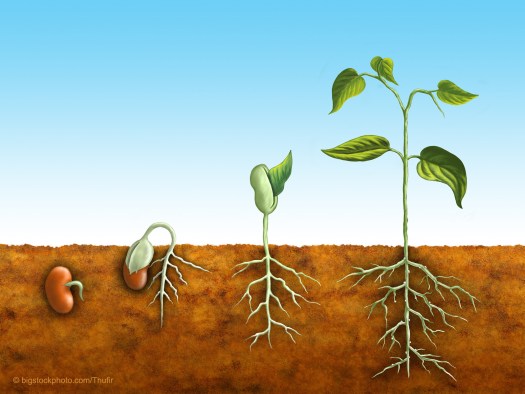
Have you ever wondered why plants grow up instead of down? Take a bean, a grain of corn, or any other seed and lay it on top of wet soil until it germinates. The root will grow out of the seed and turn downward into the soil. The shoot will go upward. It doesn’t matter which direction you position the seed when it germinates. Even if the seed germinates in a place where there is no light, the root still goes down, and the stem goes up.

After the root and stem are growing, take the seed and turn it upside down with the root pointing straight up. The root will turn around and head back down into the soil. Take a potted plant and lay it on its side so that it’s horizontal. If the dirt doesn’t fall out, the plant will make a turn and go upward and its roots downward.

Trees on a hillside don’t grow perpendicular to the slope. They grow upward, and the roots grow downward. If there is a landslide and the tree is left horizontal, it will turn and start growing upward again. Amazing, isn’t it?

This ability of plants to know up from down is called gravitropism. Only in recent years has science begun to learn the secrets of how it works. In the cells of the plant, there are particles called statoliths. They normally sit on the bottom of gravity sensing cells. When the plant is tipped, they move and send a message to the growth regulating cells that the direction of gravity has changed. The roots react positively and go toward the source of gravity. The stem responds negatively and goes in the opposite direction.

This explanation is an oversimplified description of why plants grow up. How a plant with no brain or central nervous system communicates the message of which way to grow from one cell to another is still not fully understood. Little by little, science is uncovering the mysteries of life. We still have much to learn, but it’s obvious that plants show evidence of design by a Master Engineer.
–Roland Earnst © 2018

Color Vision Gender Differences

Color Vision Gender Differences
There are many differences between men and women, but you realize that there are color vision gender differences?

Light is electromagnetic radiation that stimulates our eyes. There are only specific frequencies of the electromagnetic frequency spectrum that we can see. Frequencies below the range of visible light are called infrared. We can sometimes feel infrared radiation as heat, but we can’t see it, although some animals can. Frequencies higher than visible light are ultraviolet which we can’t see, but it affects our skin and can cause sunburn. Some animals can see infrared light.

Within the visible spectrum of light that humans can see, different bands of frequencies affect our eyes differently. Most of us have receptors in our eyes for the wavelengths which we call red, green, and blue. When light stimulates those receptors, they send a signal to our brain which combines the signals to allow us to see many variations in colors.

People with colorblindness (mostly men) have one of those color receptor categories missing. The missing color may be either red or green. Why are men colorblind more often than women? The genes that encode the red and green receptors are located in the X-chromosome. Men have one X- and one Y-chromosome. Women have two X chromosomes. That means that if a man has a defective X-chromosome, he is out of luck. A woman would need to have two defective X-chromosomes to be colorblind.

It’s interesting that the chromosome pair that creates the sex differences also explains the color vision gender differences. God said, “It is not good for man to be alone” and He took something out of the man to create a woman. Then He put them together to complete each other. In many ways, men and women really do need each other to be complete.
–Roland Earnst © 2018

Adding Nitrogen to the Soil

Adding Nitrogen to the Soil
We all know that lightning can be dangerous. Each year people are killed, and a great deal of property damage occurs because of lightning. We don’t usually consider the benefits of this powerful force. Nitrogen in the soil is essential for plants to grow and lightning is a natural method of adding nitrogen to the soil.

Although lightning can be dangerous, it also produces materials that are critical to life. All living things depend on the chemical element nitrogen. Your body contains molecules known as proteins. Proteins are made up of several elements, including nitrogen. Nitrogen is essential for proteins, but it is very hard to make nitrogen into proteins. Even though nitrogen makes up 78 percent of our atmosphere, we don’t get any nitrogen from the air we breathe. With each breath, we inhale and exhale nitrogen without using it. The nitrogen in the atmosphere has three electron bonds between the atoms, and that is a very strong and stable chemical arrangement. It takes an enormous amount of energy to break those bonds to free the nitrogen.

When lightning slices through the atmosphere, it knocks electrons from nitrogen atoms. The atoms are then free to combine with oxygen and hydrogen in the atmosphere forming nitrates. Rain carries this new compound to the ground enriching the soil with nitrates which are the building blocks of proteins. Plants synthesize the nitrates into proteins. When animals eat the plants, they get proteins. When we eat the plants or animals, we get the proteins we need to build more proteins.

Without lightning and the other processes for adding nitrogen to the soil, life could not exist on Earth. There is a purpose in the design of lightning. The Designer has also given us the intelligence to avoid many of the adverse effects of this powerful force.
–Roland Earnst © 2018