Believing in Uniformitarianism Raises Questions

Believing in Uniformitarianism Raises Questions
Evolution makes a very large number of assumptions. One of those assumptions called uniformitarianism is the belief that no process has ever operated in the past that is not going on today. Believing in uniformitarianism gives some answers, but it raises many questions.

Today we know how glaciers work and how volcanoes form and shape the land. We are aware of all of the various forms of erosion and the chemical processes that alter materials of the Earth. When we look at something like the Grand Canyon, we assume that those same processes deposited the rocks and shaped the canyon. There are places high in the canyon where there are beach deposits that look like the beaches we see along the shores of Lake Michigan. That leads us to believe that at one time there was a lake in what is now the canyon. When we look at the Coconino sandstone in the Grand Canyon, we see the remains of sand dunes that look like the ones I see out the window of my house. The angles of the dune faces, the frosting of the sand grains, and the footprints of lizards that sink deep into the dune faces all cause us to rule out a flood as the cause of the Coconino sandstone.

At the same time, processes going on today don’t explain catastrophic events that seem to have happened in the past. In the 1980s scientists found evidence suggesting that an asteroid struck the Earth and altered the history of our planet. Some scientists expressed strong resistance to the asteroid proposal and gave all kinds of alternative explanations. If an astronomical event of that magnitude took place wiping out a majority of land species, the evolutionary theories of that day would have to be modified or discarded. This gave support for proposals like punctuated equilibrium, but it also caused many people in the scientific community to reject the asteroid as a possible cause. Those believing in uniformitarianism and naturalism resisted any attempt to suggest that catastrophic events may have shaped the Earth’s history.

From a biblical standpoint, we see that there have been catastrophic events in the past that are not happening today. The flood of Noah, the crossing of the Red Sea, the deaths of the firstborn in Egypt, and all the miracles the Bible describes are not happening today and thus are not uniformitarian. These, however, are rare and are the exception to what happens on a daily basis.

New evidence shows that believing in uniformitarianism as the single cause of the Earth’s history is not valid. Evidence shows that about 12,800 years ago there was a very rapid cooling of the Earth called the Younger Dryas. One proposal is that a massive pulse of cold freshwater from glaciers flooded the ocean cooling the planet. Another suggestion is that a comet exploded in the atmosphere triggering wildfires which produced enough soot to block the Sun and cool the planet. In 1908 in Tunguska, Siberia, an event like that occurred when a meteoroid exploded producing as much energy as 1000 Hiroshima bombs and gave support to the idea that astronomical catastrophes caused some structures on Earth.

Scientific literature is full of current research reports supporting catastrophic change in the Earth’s history. Scientists will continue this debate, and new finds will establish support for various theories. It remains clear that believing in uniformitarianism and naturalism to explain the total history of our planet is on shaky ground.
–John N. Clayton © 2018
Reference: Science News, July 7, 2018, P 18.
Longest Blood Moon

Longest Blood Moon
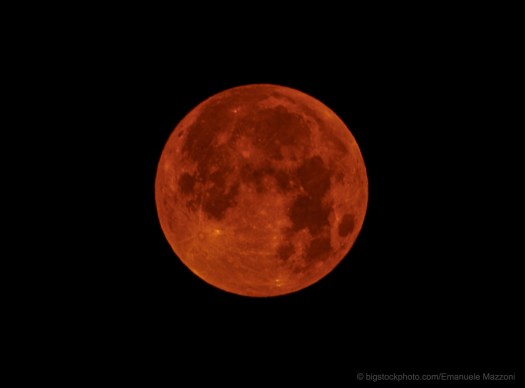
It will be the longest blood moon of the twenty-first century. There have been books and articles about “blood moons” in recent years relating them to prophecies of various kinds. However, this event will not be a miraculous sign of some impending doom or destruction. It will not be a sign of the second coming of Christ. This lunar eclipse is an entirely natural phenomenon.

A so-called “blood moon” is actually an eclipse of the Moon. Most of the time, we see the light of the Sun reflected from the Moon. When Earth, Moon, and Sun are perfectly aligned with our planet in the middle, the Moon becomes covered by Earth’s shadow. Since Earth is much larger than the Moon, it can throw a shadow across the entire Moon. That is what will happen at 4:21 p.m. U.S. Eastern Daylight Time on July 27. However, it will not be visible in the United States. A partial eclipse will be visible in most parts of the Eastern Hemisphere, and it will be total in Africa, the Middle East, and part of Asia.

Why does the Moon appear red or orange during a lunar eclipse giving it the name “blood moon?” That’s because as the Sun’s light passes through Earth’s atmosphere, it is filtered and bent so that a small amount of light reaches the Moon’s surface. We see the effect of our atmosphere on sunlight when we watch the red-orange colors of a sunrise or sunset. If you were on the surface of the Moon, you would see that sunset effect as a halo around the Earth. Looking at the Moon from Earth, we see the reflection of that sunrise/sunset glow reflected back to us. The Moon takes on an eerie, but faint blood-red glow.

This lunar eclipse will be the longest blood moon of the century because of a near-perfect alignment of Earth between the Sun and Moon. From beginning to end, this eclipse will last almost four hours. The period of totality will be an hour and 43 minutes. The next lunar eclipse visible in North America will be on January 21, 2019, and it will last only an hour and two minutes. How do we know these statistics? We can know when lunar (and solar) eclipses will occur because we know how they happen. We know that our solar system is very orderly and predictable because it is well designed.

In ancient times eclipses caused people to panic. People in ancient Mesopotamia thought an eclipse was an attack by demons. The Inca people in fifteenth-century South America would shake spears and make noise to scare away what they believed was a jaguar attacking the Moon. There is a story that Christopher Columbus and his men were stranded for six months on the island now known as Jamaica. The indigenous Arawak people became less than generous in sharing food. Columbus knew from an almanac that a total lunar eclipse was about to happen. He told the local people that his God was angry and would take away the Moon in three days. When Columbus’ prediction seemed to come true, the Arawaks were terrified. They gave Columbus’ crew whatever they wanted to bring the Moon back. Amazingly, the Moon returned to normal, and everyone was happy.

So as the longest blood moon of the century comes and goes, don’t let anyone try to tell you it is some kind of miraculous sign. After all, we can’t predict miracles. The only miracle that was clearly (and repeatedly) predicted in advance and which actually happened was the resurrection of Jesus.
–Roland Earnst © 2018

Painted Lady Butterflies Out-migrate Monarchs

Painted Lady Butterflies Out-migrate Monarchs
One of the most amazing things we see in the natural world is the ability of some living things to make incredible migrations. In the past, we have described the monarch butterfly’s migrations from wintering areas in Mexico to northern parts of the United States covering a round trip of about 10,000 kilometers. However, we see that painted lady butterflies out-migrate monarchs.

Scientists have studied how the monarchs navigate such incredible distances with formidable obstacles in their way. Biologists have proposed a variety of models as to how these fragile butterflies could acquire such an ability. However, in the case of the monarchs, the journey is not made by a single butterfly but by a succession of generations.

Science News for July 21, 2018 (page 4) told about a study of another butterfly with an amazing migration. It has the scientific name Vanessa cardui and is commonly known as the painted lady butterfly. These butterflies live in Southern Europe and migrate to Africa in the fall–a distance of 12,000 km. That’s 2000 kilometers farther than the monarchs, and the journey involves crossing the Sahara Desert. As with the monarchs, scientists had believed that the migration involved several generations. New techniques allowed researchers to put markers on the painted ladies when they were caterpillars. We now know that at least some of the butterflies make this incredible journey in one lifetime.

When you look at the barriers to this migration including changes in wind direction, mountains, desert, and storms it is difficult not to be impressed with how the painted lady butterflies out-migrate monarchs. Trying to construct a possible model based on chance processes involves so many assumptions that it is hard to accept that this ability can have an evolutionary explanation. Believing that God’s creation included building a DNA set of instructions that allows the painted ladies and monarchs to migrate is not just an assumption, but the weight of the evidence supports it.
–John N. Clayton © 2018

Tools and Intelligence

Tools and Intelligence
We tend to equate the use of tools and intelligence, but do they necessarily go together? Many kinds of animals use twigs, stones, or other objects as tools to gather food, to groom or defend themselves, or sometimes just to play. We are very familiar with how dogs can be taught to play with a ball or stick. Intelligent animals such as primates, mammals, and birds use or even create tools from materials around them.

Sometimes animals learn tool-use by watching other animals or humans. At other times tool-use seems to be instinctive. An internet search for “animals using tools” brings up many interesting videos. Ever since animal researcher Jane Goodall discovered chimpanzees using leaves and twigs as tools to obtain food in 1960, some people have suggested that tool-use is proof that humans are not unique from other animals—we have just evolved greater intelligence.

But the question is, “Does it take intelligence to use tools?” The short answer is “No.” Decorator crabs camouflage themselves with objects and plants, and they may pick up a sea anemone and use it to sweep across the sea floor picking up food. The assassin bug takes material from a termite’s nest to camouflage itself while waiting to grab a termite emerging from the nest. It then kills the termite and uses it as bait to coax other termites out of the nest. The larva of the green lacewing camouflages itself with objects such as sand grains to hide from and capture aphids.

Crabs, assassin bugs, and insect larvae have no “thinking” brain. They are not capable of being taught or learning by observation. How can they use objects as tools? In some cases, if the first of their kind could not use these tools, the species would have become extinct. We suggest that the Creator has “programmed” these unintelligent animals with the instincts they need to survive.

So as we consider tools and intelligence, we see unintelligent creatures using tools by instinct, and more intelligent creatures learning to use tools. Obviously, no animals can create and use the highly sophisticated tools that humans have, including computers, robots, and cars. But it’s the spiritual nature of humans that makes us different, and not our tools. Only humans worship God because He created us in His image.
–Roland Earnst © 2018

Nitrogen Mystery Answered

Nitrogen Mystery Answered
One of the great mysteries of the past 1000 years of soil studies has apparently been answered. The great nitrogen mystery is how nitrogen gets into the soil. Plants need nitrogen, and they need it in the form of nitrates and other compounds essential to plant growth.

Most of us put fertilizer on our plants to make them healthy and don’t think about the fact that while our atmosphere is 78% nitrogen, plants can’t absorb the nitrogen directly from the air. In high school, we learned about “nitrogen fixation” and were told about nitrogen-fixing bacteria and the role of lightning in transforming atmospheric nitrogen into forms that could be used by plants.

Plant scientists have known that this model was not complete. The nitrogen cycle clearly had some missing parts, and our knowledge of how nitrogen gets into the soil was obviously lacking. Scientists have now discovered that a significant portion of getting nitrogen to plants involves seeping through bedrock. Nitrogen becomes trapped in sedimentary rocks in the oceans. When tectonic activity lifts the sedimentary rocks, so they are at the surface of the Earth, they begin to release their nitrogen to the soils above them, Studies in California show that soils above sedimentary rocks contain 50% more nitrogen than soils above volcanic rocks.

This discovery is a breakthrough in soil chemistry and has strong implications for how we can accelerate plant growth. Choosing places suitable for agriculture can be made more accurate with this new understanding. The complexity of Earth’s various cycles to allow for plant growth and to provide for human needs is astounding. Even such a fundamental question as the nitrogen mystery is still revealing God’s wisdom and planning in providing a life-supporting planet for us to live.
–John N. Clayton © 2018
Reference: Scientific American, July 2018, page 15-17.

Breathe Easy with Oxygen

Breathe Easy Oxygen Molecule
Life requires certain elements–one of which is oxygen. To live, we must have energy and our life-energy is produced by chemical reactions requiring oxygen. Because of the oxygen level of Earth, we can breathe easy.

When oxygen combines with other elements and compounds, we call the process oxidation or combustion. Oxidation results in the release of energy. Oxidation can be slow as when oxygen combines with iron to form rust. Oxidation can be fast, as when oxygen combines with chemicals in wood, producing fire.

The rapid combustion process releases energy in the form of heat and light. In our bodies, oxygen combines with other chemicals more slowly. As oxygen combines with sugar (glucose) in our cells, energy is released warming our bodies and powering our cells. The by-products of this oxidation are carbon-dioxide and water, which can be safely eliminated from the body.

The design of the oxygen molecule with its ability to pull off electrons from other elements makes combustion possible. Are there other chemicals which can produce combustion? Yes, chlorine, fluorine, and bromine can also produce combustion. However, the by-products of that combustion, such as hydrochloric acid, would be harmful or fatal to living cells. Oxygen has just the right properties to combine with carbon-based sugars in our cells to release energy and sustain life without producing compounds harmful to life.

The fact that one-fifth of our atmosphere is oxygen enables us to breathe efficiently. A lower level of oxygen would make breathing difficult. A higher oxygen level would lead to a greater danger of rapid-combustion fires. Replacing oxygen in the air with other combustive elements would be destructive to life. Oxygen has the right properties and is available in the right amount to allow us to breathe easy and live. We think a Master Engineer designed this system.
–Roland Earnst © 2018

Lemming Suicide Myth

Lemming Suicide Myth
Lemmings are small rodents with long, soft, colorful fur and short tails that live in the Arctic tundra. They reproduce rapidly, and their population varies dramatically, usually over a four-year cycle. Scientists have studied the variation in lemming populations for many years, but they don’t entirely understand it. However, the lemming suicide myth is not an explanation.

Contrary to popular stories, lemmings do not commit mass suicide by jumping off cliffs into the sea to drown. False lemming legends are not new. In the sixteenth century, because of their rapid population increases, a story was started that they fall out of the sky when it rains. That idea was proven to be false.

The story of the mass suicide has been depicted in songs, movies, video games, stories, and a 1985 Apple TV commercial until most people accept it as true. The worst case of deception was in the 1958 Disney movie “White Wilderness.” The film won an Academy Award for best documentary, but it spread false information with a staged lemming suicide jump. It was later revealed that the lemmings were forced off the cliff by the camera crew.

When their population density becomes too high, lemmings migrate to find food. Since they can swim, they sometimes migrate across bodies of water. Occasionally some may drown in the crossing, but it’s not mass suicide. In 1980, Gary Larson’s “The Far Side” comic showed a group of lemmings jumping into the water. The last lemming in line was wearing a life preserver. Following the principle of natural selection, that lemming would have been the one to survive and reproduce. We would presume that its offspring would inherit the caution and be smart enough not to follow the crowd. Then we would assume that lemmings would evolve into creatures who would no longer take the plunge. It’s a matter of survival of the fittest, or perhaps the smartest.

The lemming suicide myth is persistent, but false, like the myth that we use only ten percent of our brains. The bottom line is, God didn’t create lemmings to be suicidal. He also didn’t create humans to be gullible.
–Roland Earnst © 2018

Why Two Genders?

Why Two Genders?
The simplest one-cell life forms can reproduce by dividing, but advanced life requires both a male and a female to procreate. We wonder why two genders are needed. How can naturalistic evolution explain sexual reproduction?

Science has discovered that sexual reproduction is much more complicated than we ever would have expected. Various plants and animals use different processes involving two genders to reproduce. The processes involved vary dramaticly between species. Would it not have been simpler for evolution to result in creatures with the ability to conceive a new life within themselves and give birth to that life without the need for another of the same species?

Think of how much more complicated the evolution of a new species would be if two genders had to evolve at the same time. If a male of a new species evolved with no female, that new species would become extinct when the male died. You must have two genders of the new species at the same moment in time with the same genes and the corresponding reproductive organs. Otherwise, reproduction would not be possible.

Genesis 1:27 says, “So God created mankind in his own image, in the image of God he created them; male and female he created them.” God created humans in His image spiritually, but He gave them a physical morphology complimentary to each other. He made the man first and then showed him all of the animals. (Genesis 2:19, 20). Surely Adam noticed that there were males and females in the animal world. As a result, Adam would have realized that something was missing from his life. He needed someone like himself, but different.

After the sex education lesson, God took some of Adam’s physical body to create his complimentary half. Adam’s reaction, “(At long last) this is now bone of my bone and flesh of my flesh.” This was God’s design for love and reproduction. Why two genders? God intended for us to have two genders to complete each other. It didn’t happen by accident. It couldn’t have.
–Roland Earnst © 2018
F. LaGard Smith has written an excellent book which goes into great detail on this topic. The title is Darwin’s Secret Sex Problem and we highly recommend it.

Law We Must Obey

Entropy - A Law We Must Obey
Have you noticed that things wear out? Whether it’s your clothes, your car, or your favorite easy chair, they all decay over time. Iron rusts, wood rots, food spoils, and everything becomes disordered. We think of it as a normal part of life, and we refer to it as getting old. People get old too, and our bodies are not what they used to be. There is a law for this, and it’s called the Second Law of Thermodynamics. It’s a law we must obey!

The principle of increasing disorder or decay is called entropy. It is unavoidable. More than that, it’s necessary for the world in which we live. Because of the principle of entropy, heat energy can be transformed into mechanical energy to perform work. That’s what happens in the engine in your car. It’s also what happens in the muscles of your body. In other words, without entropy, you would not be able to move, or digest food, or breathe. Your heart could not beat. Every process that sustains life requires work and work requires entropy.

Decay is the inescapable result of entropy. The principle of entropy proves that there was a beginning to the universe, as the Bible says from the very first verse. If the universe were infinitely old—if it did not have a beginning—it would be completely disordered today, and no life would exist. Because of entropy, we know that the universe will end. “The creation waits in eager expectation for the children of God to be revealed. For the creation was subjected to frustration, not by its own choice, but by the will of the ONE WHO SUBJECTED IT (God), in hope that the creation itself will be liberated from its bondage to decay and brought into the freedom and glory of the children of God” (Romans 8:19-21, emphasis added).

The Second Law of Thermodynamics was part of the physical laws God created in the beginning. “We know that the whole creation has been groaning as in the pains of childbirth right up to the present time. Not only so but we ourselves, who have the firstfruits of the Spirit, groan inwardly as we wait eagerly for our adoption to the sonship, the redemption of our bodies” (Romans 8:22, 23).

In other words, for now, we must obey the Second Law of Thermodynamics and its resulting entropy. But, here’s the good news, the law we must obey, will be abolished! “Then I saw a new heaven and a new earth, for the first heaven and the first earth had passed away…” (Revelation 21:1).
–Roland Earnst © 2018

The Not So Common, Common Pigeon

Common Pigeon
You may think that pigeons are more of a nuisance than anything else. Many of us have had to scrub pigeon droppings off of statues or home decorations. The sheer number of pigeons that we see in our cities can make us take these birds for granted. Discover magazine for August 2018 published a dossier of the unique features of the common pigeon, also known as the rock pigeon or rock dove. These features show it is incredibly well-designed to survive in almost any environment on Earth. Here are some interesting characteristics:

Pigeons are one of only three kinds of birds that have an enlarged crop which is an extension of the esophagus. They use this crop to store food which they eventually give to their young.

Most birds drink by taking in water and then putting their heads back to allow the water to run into their stomach. Pigeons have a unique beak that acts like a straw enabling them to suck up the water.

Wing muscle makes up about 60% of a pigeon’s body weight making pigeons excellent flyers. They can cover 500 miles a day and can reach speeds of 50 mph.

Pigeons can navigate in ways that are still poorly understood by scientists. Experiments have shown they can use sound, magnetic fields, landmarks, the Sun, and even smell. Like the Arctic Tern, the common pigeon seems to possess multiple navigational tools.

Pigeons have a concept of self and can recognize themselves in a reflection. There are only six other animals that can do that.

Pigeons are more capable than babies and toddlers in recognizing the letters of the alphabet.

Pigeons use “fright molt” which is the ability to shed feathers when attacked.

Humans have used pigeons for food, for carrying messages, and for psychological testing. In fact, the famous psychologist B.F. Skinner taught pigeons how to play ping pong. Our most abundant birds like pigeons and crows were designed to do remarkable things. God frequently advises us to learn from His creation–including all life forms. (For example, Proverbs 6:5, “Go to the ant, you sluggard; consider its ways and be wise.”) We can also learn from the common pigeon which is not so ordinary after all.
–John N. Clayton © 2018