Three-Way Symbiosis Is Hard to Explain

Three-Way Symbiosis Is Hard to Explain

Symbiosis is one evidence of design in nature that we have discussed before. In the following excerpt from his book The Source, John Clayton told about a three-way symbiosis:

One area that strongly resists a natural explanation is the area of symbiotic relationships. A symbiotic relationship is one in which two organisms live in such a close relationship that one cannot live without the other and vice versa. For example, certain plants cannot live without certain insects that pollinate them or clean them or store up certain nutrients for them. At the same time, the plant provides nourishment and/or protection for the insect.

Sometimes such relationships exist between two plants or two animals
, like the venomous jellyfish known as the Portuguese man o’ war and the tiny fish living among its tentacles yet never getting stung. These types of two-way symbiotic relationships are difficult to explain by natural causes because the question automatically arises, which came first?

Suppose you agree that there are problems answering this question with two codependent life forms. How much more difficult would it be to explain the simultaneous evolution of a three-way symbiosis? Yet this is what we find with a leaf-cutting ant species in South America. These ants live in colonies of up to eight million. That is a number that surprisingly represents the collective biomass of an adult cow.

These ants cultivate mushrooms as a farmer grows crops, using leaf cuttings instead of soil. However, the ants are not able to eat the leaves because the leaves contain a natural insecticide. Neither can the mushrooms live on the leaves because they are coated with a prohibitive wax.
To make the three-way symbiosis work, the ants must carefully avoid the poison as they scrape the wax off the leaves. Without the wax, the leaves decay into a mulch in which the mushrooms can grow. The mushrooms, in turn, harmlessly absorb the insecticide, converting it into edible food for the ants. Neither creature could live without the other.

But there is more. Recent studies have revealed another partner necessary to sustain the ant/mushroom relationship. The mushrooms have a parasite enemy that would destroy them. However, they can be protected with an antibiotic produced by a specific bacterium that, coincidentally, lives on the ants’ bodies. So the bacterium depends on the host ant’s body for life. The ant depends on the food produced by the mushrooms for life. Finally, the mushrooms depend on the ants’ farming practices and the ants’ pet bacterium for life.

This three-way symbiosis is irreducibly complex. If anyone of the partners is missing, the entire group dies. The only way such a codependent society could be produced is by intelligent design. Any other attempted explanation quickly becomes a quest for the impossible dream.

— John N. Clayton © 2021

Data came from articles in the journal Nature. You can find them HERE and HERE.

This article was adapted from The Source: Eternal Design or Infinite Accident? (page 47) by John N. Clayton. This book is available for purchase HERE.
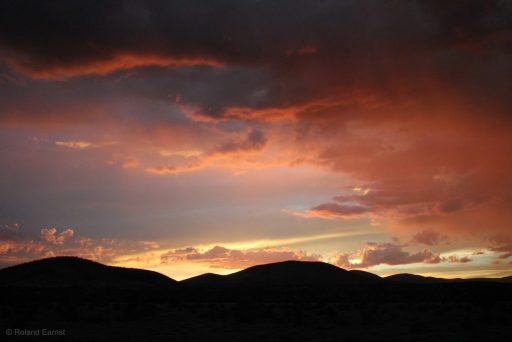
Enjoy the Beauty of a Sunset

Enjoy the Beauty of a Sunset

We were riding through the Arizona desert shortly before sunset on a Does God Exist? canyonlands field trip. We saw a storm in the distance, and it quickly surrounded us. Then, the storm lifted to reveal the sunset. We couldn’t stop gazing out of the bus window to enjoy the beauty of it all.

This incident reminded us that God sends the sunshine, and the rain, even in the desert. It also reminded us that God created a beautiful world and gave us the ability to enjoy that beauty. I think that ability is evidence that God created us in His image. God must enjoy beauty because He has created a universe of beautiful things that humans will never even see. We are aware of some of them only because our telescopes or space probes sometimes give us small glimpses of the beauty normally hidden from our eyes.

Even on our planet, there are beautiful things to be seen in locations where few people ever go. After scaling mountain peaks, a few of us enjoy the beauty of the valley below. While on the mountain, we look down and see beautiful flowers that grow in the rocky soil and cold air. Colorful plants and animals live and grow in the ocean, where only the most adventurous humans can enjoy their beauty. God sees all of the beauty, wherever it may be.

Are there any creatures other than humans that will stop to enjoy the beauty of a sunset? Thankfully, God has gifted humans with that ability. However, we often fail to do so because we think we are too busy. However, if we pause long enough to enjoy the beauty, we might be compelled to give thanks not only for the beauty but also for the ability to enjoy it.

— Roland Earnst © 2021

Science Supports Faith in God

Science Supports Faith in God

This ministry is designed to show that science and the Bible are friends and not enemies. Because of human-devised theologies and a poor understanding of science, some people claim that the Bible and scientific evidence are at odds. The fact is that all valid scientific evidence agrees 100% with what the Bible actually says in the original language. We say that science supports faith in God.

The word “science” means knowledge. Science arrives at knowledge by a methodology that involves making a theory about a question and then designing experiments to determine whether that theory is true. The media, and even some in the scientific establishment, will make a proposal, accept it as fact and not allow it to be tested. The result is that people attribute things to science, of which true science is not guilty.

A scientific discipline that has drawn much attention in Christian circles is geology. This has developed because of the invention of a theology that draws attention to physical theories and ignores the spiritual. This theological approach is called dispensationalism, and it has a restrictive way of interpreting the events in the Old Testament. It regards Jesus as a military figure who will return to engage in a physical war with human political entities on Earth, such as Russia and China. Jesus spent a large amount of time attempting to lead people away from this kind of thinking. He told them, “My kingdom is not of this world” (John 18:36).

So how can we say science supports faith in God? Proverbs 8 finds personified wisdom speaking about God’s actions. Verses 22-29 tell us that God established clouds (verse 28), brought forth the mountains (verse 25), and made the fields (verse 26). It does not tell us how He did it. Scientific studies have found that water, dust (condensation nuclei), and cool temperatures make a cloud. Geologic studies show plate tectonics and volcanism are processes that God used to make the mountains. Geology also tells us that fields are carefully crafted from sand, organic material, and various minerals that growing plants need. In Job chapters 38 to 41, God challenged Job to explain many things he could see around him. Today, science supports faith in God by helping us understand the wisdom required for God to do many of those things.

Genesis 1:1 tells us that God created the Earth. Creating a planet on which living things can survive and a place where humans can grow and prosper requires massive complexity. The passage is not dated or timed, nor does it tell us how God did the creating. Geology has helped us understand how God formed the minerals required for life. Science helps us understand the processes that formed the various soils on which life depends. We know about nutrients and the processes needed to create them, most of which are included in that brief verse of Genesis 1:1. The fact that science has learned how God formed these resources allows us to locate them. Our search for oil, coal, phosphate, sulfur, iron, and other minerals has been successful because we know how God created those vital substances.

The Bible tells us that God created time and that one day to Him is like a thousand years and a thousand years like one day (2 Peter 3:8). Quantum mechanics is now helping us understand the nature of time as a created entity that has not always existed. We must not allow our thinking to restrict God’s actions to what we mortal humans can do or understand. Isaiah 55:8-9 finds God pointing out that His thoughts and methods are superior to ours. Science supports faith in God because He has left a trail of evidence that we are slowly learning to understand.

— John N. Clayton © 2021

How Little We Know – The Pulsating Earth

How Little We Know - The Pulsating Earth

The May 2021 issue of Discover magazine (page 20) carries an interesting article about a mystery that scientists have been unable to solve. The mystery is why planet Earth pulsates every 26 seconds. Researchers at the Lamont Geological Observatory first reported the pulsation in 1960. After more than 60 years, nobody has formulated an accepted explanation of why this is happening. The point here is not Earth’s pulsations but how little we know about creation.

In time someone will probably find an acceptable explanation for Earth’s pulsations. My point is the nature of human knowledge. We are all amazed at what science has accomplished. We watch the helicopter fly on Mars. We see the COVID vaccine developed in less than a year when it usually took half a decade to build a vaccine. We are amazed by new fabrics and the products of genetic engineering.

The fact is how little we know. Human knowledge is still very primitive compared to all that we observe. We are still struggling to understand what caused gravity. We are only dimly aware of the quantum world and how it forms the material we see around us. Our understanding of the human mind is so incomplete that experts in the field of brain study say we still don’t understand what 95% of the brain does. Perhaps the most significant gap in the knowledge and beliefs of many of us is the question of why there is something instead of nothing.

What little we do understand puts us in awe of the power and intelligence of God. Dr. Frank Baxter used to say that everything he knew as a scientist taught him, “That a wonder-working hand has gone before.” In Proverbs 8:4-5, Wisdom says it another way: “To you, O men, I call out; I raise my voice to all mankind. You who are simple, gain prudence; you who are foolish, gain understanding.” The Psalmist said it this way:” When I consider your heavens, the work of your fingers, the moon and the stars, which you have set in place, what is man that you are mindful of him, the son of man that you care for him (Psalms 8:3-4).

Every bit of knowledge we acquire reminds us of how little we know and raises more questions for us to investigate. This is a wonderful time to be alive when so many of the secrets of God’s creation are just being discovered.

— John N. Clayton © 2021

Reference: Discover magazine May 2021

Simplified Cosmological Argument

Simplified Cosmological Argument

It is always interesting to read or hear arguments by atheists and skeptics about what we feature in this column. One recent phone call said, “The creation is too complex for rational discussion. All I know is that God didn’t do it.” In response to that, we want to look at the simplified cosmological argument.

The mechanics of matter/energy interactions are indeed complex.
However, it is an ignorant argument to suggest that since they are difficult to understand, you can reject God’s existence. Here is the simplified cosmological argument for God as the creator that anyone can understand, even without understanding scientific theories.

STEP 1: BELIEVE THAT YOU EXIST. If you don’t believe that you exist, then the whole discussion is untestable, can’t be falsified, and is beyond scientific investigation or debate.

STEP 2: BELIEVE THAT THERE WAS A BEGINNING TO THE PHYSICAL UNIVERSE. All observations and the laws of physics demand a specific start to the creation – be it the “big bang” or some other description.

STEP 3. BELIEVE THAT THE BEGINNING WAS CAUSED. If there was a beginning to the physical creation, something or someone had to be the cause. Matter/energy can not create itself.

STEP 4: DECIDE WHAT THE NATURE OF THE CAUSE WAS. You have two choices here. Either the cause was an intelligence, or the cause was blind, mechanistic, opportunistic chance.

STEP 5: EXAMINE THE EVIDENCE. What does the evidence show? Is chance a statistically reasonable possibility? Is there evidence of design and purpose in the creation?

STEP 6: DEAL WITH THE QUESTION OF WHY THERE IS SOMETHING INSTEAD OF NOTHING. Philosophers can debate this as long as they wish, but if the cosmos is a product of blind chance, then there is no meaningful purpose to human existence. It also means that evil does not exist, and all events on the planet revolve around the survival of the fittest. If there is an intelligence that resides in a personal God, then evil exists, and the war between good and evil gives a purpose for all human existence.

The book of Job explores these points, and Jesus Christ clearly laid out our purpose in the Sermon on the Mount in Matthew 5 – 7. You are here for a reason. Not only do “the heavens declare the glory of God” (Psalms 19:1) but so does the Earth, and so do God’s people. That is the simplified cosmological argument.

— John N. Clayton © 2021

Christmas and Creation

Christmas and Creation

In the modern Christmas celebration, we tend to think of the cute little baby lying in a sanitized manger with cattle and sheep and handsome shepherds looking on. We see oriental kings bringing expensive gifts to the Christ child. The birth of Christ was far more than that. We need to go back to see the connection between Christmas and creation.

Before creation, there was nothing – no matter, no space, no time. John 1:1-3 tells us, “In the beginning was the Word (Logos) and the Word (Logos) was with God, and the Word (Logos) was God. The same was in the beginning with God. All things were made by him; and without him was not anything made that was made.”

In John 1:14, we read that the Logos became flesh and dwelt among us. Colossians 1:16-20 tells us: “For by him (Jesus) were all things created, that are in heaven and that are in earth, visible and invisible, whether they be thrones, or dominions, or principalities, or powers: all things were created by him and for him: And he is before all things, and by Him all things hold together.” As we learn more about quarks and the whole subject of quantum mechanics, we are beginning to understand a small part of what creation involved scientifically.

Part of the process was the creation of humans in the image of God with the capacity to demonstrate God’s “agape” kind of love. “God so loved the world…” (John 3;16a) is an expression of God’s love. To demonstrate that love, we had to have a choice not to love. If you can’t choose, you can’t really love. Because they had the choice, humans chose not only to reject God’s love but to rebel against Him. John 1:9-14 describes the Logos or Word coming into the world and His own people rejecting Him. This set the stage for the fulfillment of God’s love “..that He gave His only begotten Son …” (John 3:16b).

That is how Christmas and creation tie together. John 1:17 tells us that Moses gave the physical rules for life, but the spiritual redemption came from Jesus. “For the law was given by Moses, but grace and truth came by Jesus Christ.” The Logos became flesh and dwelt among us (John 1:14). The Logos didn’t come in power and splendor but as a baby born to a poor couple in a dirty feeding trough surrounded by smelly, filthy animals.

Even though John 1:11 says that His own people did not receive Him, verse 12 tells us, “But to all who did receive him, who believed on his name, he gave the right to become children of God.” As we celebrate the birth of Jesus, let us think about the connection between Christmas and creation. Jesus, the Logos, the one who created all things, “became flesh and dwelt among us” and redeemed us through His agape love.

— John N. Clayton © 2020

Examine Your Faith

Examine Your Faith

For the past three days, we have looked at the role of faith in our lives. We have seen that the biblical definition of faith is the “foundation” – that on which we build our lives. We have seen that faith has a role in science, religion, and the practical day-to-day living of our lives. I have shared my journey with you, leaving my family’s atheistic faith and growing a faith in God from the scientific evidence and the Bible. I hope that you will examine your faith. Look at your foundation and how it affects the building of your life. Here are some suggestions:

#1. DEAL WITH CREATION. You have two choices about how the creation came into existence. Either it has always existed, or it had a beginning. As an atheist, I believed that matter/energy was eternal. I thought that it might go through change, but there was no beginning. The Bible clearly stated there was a beginning to space, time, and matter/energy.

As I learned about the laws of thermodynamics, it became increasingly apparent that matter/energy could not be eternal. Now quantum mechanics and relativity have added new evidence that there was a beginning. If there was a beginning, it had to be caused. We can say that we don’t know enough to understand the cause. However, the deeper we go onto the quantum world, the more obvious it is that the creation started from a cause outside of space and time. God is a causer outside of space and time, which He created. The fact that there are purpose and design in the cosmos eliminates chance as a causer. We have a large volume of material on this subject and can make it available to you without cost.

#2. DEAL WITH WHERE YOUR FOUNDATION (YOUR FAITH) TAKES YOU. Where did my father’s faith in education take him? Did it make him happy, secure, and fulfilled? Examine your faith. Does it give you a reason to live, a purpose in existing? Does your faith allow you to deal with the problems that life brings to us all?

All of us know people who have tried to base their lives on the alternatives to faith in God. Does making a lot of money lead to a meaningful life? Does becoming a political leader bring joy, contentment, and peace? Do recreational drugs fulfill us as humans? I have had a lot of adversity in my life. My history includes having a multiply handicapped child, losing my wife to death, never having much money, and having physical problems and pain. I have struggled and wept and wondered why, but I have had a good life and have enjoyed my life. Do other foundations enable a person to deal with life’s problems?*

#3. LOOK TO THE FUTURE. Now I am at the end of my life, but that is only the end of my physical existence. My faith allows me to be confident that something better lies ahead. I have hope and peace with the fact that I will die. I see that I have had a purpose in living and my feeble existence turned out to leave the world a better place than I found it. That is because I have been able to share my faith with others and enable them to find joy in living.

Jesus makes a promise to those who choose to build their lives on faith in God. “Come unto me all of you that labor and are heavy laden, and I will give you rest. Take my yoke upon you and LEARN of me for I am meek and lowly in heart and you will find rest for your souls, for my yoke is easy, and my burden is light” (Matthew 11:28-30). Don’t listen to religion or philosophy or the pleasure peddlers of our world who will give you an unproven faith that doesn’t work. Examine your faith and build it by learning and growing in your understanding of God.

— John N. Clayton © 2020

*To see John’s discussion of why God allows pain and suffering, go to DoesGodExist.TV and watch program 11 in the video series.

Teaching Human Evolution

Teaching Human Evolution

Researchers at Penn State University and the National Center for Science Education report that teaching human evolution in public schools has doubled since 2007. The study shows that the percentage of public school science teachers who teach evolution as established science has grown from 51% in 2007 to 67% in 2019. Simultaneously, the percentage of science teachers who discuss intelligent design has dropped from 23% to 14%.

The problem with data like this is that terminology is not defined. There is a difference between teaching human evolution according to neo-Darwinian theory and teaching the fact that living things can change. Nobody denies that new breeds of dogs, roses, corn, cattle, and fish have come into existence within recorded human history. There is also no doubt that racial variations of humans are happening as we watch. The Bible even describes evolutionary change as we read about what Jacob did with Laban’s flocks in Genesis 30:31-43. It is difficult to imagine a competent biology teacher not explaining how these changes come about, and how we can use them to solve the problems of hunger and disease today.

It is also easy to see how a teacher can destroy children’s faith by teaching that chance physical changes determine everything about humans. Teaching human evolution from primates makes humans no different from any other form of life on Earth. Children do not need to be taught that survival of the fittest governs every part of all life. There is a close correlation between the teaching of human evolution, playground bullying, and the historical justification of slavery. They all center around the survival of the fittest.

This ministry is based on the belief that science and faith in God are symbiotic. They support each other. It is bad science to teach theory as fact. It is also wrong to be selective in what valid data we use to make decisions about what we teach children. As a science teacher in public schools for 41 years, I know the pressure that teachers face. But avoiding bad science and bad theology is the answer to the evolution/creation controversy. The current pandemic may offer parents and teachers a unique opportunity to improve the education of our students and reduce the tension between science and faith in America today.

— John N. Clayton © 2020

Data from Christianity Today, September 2020 page 22 and CHRISTIANITYTODAY.COM.

Spreading Life Throughout the Earth

Spreading Life Throughout the Earth - Great Blue Heron
Great Blue Heron

An amazing fact is that the creation is designed for continually spreading life throughout the Earth. That isn’t always a good thing for humans.

Several years ago, a friend of mine built a large pond on his farm. He planned to stock the pond with desirable fish, avoiding carp and sunfish, which he considered to be trash fish. He stocked it with largemouth bass, and some minnows used as food for the bass. Later, when I was visiting him, I decided to do a little fishing in his pond. The first fish I caught was a large carp, and a whole school of sunfish converged on a grasshopper or worm I used as bait.

My friend was horrified and promptly wanted to accuse an enemy of putting trash fish in his pond. I noticed a great blue heron wading through the shallows of the pond picking off minnows, and immediately I knew how the sunfish got there. Herons wade through areas where fish have built nests of eggs during their spawn. The eggs are sticky and adhere to the Heron’s legs. When the Heron goes to another pond, it carries the fish eggs along.

Recent research has discovered another way in which fish are designed to spread from place to place. A study in Hungary has shown that some fish eggs can pass through the digestive system of a duck, and a small percentage of the eggs have baby fish still alive inside.

The wisdom of this system in the natural world is apparent. A new body of water will usually be sterile. To get a functional ecological system going, the bottom of the food chain must be established quickly. Birds are facilitators in getting a fish population in operation, and now we know of at least two ways they do it.

The implications for humans are significant. Biologists trying to keep a species of carp out of the Great Lakes have a huge problem. The design of fish and birds makes it almost impossible to keep any fish population isolated. God has created many designs for spreading life throughout the Earth, even into sterile places.

— John N. Clayton © 2020

Reference: Science News, August 1, 2020 page 13.

Fast Radio Bursts and the Cosmos

Fast Radio Bursts and the Cosmos - Bright, Spinning Neutron Star in the Center of a Supernova Remnant
Bright, Spinning Neutron Star in the Center of a Supernova Remnant

Those of us who are interested in the subject of creation have been excited about some new data which will help us understand the cosmos. Apparently God has built into the creation various devices to help us more clearly see what He has created. Among those devices are fast radio bursts (FRBs).

When high mass stars draw in matter, they emit various frequencies of radio waves. Neutron stars and black holes release radio waves in a wide range of different energies. High energy waves travel through space without being affected a great deal by anything. Lower energy radio waves are affected by whatever material they pass through. Recent research has shown that in interstellar space there are variations in the actual speed of radio waves coming from a common source, depending on how much intergalactic material the waves are going through.

The material that slows the radiation is the ordinary particles called baryons, including protons and neutrons. We now know that interstellar space is full of the matter that makes up our galaxy, but at a very low density. These microscopic baryons do not emit light so we have not been able to detect their presence in the past. Fast radio bursts can make it possible for us to observe them because of the effect they have on the speed of the radiation.

Astronomers know from observing the light that was emitted when the universe was young that baryons should be the source of five percent of all the mass and energy in the cosmos. If that was true at the beginning, it should also be true today. However, the stars and gas we can see only account for half of that amount. The baryons are not uniform or isotropic in their distribution, but rather exist as filaments making a sort of web of low density matter which can be measured using FRBs. Astronomers are optimistic that this discovery will account for the “missing mass” in the creation. (This is the missing mass of regular matter, not dark matter, which is still a mystery.)

When the Bible challenges us to “know there is a God through the things He has made (Romans 1:20), it implies that this process is ongoing. In the 21st century we are blessed with new and better tools to see what God has made. Like the microscope, fast radio bursts open whole new vistas for us so that we can see and understand more of the handiwork of God.

— John N. Clayton © 2020

Reference: Science News , June 20, 2020, page 6, and Nature.com