What Syzygy Means

What Syzygy Means

Syzygy is an interesting word used in astronomy. It’s a great word for Scrabble, but my kids quit playing with me when I used it once. You might wonder what syzygy means. Let me explain.

This spring brings an unusual view of the solar system. If you get up before the Sun now through May, look to the east, and you will see four planets that shine very brightly. The planets from left to right are Jupiter, Venus, Mars, and Saturn. All of them will be bright enough to see with the naked eye. With binoculars or a small telescope, you will also see some of the moons of Jupiter and Saturn. Astronomers call an alignment of planets like this a syzygy.

We can see these planets in this rare alignment because they orbit the Sun in the same plane, called the ecliptic plane. This is not just some happy accident but is a critical factor in the survival of life on Earth. Objects coming into the solar system along the ecliptic will not collide with Earth because the planets that lie further out in the solar system will intercept them long before they can reach our planet.

We have actually seen Jupiter intercept a comet coming toward the Sun along the ecliptic. The fireball the impact produced was larger than Earth’s diameter. This solar system design is so complete that the gravitational fields of the outer planets overlap so that nothing from outside the solar system can get to the Earth. The only “planet” not in the ecliptic is Pluto, which is inclined to the ecliptic. For that reason, scientists say that Pluto is not a planet but a captured object.

The design of the solar system is far more complex than most of us understand. The more we travel in space, the more we see the effect of not having a designed protection system. As science deals with space travel, the wisdom and planning of God become apparent. Take a few minutes on a clear morning before the Sun comes up to go out and look and wonder at how “The heavens declare the glory of God” (Psalms 19:1). Now you know what syzygy means, and you can use it the next time you play Scrabble.

— John N. Clayton © 2022

References: apod.nasa.gov for April 20, 2022, and earthsky.org.
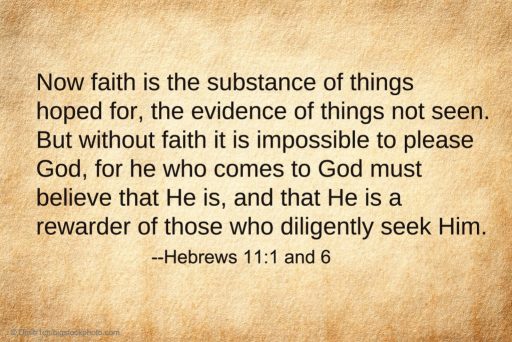
Faith and Evidence Go Together

Faith and Evidence Go Together

We get mail from people who suggest that if you accept science and evidence, you have demeaned God. “You just have to have faith,” one person wrote, “and saying that you need evidence devalues God.” I take strong exception to this claim on many levels, but my main objections are that it contradicts the Bible and eliminates evangelism in today’s world. Hebrews 11, “the faith chapter,” describes the faith of heroes of the Old Testament, including Abel, Enoch, Noah, Abraham, Sarah, Isaac, Jacob, Joseph, Moses, and Rahab. Let’s consider the connection between their faith and evidence.

For example, how did Moses get his faith? Did he come out of a vacuum and just have faith? Remember that his mother raised him and taught him about his people. What about the evidence of the burning bush and the staff that became a snake? Remember his discussions with God that gave him the courage to confront Pharaoh. What about the plagues in Egypt, the crossing of the Red Sea, the brass serpent, and receiving the Ten Commandments on Mount Sinai? Were those not evidence?

Also, read the story of Abraham and notice how many times God reassured him and how much evidence he saw before that near-sacrifice of Isaac. Using Hebrews 11 to justify violating the teachings of the New Testament is not only unwise, but it is also a violation of the teachings of the apostles. Faith and evidence are closely tied together in the New Testament.

For example, 1 Peter 3:15 tells Christians to “be ready to give an answer for the hope that is within us to anyone who asks.” Romans 1:20 tells us we can “know there is a God through the things He has made.” Jesus set the example with Thomas, who at one time had been the strongest of the apostles (See John 11:16) but saw his faith collapse at the death of Christ. How did Jesus deal with this incredible failing in Thomas? Did He condemn him or cast him off as a weakling? Read John 20:24-29 and see how Jesus encouraged Thomas to examine the evidence.

Someone might refer to Acts 2-3, where people, in less than a day, gave their lives to God.
Realize that God had been preparing that “soil” for thousands of years, and Jesus had been planting and nurturing it for three years. Today the voices of atheism, agnosticism, skepticism, materialism, and paganism are louder than ever. We cannot withdraw into our cocoon of church buildings and not do what God has called us to do.

Read Acts 17 and see how Paul dealt with the philosophers and skeptics of his day. He didn’t call them to blind faith. Instead, he gave them evidence of “the God in whom we live and move and have our being.” Faith and evidence go together. We must use evidence as Jesus and the Apostles did, or our numbers will continue to shrink as we lose our children and grandchildren to Satan.

— John N. Clayton © 2022

The Event to Remember

The Event to Remember - Empty Tomb

Today, we think once more of the event to remember which we described in this post from five years ago.

Early on the first day of the week, some women came to the tomb where the lifeless body of Jesus had been placed. It was empty. It had been opened–not by any human hands but by an angel. It wasn’t opened to let Jesus out. The tomb was opened so that people might see that it was empty. The followers of Jesus were not expecting him to be alive again. At first, they couldn’t believe it. Powerful people tried to find the body or to convince the public that it had been stolen. But they could not.

Now, over 2000 years later, there are still those who try to deny the resurrection. The evidence is there. The friends of Jesus were not expecting the resurrection, but after they had seen him alive, they spent the rest of their lives telling others about it. Even when they were tortured and killed for preaching the resurrection, not one of them ever recanted. Without a body, the powerful enemies of Jesus could not disprove the resurrection.

In 1 Corinthians 15:3-7, written only a few years after the resurrection of Jesus, the Apostle Paul recorded what scholars believe was an oral tradition of the resurrection appearances dating back to the very time of the resurrection. If it had not been true, this tradition and Paul’s record of it would have been debunked by the eyewitnesses who were still around. It was true, and the resurrection of Jesus Christ is the most solidly attested event of ancient history. The world will never be the same because of the day when Jesus Christ conquered death.
–Roland Earnst © 2017

Waiting for the New Day

Waiting for the New Day - Joseph's Tomb

As we are waiting for the new day, we want to share this post from five years ago.

Joseph of Arimathea was a wealthy man who had a new tomb carved into a stone hillside. This was not a pauper’s grave. Only the rich and powerful could afford such a burial place, and it was soon to become a temporarily borrowed tomb.

The first man to use it was not a wealthy man. He grew up as the son of a carpenter and had no home to call His own. He had a small group of friends who deserted Him at the last minute. His thousands of admirers quickly sought to get rid of Him when He didn’t overthrow the Romans as they expected.

A few days after they greeted Him with shouts of praise and honor, they were begging the Romans to put him to death. His lifeless body was placed in a rich man’s tomb because the rich man named Joseph stepped out of the shadows and loaned his tomb to Jesus. “Loaned” is the appropriate word, because Jesus would not need it for very long. This was a temporarily borrowed tomb. A miracle was about to happen!
–Roland Earnst © 2017

In the Shadow of NASA

In the Shadow of NASA

The John F. Kennedy Space Center in Florida gets a lot of attention from the media. However, most people probably are not aware that attached to the Space Center in the shadow of NASA is the Canaveral National Seashore/Merritt Island National Wildlife Refuge. It has 69,000 acres of marsh left undeveloped and managed by the National Park Service. Researchers have identified 1045 plant species and 310 bird species in the shadow of NASA.

A dozen species of wildlife that are federally listed as endangered live there, including sea turtles, West Indian manatees, wood storks, eastern indigo snakes, and Florida scrub jays. In addition, there are the usual animals found in Florida, including land tortoises, otters, armadillos, and a wild assortment of crabs, insects, oysters, clams, and shrimp.

We had the pleasure of visiting this refuge the second week of April in 2022. It was interesting to watch hundreds of birds wading through the marsh, eating crabs and shrimp. We also saw mullet jumping as they were chased by larger fish and alligators basking in the Sun and then looking up to see a rocket being prepared to lift astronauts to the space station.

The refuge is a barrier island with sand dunes covered with various plants, including numerous palm trees and ancient oaks covered with Spanish moss and palmetto and sea oats. The National Park Service has built wooden walkways to control human traffic, allowing a natural environment to function within sight of the Kennedy Space Center in the shadow of NASA.

Just north of this area is New Smyrna Beach with its towering resorts, massive numbers of tourist attractions, and where people can drive vehicles on the beach. That area is essentially a biological desert with some gulls and pelicans and various sparrows, vultures, and blackbirds, but nothing like what we see in the wildlife refuge. The primary vegetation is a variety of human-introduced plants decorating the resorts. As you drive through the area, you see the trunks of dead palm trees everywhere but very little wildlife. Meanwhile, construction continues on more resorts and tourist complexes.

What happens when a hurricane hits this area? In the wildlife refuge, the answer is almost nothing. The vegetation holds the dunes and prevents the destruction of the plants and wildlife that depends on them. We all know about the collapse of the resort tower in this area, which tragically killed several people. No human structure is free from the elements. The human-introduced plants are generally wiped out in a hurricane and have to be replanted. Human attempts to control the area are at the mercy of natural processes. As the climate warms and water levels rise, more human-made structures will be destroyed, but what God constructed will survive. The refuge will change, and the wildlife and plant life will adapt, but it will do quite well left alone.

It was interesting to see the challenges facing the park service in the refuge. Roads don’t do well, and wooden structures have to be replaced. Meanwhile, the natural world functions smoothly and efficiently with an abundance of residential and migratory life. As humans try to control parts of nature, we constantly need to rebuild and replace. “And God said, “Let the earth bring forth grass, the herb yielding seed, and the fruit tree yielding fruit … and God saw that it was good” (Genesis 1:11-12). You can see how good it is when you visit an area not corrupted by human ignorance, greed, and selfishness.

— John N. Clayton © 2022

Data from National Park Foundation publication Canaveral/Merritt Island 2021.

Meek or Weak – What’s the Difference?

Meek or Weak – What’s the Difference?

Jesus said, “Blessed are the meek, for they will inherit the earth” (Matthew 5:5). A regular challenge to Christianity is that it’s a group of weak people. Those who make this challenge don’t understand the difference between being meek or weak. These words are not synonyms but very different concepts.

The word translated as “meek” is “praus” in Greek. According to a Greek dictionary, it means “power under control as in a soothing medicine, a gentle breeze, a broken colt horse.” Nelson’s Bible Dictionary explains, “Meekness is an attitude of humility toward God and gentleness toward men, springing from a recognition that God is in control. It is strength and courage under control, coupled with kindness.”

The current crisis in Ukraine is because a very weak man (Putin) has control of the Russian military. He follows other weak men, such as Hitler, in bringing pain and suffering to innocent humans while he sits in comfort far away from where his weakness is being displayed. He is an example of power that is not under control.

We see the classic example of meekness in Jesus Christ. Christ shows His meekness in a plea to all of humanity, “Come to me all of you who are weary and burdened, and I will give you rest. Take my yoke upon you and learn from me, for I am meek and humble in heart, and you will find rest for your souls. For my yoke is easy and my burden is light” (Matthew 11:28-30).

The yoke Jesus calls us to take on is being kind, gentle, fair, forgiving, and peaceful. It is not giving up power but putting it under God’s control. Those who are weak don’t know how to live except by violence and abuse. When Jesus was on Earth, no one accused Him of being weak. Instead, people said, “What is this, for with authority and power He commands … and the fame of Him went out into every place in the country around” (Luke 4:36-7).

Considering meek or weak persons, the Bible contains stories about meek heroes and weak people. For example, Abraham meekly gives his nephew Lot the first choice in dividing the land given to him. Lot takes advantage of Abraham’s strength to support his own weakness (Genesis 13:7-9). Joseph shows meekness in dealing with his treacherous brothers (Genesis 45:3-5). Saul, in his weakness, could not handle David’s success (1 Samuel 18:7-9). Simon wanted Paul’s power and tried to buy it (Acts 8:9-24). Governor Felix was too weak to handle the truth (Acts 24:24-27). King Agrippa was too weak to become a Christian (Acts 26:27-29).

Jesus showed meekness in the extreme by how He faced death. John 10:17-18 quotes Jesus saying that no one could take His life from Him, but He had the power to lay it down. When Peter demonstrated weakness by taking out a sword and slashing away at his enemies, Jesus told him to put the sword away. He said, “Don’t you think I could pray to my Father and He would give me more than twelve legions of angels?” (Matthew 26:50-54). As a Christian, I am weak only when I don’t have the strength to measure up to the meekness that being a Christian requires.

I will never reach the meekness of great Christians of the past. I marvel at Paul, who changed from being an opponent of Christ to one of the meekest men who ever lived. I have not always shown meekness and have sometimes been very weak. Even Paul struggled with the challenge of being a Christian. Read Romans 7:14-8:2. The yoke Jesus offers is easy because God helps us. He is looking to save and not condemn us.

— John N. Clayton © 2022

The Mighty Seahorse Threatened

The Mighty Seahorse Threatened

“The mighty seahorse” suggests a massive stallion galloping across the ocean’s waves. The reality is that these amazing fish range from 5⁄8 inch to 14 inches (1.5 to 35.5 cm), and they are threatened.

There are 46 identified species of seahorses, and the scientific classification is Hippocampus from the ancient Greek for ‘horse” and “sea monster.” This fish has a head like a horse and eyes that function independently and can rotate like a chameleon’s. They have a pouch like a kangaroo and a prehensile tail like a monkey. Instead of scales, their skin is covered with boney plates, spikes, and lacy skin extensions. They swim in a vertical posture using their dorsal fin for power while steering with their pectoral fins. They anchor themselves using the prehensile tail to grab onto a fixed object.

The reproductive system of the seahorse family is unlike any other group of animals. The male and female connect face to face with their tails entwining, and the female impregnates the male by depositing massive numbers of eggs in his pouch. Then, several weeks later, the males eject up to a thousand baby seahorses who will drift with the current, eventually settling down on seagrass or coral or any fixed object on the seafloor.

Seahorses eat smaller forms of sea life, including copepods, shrimp, and fish larvae. They are themselves part of the food chain eaten by larger fish. Commercial fishing operations catch 76 million seahorses a year, and human exploitation has endangered these animals.

Human understanding of all the agents of change and balance in the oceans is very limited. The role of the seahorse in the functioning of a healthy ocean has only recently become understood. The ocean system has a complex influence on life on the land. As we learn more, the complexity speaks of a design that makes chance an unlikely cause. God’s design of life on Earth is clearly seen through what has been made (Romans 1:20). The mighty seahorse is an excellent demonstration of that design.

— John N. Clayton © 2022

Reference: National Geographic, April 2022, page 72-85.

Jonah’s Icefish and Animals of the Cold

Animals of the Cold include Jonah's Icefish and Ooligans

Deep-sea biologists from Germany accidentally discovered a massive colony of icefish nests under the ice in Antarctica’s Weddell Sea. The fish known as Jonah’s icefish have formed a colony the researchers estimate to contain 60 million nests 500 meters below the sea ice. The animals of the cold always amaze us.

Jonah’s icefish are nesting fish that carve out circular nests with rocky centers on the seafloor, where they lay over 1,000 eggs. Other ocean and freshwater fish species form nests, including bluegills that nest in the lakes of the midwestern United States. However, bluegill breeding colonies are limited to a few hundred individuals, not millions. Like bluegills that feed on small aquatic life and are food for larger fish, Jonah’s icefish play an essential role as food for the Weddell seals, and they feed on the abundant plankton in the Antarctic waters. 

When it comes to animals of the cold, Jonah’s icefish are like the ooligan (eulachon) fish of Alaskan waters in that their blood is full of antifreeze compounds. Ooligans have so much oil in their bodies that if you dry the fish and put a wick in its mouth, it will burn like a candle. In Alaska, a nickname for the ooligan is the “candlefish.”

Many animals are specially designed to live in very cold conditions. For example, one of the books in our children’s book collection is titled Animals of the Cold, written by Charlsey Ford. As well as the ooligan, that book discusses the musk ox, ice worms, and the Kermode bear. All of these animals are specially designed to live in the extreme cold. 

We see God’s design in every ecological system on our planet. Each time we find a new example, we are amazed at God’s creative design of life. Romans 1:19-22 reminds us that “We can know there is a God through the things He has made.” Jonah’s icefish is another excellent example of that truth. 

— John N. Clayton 2022

References: Science News February 12, 2022, pages 12-13, and Current Biology volume 32, issue 4.

The complete set of our children’s books is available HERE.

The Purpose of Beauty

 The Purpose of Beauty - Sunset

Humans are obsessed with beauty. We try to make ourselves more beautiful with clothing and cosmetics. We seek to create beauty in music and art, and we continually long for something even more beautiful. But, what is the purpose of beauty, and how can we explain excessive beauty in nature? That is what we have called “the problem of beauty,” which we have discussed all this week.

Beauty is not to provide protection or to solve problems. The purpose of beauty is to bring joy, peace, and meaning to life. However, as we seek beauty, we long for something even more beautiful. We strive to create it, and we desire to find it in people and in nature.

The prophet Isaiah in a vision, saw God’s throne room where one seraph cried out, “Holy, holy, holy is the Lord of hosts, the whole earth is full of His glory” (Isaiah 6:3). God’s glory is displayed in the beauty we see on this planet. The curse of sin has marred that beauty, but it still peaks through. It reminds us of the Creator of “every good and perfect gift” (James 1:17). Theologian N.T. Wright asked the question that we all face at some time, “If the earth is full of God’s glory, why is it also so full of pain and anguish and screaming and despair?” That is what we call “the problem of pain.” I think we can see a glimpse of the answer in the purpose of beauty.

I suggest that humans appreciate and desire beauty because God created us in His image.
God creates beauty in the world around us to give us a sample of what is possible. When we see beauty, we long for more because we always find imperfections in the beauty we see here. Beautiful peacocks die. Colorful fall leaves turn brown and fall to the ground. The beauty of a sunset is fleeting. We long for more. We want to know what more God has in store for us.

The apostle John saw a vision of what God has waiting for those who accept His gift of eternal life. In Revelation chapters 21 and 22, he struggled to describe it in terms of the familiar, such as gold, pearls, and jewels, but he knew those words were inadequate. Perhaps the purpose of beauty in the world around us is to show us a glimpse of the glory of God’s beauty. We long for the revelation of the pure beauty of God’s kingdom. As we struggle to answer the problem of pain, perhaps the answer is before our eyes. The problem of beauty is only a hint, a clue, a sample of the ultimate beauty. I can’t wait to see the real thing.

— Roland Earnst © 2022

Archaeology in Jerusalem Today

Archaeology in Jerusalem Today

The work of archaeology in Jerusalem is changing with the current national political situation and the use of new scientific tools. Three religions have an interest in Jerusalem. Judaism has great interest in the Western Wall. Islam is very concerned about the Dome of the Rock. Various Christian sects express interest in the Church of the Holy Sepulchre.

The obstacles to progress in archaeological excavations in Jerusalem are many and quite complex. First, the Israel Antiquities Authority controls all Jerusalem excavations. They will not give any permits to Palestinian teams and rarely grant permits to foreigners.

In Jerusalem, the chief building stone was a relatively soft limestone that was easy to quarry and got harder when exposed to the air. This stone was reused over the centuries by tearing down the remains of an ancient culture and using the limestone for new construction, leaving little evidence of the past. There was virtually no wood in the area, so standard dating methods like dendrochronology and carbon 14 were impossible.

Another problem with archaeology in Jerusalem is that treasure seekers used violent and unscientific methods as these untrained people pillaged the area. They were often looking for an item claimed to have mystical powers, such as the Ark of the Covenant. Dreams of wealth and notoriety were their goals.

Still complicating the situation is that while early archaeologists were Christian believers who saw archaeology as a means to verify the integrity of scripture, modern archaeologists are “overwhelmingly made up of agnostics and atheists.” They have often allowed their personal beliefs to attach a negative bias to whatever artifacts they find.

Despite these challenges to archaeology in Jerusalem, researchers are progressing in understanding the city’s history thanks to new scientific tools. Geomagnetic instruments with great sensitivity allow researchers to use changes in the Earth’s magnetic field to date some artifacts accurately. New laboratory techniques enable researchers to learn from tiny bone fragments and detritus that reveal the diets and diseases of people in the past. Much of archaeology in this century is going on in the laboratory, where scientists analyze the uncovered artifacts.

Archaeological work is hard, but Webster defines “science” as “knowledge,” and new scientific techniques provide us with knowledge. That knowledge continues to support the accuracy of the biblical narrative. While nationalism, politics, and Zionism complicate archaeology in Jerusalem, the unfolding story supports the accuracy of the Bible. The science of archaeology must be supported by the facts, not the opinions of archaeologists.

— John N. Clayton © 2022

Reference: Article on Jerusalem Archaeology by Andrew Lawler in the April 2022 issue of Scientific American.

The Does God Exist? ministry has produced a series of videos on archaeology and the Bible available on DVDs with a study guide HERE. Or you can view them for free HERE.