Justifying Animal Behavior in Humans

Bonobos - Justifying Animal Behavior in Humans
We have received several letters from people suggesting that sexual practices among animals show that humans are not unique in their moral choices but are merely acting out their animal heritage. Our supposed animal heritage can then be used for justifying animal behavior in humans.

We have read articles and news releases describing animal behavior including the pedophilia practices of bonobo apes, and recreational sex, rape, and homosexuality in monkeys. We have seen documentaries on the fact that many males in the animal kingdom kill the babies of their own species. The supposed reason for that is to push the mothers of those babies to become more quickly receptive to the sexual advances of the males.

It is a foolish argument to suggest that humans are just animals and that all human behavior is inherited and therefore we can’t condemn it. One PBS program recently said that the greatest threat to the babies of bears and lions was from the males of their own species. I am sure that very few atheists would maintain that human males should not be condemned for killing their offspring.

The other major point we would make is that sexual activity in animals is almost always a way of expressing dominance and control. The pedophilia practices of the bonobos produce extreme violence among the clan. Using sex to show dominance or to establish a pecking order among the group is a long way from the purpose of human homosexuality.

God created humans in His image. That means that dominance and control is not the only focus of our relationships. The “oneness” that God intended for sexual relationships (Genesis 2:24) is a long way from establishing who is going to control the group in which they live. The “agape” love which humans are capable of, goes far beyond sex. In John 17:24-26 Jesus spells out agape in terms of God’s love for His son. Animals are not capable of that kind of love.

When humans misuse sex or use sex only for physical pleasure, the result is always catastrophic. After Amnon raped Tamar (see 2 Samuel 13) he “hated her exceedingly.” That was the beginning of a long series of tragedies for the whole family. Justifying animal behavior in humans violates the uniqueness of humans and human relationships, just as it did for both Tamar and Amnon. Animal sexual activity does not produce what God intended in the marriage relationship.
–John N. Clayton © 2018

California Wildfires Follow Up

California Wildfires Follow Up
Our printed journal for the fourth quarter of 2018 contained an article titled “Lessons From the Fire.” In it, we pointed out that the California wildfires in 2018 were the result of human mismanagement of the forest, and not some “act of God” as the media has sometimes reported. In the article, we gave three biblically-based lessons that we should have learned from the fire. You can read it HERE.

We have received responses from people who live in the fire area. Here is a recent email comment:

“I drive past the ruins from this fire when going to the doctor and have observed that houses are being rebuilt in the same location using the same materials. Nothing has been learned from the past experience. Besides this, lawyers are having a field day getting clients to sue the local utility company. One of them has had a half page ad in the local paper every day since the fire. It’s true that the company power lines were responsible for some of the fires…but not all of them.”

The fact is that the start of the fires was not the issue. The real problem was the biomass that provided fuel for the flames once they started. There has been almost no discussion in the media about managing the other forests in California that are tinderboxes waiting for a spark to repeat what happened this fall.

God didn’t cause the California wildfires, and He will not prevent catastrophe from resulting from human stupidity, mismanagement, and greed. God told Adam, “take care of the garden of Eden, dress it and keep it” (Genesis 2:15). The basis of that command surely applies to us today. It is up to us to take care of what God has loaned to us.
–John N. Clayton © 2018

Human Gene Editing

Human Gene Editing
We have written about human gene editing using the technique known as CRISPR. (Read more about it HERE and HERE.) One of the fears of those who are opposed to uncontrolled use of the CRISPR technique is that it will be used to produce “made to order” babies.

CRISPR could be used to treat a person with a genetic disease, but that is a different scenario from controlling a baby’s athletic skills or eye color. The big problem is that once we apply human gene editing, whatever was changed is passed on to future generations. That includes whatever errors might be made in the process.

He Jiankui, a Chinese scientist, announced in early December 2018, that he had altered the DNA of two embryos to make them resistant to HIV. He then placed them in their mother’s womb resulting in a successful live birth. Marc Thiessen writing in the Washington Post said, “Gene editing is here, and it poses an enormous threat to humanity.” The problem is that there is no way of telling what other characteristics were altered in the process, or what it could lead to. Thiessen says “If science continues down this road, we will cross a moral line from which there may be no return.”

Science cannot determine the use to which its discoveries, such as human gene editing, will be applied. Will CRISPR be used to eliminate diseases that are produced by genetic change? On the other hand, will it become a way for scientists like Jiankui to make large amounts of money by producing made-to-order babies? The belief system of the scientists is what will determine this. An atheist has no reason not to use CRISPR to make a fortune for himself no matter what it does to the human race.

We need Christians who believe God is our Creator. We need scientists and medical practitioners who accept God’s view of humans that we are special, created in His image and the dwelling place of the Holy Spirit. (See 1 Corinthians 3:16.)
–John N. Clayton © 2018

Life Expectancy and Despair

Life Expectancy and Despair
The Centers for Disease Control and Prevention has just released its latest annual report on American life expectancy. The report shows that for the third year life expectancy in the United States has not grown and has declined. The last time that this happened was in World War I when a flu pandemic killed 675,000 people.

The report says that drugs and suicide are the main culprits now with the overdose rate up 356% since 1999. The 2017 death toll is 70,237 far outstripping the total American fatalities in Vietnam.

It is interesting that everyone studying this life expectancy issue seems to agree on what the cause is, and what the solution is. The NationalReview.com says that “we are facing not so much a drug problem as a heartbreak problem.” An AARP study found that one-third of Americans report chronic loneliness and conclude that isolation is a state “about as deadly as smoking.” David Brooks writing in the New York Times says “It’s not jobs, jobs, jobs or better welfare programs that will save us from this ongoing social catastrophe; it’s human relationships and a society that cares about people more than money.”

We suggest that people need to read and follow the example in Acts 2:41-47. People had a common faith in God, and they took care of each other. They “CONTINUED DAILY WITH ONE ACCORD” and spent time together focusing on meaningful relationships. The result was that “they had favor with all the people.”

This reminds me of a comment I heard Carl Sandburg make when someone asked him what he thought about Christianity. His response was “I don’t know, I have never seen it tried.” Christianity is not a legalistic way of restricting human behavior. It is a way of life that blesses everyone who is a part of it and everyone around those who live it.
–John N. Clayton © 2018

Reference: The Week, December 14, 2018, page 17

Demons Cannot Make Us Act Against Our Will

Demons Cannot Make Us Act Against Our Will
Yesterday we stated that a careful study of the Bible and some common sense make it clear that you and I are not in danger of being taken over by a demon. In other words, demons cannot make us act against our will. We have free will to choose our actions. There are six reasons why that is true:

#1) Hebrews 4:15 tells us that Jesus “was tempted in ALL points as are we.” You don’t need to be biblical scholars to know that Jesus was never tempted by being demon possessed and never needed an exorcism.

#2) There is no warning to the early Church in scriptures about demon possession. The New Testament is full of warnings about things. Read Acts 20:27, Acts 20:31, 1 Corinthians 4:14, Colossians 1:28, and 1 Peter 1:3. These are realistic threats, and ones that we have seen become a problem. Nowhere is there a warning about demons. We see people do horrible things, and we see greed and selfishness express themselves in terrible events. We have also seen mental illness cause suffering. Those things are the result of human weakness, abuse, or neglect. They are not involuntary takeovers by demonic forces.

#3) The Bible gives us cures for Satan’s attacks on us. James 4:7 tell us to “resist the devil, and he will flee from you.” Ephesians 6:12-18 tells us that God has given us armor “that you may be able to withstand the evil day having done all to stand.” God has never put us into a situation where he could not resist evil. Demon possession even occurred in defenseless, innocent children in biblical times. (See Matthew 17:18 and Mark 9:24).

#4) God has promised Christians protection from anything that could cause us to lose our soul. First Corinthians 10:13 tells us nothing can happen to us that hasn’t been experienced by others and that there is always a way out of anything that could destroy us. Demon possession is certainly not “common to man.” Revelation 20:1-3 gives us assurance that God can control Satan and make good on the promise that demons cannot make us act against our will.

#5) The methodology of exorcism in the Bible is nothing like what happens in today’s world. The exorcisms that I have seen took hours and involved incredible psychological pressure on the “possessed.” In biblical times the process took seconds and generally involved one command. There were no regressions in people who experienced exorcism. In today’s world regression is very common.

#6) Perhaps most importantly is the fact that demon possession violates the entire Bible in that it defeats our capacity to choose. It violates our free moral choice. Joshua said, “Choose you this day who you will serve, but as for me and my house we will serve the Lord” (Joshua 24:14-15). That admonition is violated if a person involuntarily is forced to obey Satan and evil. Philippians 2:12 tells us to choose to find salvation, but leaves it up to us to do it. Demons cannot make us act against our will.

Every judgment scene revealed in the Bible shows people answering their judgment by how they lived and what they chose to obey. (See John 20:31 and Mathew 25:31-46.) From Job to Paul we see the principle of freedom of choice. Demons cannot make us act against our will. Nobody at the judgment will be able to say that they had no choice, or as comedian Flip Wilson used to say, “The devil made me do it.” We make our own choices, and God does not allow us to foist our imperfections off on something over which we had no control.
–John N. Clayton © 2018

Demon Possession and Exorcisms Today

Demon Possession and Exorcisms Today
An often discussed biblical subject is whether demons can possess people today and whether certain religious leaders can perform exorcisms. The Catholic priest, John J. Nicola, who was the adviser to the 1973 film “The Exorcist” gave what is perhaps the best definition of demon possession: “In the case of demonic possession the use of free will and intellect has been suspended. The person is no longer responsible for his or her actions.” What about demon possession and exorcisms today?

When someone does something horrible, like the recent shootings that have taken the lives of innocent people, are they possessed by demons? Is this a risk for you and I in today’s world? I have personally witnessed exorcisms and have talked to people who sincerely believed they had been demon possessed. This discussion is not about whether or not these things happened in the time of Christ and the apostles. Miracles and events the Bible describes cannot be repeated and tested. Demon possession and exorcisms are among them. The question is whether they occur today. What does the Bible actually say about this subject?

Demon possession was a New Testament phenomenon and is not present in the Old Testament. The Hebrew word for demon is “shaidim” and is only used twice in the Old Testament – in Deuteronomy 32:17 and in Psalms 106:37. The context of both of these passages is about idols. In the New Testament the Greek word used is “deimonion” and is used several times to describe many symptoms – some violent and some passive such as in Acts 16:16-19. People sometimes notice these descriptions sound like things that happen today, such as epileptic seizures or mental illness.

At the beginning of the Church, the apostles needed to demonstrate that they had knowledge of and authority over all realms of human experience. That included the spiritual world. When people tried to provide fake exorcisms, the results were catastrophic. (See Acts 19:13-16). Once the Bible was available to answer spiritual questions, there was no need for exorcisms or miracles for that matter.

The prophecies of the Old Testament and the statements of the New Testament indicate that demon possession and exorcisms would end. (See Zechariah 13: 1-4, Colossians 2:15, and 1 John 3:8.) First Corinthians 13:8-10 indicates that when the perfect comes, the imperfect will pass away. Second Timothy 3:15-17 says that the Word of God is perfect. Hebrews 4:12 tells us that we don’t have to wait until we are in heaven to have contact with God’s perfect will.

Demon possession and exorcisms have no place in the lives of people today. A careful study of the Bible and some common sense make that clear. You and I are not in danger of being taken over by a demon with the power to remove our ability to choose our actions. There are six reasons why that is true, and we will examine those reasons tomorrow.
–John N. Clayton

Amazing Human Eye

Amazing Human Eye
Eyes are among the great challenges to those who insist that unguided, naturalistic evolution created all living things. Eyes are complex devices that display engineering design skill. A significant problem for naturalists is that some very complex eyes appear early in the fossil record, such as the trilobite eye. Each animal has eyes well-designed for the life they live. That is certainly true of the amazing human eye.

Many things about human eyes make them amazing. One of those is the cornea, the clear front covering of our eyes. Corneas must be perfectly clear to allow light to pass through for an unobstructed view of the world around us. Because of the need for complete transparency, they have no blood vessels. Our corneas get their nourishment from the aqueous humor (the liquid inside the eye) and the tear fluid on the outside. They get oxygen from direct contact with the air.

Corneas must be designed to fit a curving surface full of a fluid which maintains the critical pressure inside the eye. However, there is a problem with the cornea being exposed to the air with all of the contaminants it contains – pollen, dust, chemicals, and grit. Corneas can become scratched. Over time, any surface exposed to dirt and grit, and sometimes bumps and blows, can get tiny scratches. How is it possible for corneas to remain transparent with so much abuse?

When you cut your skin, as the cut heals, scar tissue forms. Scratches in our corneas must heal without scar tissue. When the outer layer of the cornea gets scratched, the surrounding cells move toward one another and close the scratch leaving no scar tissue. This is only one feature of corneas which consist of five different layers each having an important function and showing evidence of design.

Think what it would be like if scar tissue formed every time the surface of our corneas got scratched. By the time we reached middle-age, we would certainly be looking through cloudy lenses. If you can read this, you should be thankful for just one of the features of the amazing human eye!
–Roland Earnst © 2018

Programmed to Change

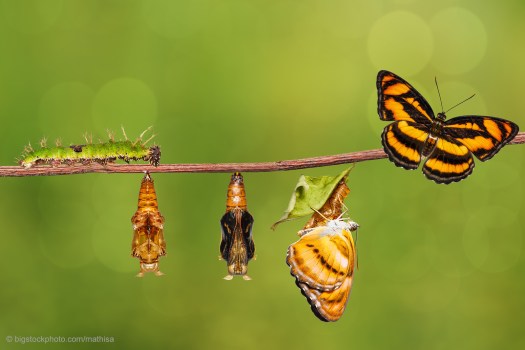
Colour Sergeant Butterfly - Programmed to Change
When I was a child, I was introduced to the metamorphosis of a caterpillar to a chrysalis to a beautiful butterfly. I decided to figure out how that change took place, so I cut open a chrysalis to see what was going on inside. Instead of catching the transformation in progress all I found was a capsule of black soup. Later when I asked biologists how the process took place, I realized that no one fully understood it. The caterpillar was programmed to change, but nobody could understand how.

What I did learn was that this process goes on in a wide variety of life forms. Frogs, sea urchins, flying wasps, and beetles are just a few examples of creatures programmed to change. The December 2018 issue of National Geographic features a wonderful article about the use of 3D models and micro-CT scanning of the process. These tools have given us a great deal of understanding of how this transformation occurs. The article identifies three stages of the change that happens as the caterpillar changes into a butterfly.

1. PROGRAMMED ACTIVATION. The caterpillar eats vegetation until it is full grown. As it does so, its hormones begin to shift with some parts of the caterpillar expanding and others becoming degenerate. The thoracic legs grow into legs that are good for grasping. Four wing buds on the caterpillar’s body begin to develop into wings, and the antennae become larger. The silk gland begins to degenerate to become the chrysalis. The proleg degenerates making the caterpillar more dependent on crawling. The mandible the caterpillar uses for chewing begins to degenerate making room for a tube for sipping nectar. The simple eye of the caterpillar which could only detect the presence or absence of light begins to change. All of this is programmed into the genetic makeup of the caterpillar.

2. TRANSFORMATION. As the prolegs degenerate, thoracic legs grow to adult size. Wings develop with full color from the four wing buds. The chewing mandibles morph into two halves that zip into pipes that make a straw-like proboscis. Simple eyes move forward closer to the brain and produce a compound eye which gives true vision.

3. EMERGENCE. The brain of the butterfly is almost completely rewired to meet flight requirements.  One thing that the butterfly seems to retain from its caterpillar stage is olfactory memories. It needs that to know where to produce the next generation of caterpillars. The butterfly sucks in air until its chrysalis breaks open. The butterfly flaps its wings for several hours to dry them and to circulate blood before flying off in search of a mate.

All of this happens in 15 to 21 days. The gut of the butterfly shifts from digesting plants to nectar in that short time. There are wonderful artistic drawings of all this in the article. The author summarizes his study by saying, “..the insect’s makeover is a programmed mix of destruction and growth. Certain cells die, and body parts atrophy. Meanwhile, other cells, in place since birth, rapidly expand in as little as two weeks, the adult emerges completely remodeled, capable of flight – and bent on finding a mate.”

We would add that no programming happens by chance. It takes intelligence to program a computer. The caterpillar programmed to change to a butterfly reflects the wisdom and intelligence of a great programmer superior to anything the software companies can offer.
–John N. Clayton © 2018

Artistic Expression and Human History

Artistic Expression and Human History
One of the interesting challenges to human evolution has to do with our capacity for artistic creation. Why do human artistic expressions display beauty and color? There is no good evidence that animals express themselves aesthetically – be it music, color, artistic expression, abstractionism, or worship. When people have claimed that animals express themselves in these areas, the claims have turned out to be anthropomorphisms by those making the claims. We all tend to attach human attributes to animal actions, but the evidence supports the view that animals don’t do those things. On the other hand, artistic expression and human history go together.

One evidence of artistic work has to do with the pictures left on cave walls in various locations. Those drawings do not show a sequence of development. In other words, you don’t see older drawings that are more primitive than recent ones. There is a story that Picasso examined the Cromagnon cave drawings and said, “We have learned nothing about art in our entire history on planet earth.”

USA Today (November 9, 2018) published an article on new art finds in Borneo and Indonesia. They are much older than any of the drawings in Spain and France. Dr. Maxime Aubert who led the discovery says the paintings are 4,000 years older than any other find. Aubert says “they are the earliest known figurative artwork.” In addition to the drawings of mystic animals, there are hand stencils and cave paintings of human scenes, and extensive use of color.

Genesis 4:21-22 indicates that humans developed tools and musical instruments early. Human history has included artwork and musical synthesis from a very early time. We would suggest this is all tied to our spiritual nature. It is our soul that gives us the capacity to do all the things that set humans apart from animals. The new finds support the view that these abilities were present in human’s from the beginning, not developed over a long time. Artistic expression and human history cannot be separated.
John N. Clayton © 2018

Sex Recession Cause

“Sex Recession” Cause
There is little doubt that there has been a radical change in sexual behavior in the past 25 years. Moral acceptance of premarital sex is at an all-time high. Birth control is easily accessible for all ages. People can find hook-up partners on dating apps without leaving home. Online porn is a major industry in today’s world. Websites are selling sex toys and vibrators to promote masturbation. How can there be a sex recession?

Liberals maintained that all this was good and that freedom from old norms would lead to what they called “sexual fulfillment.” What the numbers are showing is just the opposite. The number of sexually active high school students has dropped from 54% to 40% in the past 25 years. People in their early 20s are 2.5 times as likely to be abstinent as GenXers were at that same age. Dating apps have turned out to be addictive games that produce more frustration than connection.

The New York Times recently published a report on the “sex recession.” Writer Ross Douthat said that the trend mentioned above “has led to the growing alienation of the sexes from one another. In our new sterility, ‘virtual sex’ has become the opiate of the frustrated masses.” Editorials in the media have blamed everything from porn to the record number of people under 35 who are living with their parents.

When God gave the beautiful oneness that marriage brings, He then gave admonitions about how to use the gift of sex. When we follow God’s guidelines, sex can give fulfillment, relationships, security, and freedom. Genesis 2:24 stated the relationship God intended, and the Bible is full of teaching about avoiding the corrupted misuse of sexual relationships.

Atheists and skeptics have challenged these teachings saying they are unrealistic and merely an attempt to deprive us of potential pleasure, but just the opposite is true. God’s instructions are to designed to give us freedom, joy, and the maximum pleasure. When we misuse the power of sex, the result is catastrophic. The “sex recession” is proof of what happens when we fail to follow God’s instructions.
–John N. Clayton © 2018
Data from The Week, November 30, 2018, page 17.