Komodo Dragons and Parthenogenesis

Komodo Dragons and Parthenogenesis
There seems to be an unlimited number of methods by which plants and animals reproduce. In 2006 in England’s Chester Zoo a female Komodo dragon (a large lizard) who had never been in the presence of a male laid a clutch of eggs that hatched producing male Komodo dragons.

This self-fertilization process is called parthenogenesis, and it apparently happens often with Komodo dragons. When a female Komodo dragon is isolated so that normal sexual reproduction cannot take place, the isolated female can bear male offspring which will have the same DNA as the mother. When they grow up, they can be the female’s mate. This doesn’t allow for diversity in the gene pool, but it does provide a way for a geographically isolated population to reproduce.

Komodo dragons only live in the wild on seven islands of Indonesia. They are threatened by loss of habitat and poaching of the animals they prey on such as wild boar, water buffalo, and deer. They have been designed with a method to protect them from extinction.

Komodo dragon parthenogenesis is possible because the females have both male and female chromosomes. This allows for reproduction in a way that meets their particular situation. God’s design to keep Earth populated with life is incredible, and discoveries continue to help us understand just how complex the design is.
Reference: National Geographic, November 2017, page 29.
–John N. Clayton © 2017
Ancient Animal Butchering by Humans Is a Croc?

Ancient Animal Butchering Is a Croc
One of the things I love about science is that because of the nature of the discipline, errors eventually get corrected. Data on ancient animal butchering by humans just received a correction.

“In a field where researchers reap big rewards for publishing media-grabbing results in high-profile journals … there’s a push to publish extraordinary findings, but evolutionary researchers always have to weigh what is interesting versus what’s correct.” That statement was made by David Braun, an archaeologist at George Washington University in Washington D.C. He was responding to an announcement that what scientists thought was human butchering work with stone tools was apparently crocodile bites.

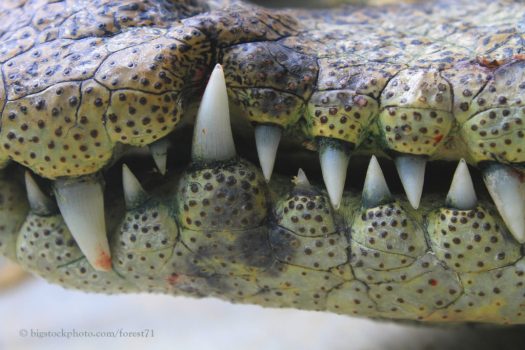
The date of tool use by early humans has been pushed back again and again as microscopic investigations looked at the shape of marks on the bones of horses and other animals. Carnivores like hyenas leave U-shaped marks on bones. Scientists had assumed that V-shaped incisions with internal ridges were caused by ancient animal butchering by humans using stone-age tools. The new finds show that crocodile bites can leave the same pattern on bones as stone butchering tools.

The traditional and biblical views of early humans show that they were gatherers and that butchering animals came along sometime later. The picture of the real human history is based on the evidence, and it is a constantly changing picture. The picture gets modified as scientists discover new evidence. The model indicated by Scripture and the scientifically-accepted picture will get closer to agreement as new evidence comes to light, and old evidence is re-examined.

Data from Science News December 9, 2017, and the November 6 Proceedings of the National Academy of Sciences.
–John N. Clayton © 2017

Yeti or Yogi Bear?

Yeti or Yogi Bear
The Yeti is a legendary creature of the snow-covered Himalayas. He has been described as an ape-like creature taller than a man and covered with white fur. In the 1920s a reporter for a newspaper in India gave the creature the nickname of “the abominable snowman.”

The general public continues to be fascinated with stories about Yeti or his temperate-weather cousin Bigfoot or Sasquatch. Some of the fascination is that there are folks who suggest that this creature offers a proof or disproof about the evolution of humans. The fact that Bigfoot continues to be a show on the Animal Planet network indicates that the value of these mythical creatures is more for entertainment than education.

The first point that we would like to make is that if a human-like creature existed, that science had not discovered yet, it would not have evolutionary implications. Neo-Darwinists would say it was just another dead-end in hominid evolution. Creationists would say that God had created another creature that was previously unknown. Quite often previously unknown species of various creatures are discovered somewhere in the world.

On November 28, 2017, the Proceedings of The Royal Society B, released a report of genetic studies of the remains of bones, teeth, skin, and hair that people claimed were from Yetis. All of them turned out to be from bears. The genome of a bear is distinctive enough that scientists can know with great certainty what creature left the sample. While the report probably won’t cancel any TV series on Bigfoot or interest in Yeti, it does give a rational answer to some of the claims.
–John N. Clayton and Roland Earnst © 2017

Thankfulness and Being Human

Thankfulness
We had just left a sandwich shop where we ate lunch. A woman with a smile on her face came up to our car window holding a sandwich. I rolled down the window to see what she wanted. She said, “Are you the ones who paid for my sandwich?” She said the employee in the store told her that a person ahead of her had paid, so she didn’t owe anything. I told her that I was glad for her, but we were not the ones who had done this generous act. As she went away, it was obvious that the small kindness had made her day, but she was disappointed that she didn’t get to express her thankfulness to her benefactor.

We have many people to thank, such as soldiers, police, firefighters, and teachers; but most of all our thankfulness should be directed toward God. There is something about humans that makes us want to express our gratitude. It’s part of what makes us different from the animals. Our pets are loyal to us because we feed them, and they get excited when they see us open the food container. But only humans are motivated to express true gratitude. The Psalms often express thankfulness to God for the things He has done. Reformer Martin Luther called thankfulness “the basic Christian attitude.” G. K. Chesterton once wrote, “The worst moment for an atheist is when he is really thankful and has nobody to thank.”

We often show thankfulness toward each other, but our greatest debt of gratitude is to God. One evidence of God’s existence is that not only does He give us many good things, but He also has given us the desire and ability to say, “Thank you.” In Romans 1:21 the apostle Paul wrote about godless people, “…they neither glorified him as God nor gave thanks to him, but their thinking became futile, and their foolish hearts were darkened.”

Thank you for reading our daily posts. We hope that you will express your thanks to God who has given us all good things.
–Roland Earnst © 2017

Respectable Bird– Confusing Name

Respectable Bird
Benjamin Franklin called this animal a respectable bird. They are large birds native to North America where they’re called “turkeys.” The origin of that name is disputed, but it apparently has a connection with the country of Turkey.

Turkeys were brought to England from America, on merchant ships from the Middle East area of Turkey. After being domesticated in England, turkeys spread throughout the British Empire, including India. From India, they were taken to various other countries where they were known as “a bird from India.” For that reason, the name for turkeys in several languages is connected to India. In the country of Turkey, turkeys are called “hindi” which means “India” in Turkish. To make things even more confusing, in Portuguese a turkey is called a “peru” which is apparently derived from the name of the country of Peru. To further compound the confusion, there are several other birds in other countries that have “turkey” names but are not related to the American turkey.

Native Americans first used turkeys for their feathers in about 800 BC. It was almost 2,000 years later before they used turkeys for meat. In the United States, turkeys are a popular meat on Thanksgiving Day and Christmas.

The founders of the United States chose the bald eagle as a national symbol. Benjamin Franklin was famously critical of that. He called the eagle “a bird of bad moral character” and wrote that “the turkey is in comparison a much more respectable bird, and withal a true original native of America.” With respect for Mr. Franklin, the truth is that the only creature God created that has “moral character,” whether good or bad, is the human creature. All other creatures do what God created them to do. Humans often choose to do otherwise.
–Roland Earnst © 2017

Our Ancestor Was a Rat

Our Ancestor Was a Rat
The headline of a lead article in USA Today for November 8, 2017, said: “Our Ancestors Were Rats.” Written by Doyle Rice, the article claims that fossils prove our distant ancestor was a rat.

According to the article, Steve Sweetman of the University of Portsmouth in the U.K. says we know about this ancestor of ours. He said it is “undoubtedly the earliest yet known from a line of mammals that led to our own species.” The article further said that line of mammals included blue whales and pygmy shrews. Sweetman says the mammals they have discovered “were small furry creatures.” He speculates that they were nocturnal, possibly burrowers, and ate insects and possibly plants.

Would we not assume that this newly discovered fossil had a skeleton and traces or impressions of fur? Wouldn’t we have found coprolite (petrified poop) to make claims about what the animal’s diet was or perhaps plant or insect material in the animal’s stomach? Would we not also assume that the biosphere in which the animal lived was well documented by fossils of what the animal ate? Are we not assuming that the “line of mammals that led to our own species” has been so well documented that no reputable scientist would deny it?

The fact is that an undergraduate student was sifting through rocks and fossils in a box in his geology lab when he found two teeth which he showed to Sweetman who is a mammal expert. That is all the evidence we have for this rat which was supposedly our ancestor. How do you determine the animal had fur from two teeth?

There is great controversy about the phylogenetic trees that various scientists have constructed to develop theories about the history of life on planet Earth and human life. Many scientists believe that multiple trees and cladistic techniques better explain the history of life than the our ancestor was a rat version that Sweetman promotes.

We have said that when there is a conflict between faith in God and science, it is because of bad theology and/or bad science. Maybe bad journalism is another source of problems. This story is grossly misleading and represents the source of many of the conflicts that young people have between what they hear at Church and what they hear from the media.
–John N. Clayton © 2017

Fire Ant Towers

Fire Ant Towers
Those who live in areas where fire ants are active can tell you about fire ant towers. The ants will encircle a rod, stick, or tree to build a tower that is wide at the base and narrows as it goes up. You can watch this behavior on a video posted here.

Researchers at the Georgia Institute of Technology were interested in how the ants do this without crushing the ants at the bottom. What they found was that the ants form rings around the structure at the center using their sticky feet to cling to each other. The rings are all concentric, but they get smaller as the tower grows. Ants near the bottom only stay there for a short time, backing off to take a break and then climbing up to the top to rejoin the structure to keep the tower standing. These towers are temporary, but they shield the colony from outside forces.

This behavior of fire ants cannot be learned. It is certainly not the product of trial and error but is clearly programmed into the ant’s DNA. Many insect behaviors are characteristic and peculiar to a certain species of insect. These built-in skills strongly suggest that the programming was done by an intelligent Creator to enhance the survival of the insects.

Proverbs 6:6 tells us, “Go to the ant, you sluggard; consider its ways and be wise.” While the passage is about being active in providing for the future and avoiding poverty, the message also comes to us today to see the handiwork of God in even His smallest creatures. Scientists are studying these ants to learn how they work together and build fire ant towers so that science can apply that intelligence to program robots.
–John N. Clayton © 2017

Incredible Color

Incredible Color
Our ability to see the incredible color in the world around us is amazingly complex. We don’t actually see color with our eyes. We see color with our brains.

Most humans have trichromatic vision. Our eyes only detect red, green and blue. If our eyes detect a lot of red and green but not much blue, our brains decide that we are seeing yellow. When our eyes register equal amounts of red, green, and blue, our brain decides that we are seeing gray. If red and blue are present, but not much green, our brain decides we are seeing purple.

Some of us do not have red or green receptors in our eyes, especially people with XY chromosomes (males). We call it color blindness, but in reality, our eyes just don’t see one particular set of wavelengths. Some of us with XX chromosomes (females) may have tetrachromacy which means we see more than the three primary colors.

In the animal world, color is produced by many different techniques. The wings of the Morpho butterfly appear to be blue or violet depending on how the light strikes them. This is due to light-scattering scales that cover the insect’s wings. Dragonfly wings look similar to the Morpho wings, but the dragonfly’s color comes from waxy crystals that cover layers of the pigment melanin. We call the method of color production in these insects “structural color” because it is produced by the structure of the material rather than by pigments. Cameleons also use structural color using nanocrystals in their skin. They can tune the nanocrystals to reflect different colors. In this way, they can match the color of their environment or their mood.

We use color in many different ways such as camouflage, disguising foods to avoid their natural look, and to identify things. Much of the color that we see in the world has no practical value. For the most part, beauty is not a survival attribute. Evolutionary models attempt to explain some of the coloration we see around us, but in many cases, color is not a survival factor. Incredible color may be simply an expression of God’s desire for us to see the beauty and the majesty of His creation.
–John N. Clayton © 2017

Most Sophisticated Visual System

Most Sophisticated Visual System
You might be surprised to know what animal has the most sophisticated visual system. Its eyes have at least twice as many types of color receptors compared to human eyes. They have three focal points while human eyes have only one. This animal can see both ultraviolet and infrared light, which our eyes cannot do. It has six polarization channels in each eye with high polarization sensitivity and hyperspectral imaging. What is the animal with this incredible visual system? It’s the mantis shrimp–a marine crustacean of the order Stomatopoda.

Researchers studying this animal’s eye say that it not only surpasses the sensitivity of our own visual system, but also captures more visual information, uses less power, and takes up less space than the most sophisticated state-of-the-art cameras. Scientists at the University of Illinois have developed a color-polarization camera based on the mantis shrimp’s visual system. The camera can aid in the early detection of cancer.

Mantis shrimps communicate using polarized light which cannot be detected by predators. They polarize the light by sending it across a reflector rather than the conventional method of sending the light through a lens. Researchers are copying this method of the mantis shrimp to develop a single chip, low-power, high-resolution color-polarization camera. The National Science Foundation and the Air Force Office of Scientific Research are sponsoring the project. The mantis-copied camera concept has great potential for a variety of applications.

Romans 1:19-20 tells us we can know there is a God through the things He has made. Again and again, scientists discover design’s like the most sophisticated visual system of the mantis shrimp. These amazing discoveries happen in every discipline of science. It is an exciting time to be alive, as we see more and more examples of God’s creative wisdom and design. Go to Photonics Online for more on this.
–John N. Clayton © 2017

Cormorants Find Fish in Muddy Waters

Cormorants Find Fish in Muddy Waters
Several years ago a flock of cormorants arrived on the St. Joseph River near our home. The river was close to flood stage. The water was so muddy that you couldn’t see the bottom even if the water had been only an inch deep. Those birds demonstrated that cormorants find fish in muddy waters.

The birds landed in a large tree on an island in the middle of the river. Very soon after they landed, one took off and dove into the river. A minute or so later it came to the surface with a fish in its beak. For the rest of the day, we saw these fishing birds dive and catch fish, sometimes staying under water for a very long time. I wondered how they could do that because sight in the water was non-existent.

In the October/November 2017, issue of National Wildlife (page 8), there is an article explaining how cormorants and other fish-eating birds manage when the water is so loaded with mud that they can’t see. Scientists at the University of Southern Denmark have studied the hearing of the great cormorant. They discovered that this seabird has a specialized sense of hearing tuned to a very narrow frequency range. The frequency is the same as the sound produced by herring and sculpin fish as they swim in the water. Those fish are the primary prey of the cormorant and sculpin live on the bottom of water bodies where it is dark, and the water is often dirty.

There are over 800 species of birds that find their food underwater. Since these cormorants find fish in muddy waters, the scientists on this project predict that other aquatic birds also use specialized hearing to catch fish. We see this as another design that God gave these creatures for survival.
–John N. Clayton © 2017