Sirius Shining Brightly

Sirius Shining Brightly

On a clear night look around to find the brightest star. (Don’t get confused with planets which sometimes are more brilliant than stars.) The brightest star in the sky is Sirius.

The name comes from an ancient Greek word which means “glowing.” It’s in the constellation Canis Major which means “big dog.” Sirius is at the base of the dog’s neck. It looks bright because it’s 25 times more luminous than the Sun and is “only” 8.6 light-years away. Other stars are more luminous, but they don’t appear as bright because they are farther away from the Earth.

We see Sirius as a single star, but it’s more than that. It is actually a binary star consisting of Sirius A and Sirius B. A binary star is two stars orbiting around a central point. There are star systems composed of 2, 3, 4, or more stars orbiting each other which look like a single star to us. Astronomers estimate that half or more of the stars we see in the night sky are actually multiple star systems.

If our Sun had been part of a multiple star system, we wouldn’t be here. Imagine being on a planet orbiting a star which is orbiting one or more other stars. Gravitational forces would pull the planetary orbit apart. Days and seasons and years would be completely chaotic. Life would not be possible.

Genesis 1:14 tells us that God established the Sun and Moon to “serve as signs to mark seasons and days and years.” It’s no coincidence that we are orbiting a single star to light the day, and we are orbited by a moon to light the night. Together it is an unusual and extraordinary system. It is a gift from God.

–Roland Earnst © 2019

Benefits of Trees

Benefits of Trees

We take for granted many things that God has built into the Earth so that we can survive. Among those are trees. World Ark magazine for the spring of 2019 published some interesting data that demonstrate the benefits of trees:

One acre of forest absorbs six tons of carbon dioxide in a year. That is enough to meet the annual needs of 18 people.

One acre of forest produces six tons of oxygen a year. That is also enough to meet the annual needs of 18 people.

A single average-sized tree produces 260 pounds of oxygen a year, which is enough for two people.

Large areas of asphalt or cement attract and retain the Sun’s heat artificially boosting local temperatures. Trees are the only cure for this overheating.

Trees are the most efficient way to reduce urban noise.

Planting a tree on the west side of your house can block enough of the Sun’s heat to save $25 on your air conditioning bill every year. Trees also serve as natural windbreakers to reduce your heating bill in winter.

Some trees, such as apple trees, attract birds which eat invasive caterpillars.

Property values are increased up to 15% by having trees in yards and throughout neighborhoods.


Joyce Kilmer wrote, “I think I shall never see, a poem as lovely as a tree.” That is even more true when we realize the multiple hidden benefits of trees.

“And the earth brought forth grass, and herb yielding seed after his kind, and the tree yielding fruit whose seed was in itself after its kind: and God saw that it was good” (Genesis 1:12).

The last verse of Kilmer’s poem says:

“Poems are made by fools like me, But only God can make a tree.”

–John N. Clayton © 2019

Women’s Rights in the Bible

Women's Rights in the Bible

A major issue of our day is the question of equal rights for all people. We have talked about racial issues in the past and considered the conversation Jesus had with a Samaritan woman who represented a despised population in that day. This brings us to the issue of women’s rights in the Bible.

John 4:5-42 describes this incredible story of the total freedom from any prejudice in the practice of Jesus Christ. The Jews hated the Samaritans. The hatred had historical roots, and most Jews would not even walk through Samaria. In addition to being in Samaria, Jesus was talking to a woman. In verse 9 the woman expresses amazement that a Jewish man would talk to her, a Samaritan woman. Verse 40 tells us that Jesus stayed with the Samaritans for two more days. That is something a typical Jew would never do.

Those who accuse the biblical record of promoting male chauvinism and racial bias are making an argument that cannot be well supported. There are many reasons why such charges against the Bible are incorrect, and here are a few:

Cherry picking examples without looking at the time, the culture, and the practices of the day is a dishonest approach to women’s rights in the Bible. In the early days of human existence, survival depended on the entire family being involved in providing food and shelter. This meant that women necessarily were confined to certain roles. Defending the family against animals and enemies didn’t fit the roles of most women, and the times and conditions dictated the functions of each member of the family.

Failing to see the God-given roles for women and ascribing abuse that was done in opposition to God’s commands is an invalid argument. In Genesis 24:54-58 the story of Rebekah shows that in God’s system a woman had the right to control whom she married. Numbers 30:3-16 shows God’s rules that protected women. Proverbs 31 describes the voluntary role of a woman who chose to manage her household. The entire book of Ruth shows women having rights even in the ancient world. Deborah in Judges 4 was a judge and political leader. Esther is a revered figure of the Old Testament.

Women in the New Testament could choose any role they wished. First Corinthians 7:32-40 makes it clear that women have the option of choosing a career instead of marriage. Luke 8:1-3 shows us that women supported Christ financially in His ministry. Acts 16 tells about a woman named Lydia who owned a business and played a vital role in the ministry of Paul.

The whole New Testament plan placed great value on all people, including women, above every other consideration. This is stated plainly in Galatians 3:28, “There is neither Jew nor Greek, there is neither bond nor free, there is neither male nor female: for you are all one in Christ Jesus.” In Acts 21:9 we read that Philip had four daughters who prophesied. In Romans 16 Paul lists a group of individuals who played critical roles in the work of the early Church. Most of them are women, and he especially tells the Church in Rome to assist a woman named Phoebe.


The Bible has contradicted the practices and teachings of society again and again as it places women in critical roles and includes women in places of respect and honor. Women’s rights in the Bible is a topic worth considering. Jesus Christ never promoted the abuse or denigration of women in any way.

–John N. Clayton © 2019

Loving and Praying

Loving and Praying for Enemies

On Valentine’s Day, the word “love” gets overused. When people around the world are demonstrating hatred for one another, do we even understand what love is? I am reminded of two incidents that happened in 2015 that involved loving and praying.

In the wake of terrorist attacks in Paris, many people posted that they are praying for the people of France. However, an international affairs columnist for a major Canadian newspaper The Globe and Mail got media attention when he tweeted that praying for the French people was both “cruel” and “selfish.” He said that “modern European values were built on the ending of religion.” He blamed the mass murders on “religion” in general. He said that “cheering on the belief system that’s causing murder” by urging people to pray was “selfish and inappropriate.” He also wrote, “I am sure the guys in there attacking are praying. To the same God, too.”

Much could be said about the statements of that columnist, but were the attackers really praying to the same God? If the God who created the Earth and the people on it wanted to kill masses of innocent people why would He need terrorists to do it? Couldn’t He destroy anyone He didn’t like? I think the terrorists must be praying to a different god. The god of destruction must be different from the God who created us. I choose to be loving and praying to the God of peace for everyone to come to know His love.

A second incident occurred that same year. After the mass shooting in San Bernardino, California, the New York Daily News ran a cover story with the headline “God Isn’t Fixing This.” The story was critical of Republican presidential candidates who expressed sympathy and prayers for the people affected by the tragedy. The newspaper was taking the view that God can’t fix the problem of hatred and violence that is destroying our civilization.

So what was the solution suggested by the editors of the New York Daily News? They suggested that the solution was more laws. But we have tried laws. We have laws against murder, and we have hate-crime laws. Laws don’t get to the real problem. The problem is in the hearts of men and women, and only God can fix that. (See Romans 8:3.)

Jesus gave us the solution, “Love your neighbor as you love yourself.” Then He told the Parable of the Good Samaritan to show that our neighbor is anyone we can help and serve. In other words, the neighborhood has no limits! Then He showed us the true extent of God’s love through the ultimate sacrifice of Himself.

Those who serve a “god” of hatred and killing as they seek to destroy anyone they don’t like or don’t agree with, are really only serving themselves. The Creator gave us life, a beautiful Earth to live out that life, and the instructions for how to live. Let’s accept God’s solution to our destructive behavior. Start by allowing Christ to change your heart and then loving and praying for others—even for your enemies. Tomorrow we will look at the New Testament words for “love.”

–Roland Earnst © 2019

Exoplanets and TESS

Exoplanets and TESS
Data is coming in from the Transiting Exoplanet Survey Satellite, known as TESS for short. It is the most powerful telescope ever deployed to look for planets orbiting other stars. Over two years, TESS can cover all 360 degrees of sky visible from Earth’s orbit. Our previous satellite called Kepler could only scan a small segment of the sky. Already Tess has identified over 300 probable exoplanets including one named HD 21749b which has the lowest known temperature for a planet orbiting a bright nearby star. (“Nearby” being 53 light-years away.)

The problem with this is that what astronomers consider “cool” is not cool from our standpoint. The surface temperature of HD 21749b is 150 degrees Celsius, which is way too hot for liquid water. (Water boils at 100 degrees Celsius.) A year on that planet equals 36 Earth days as it makes a complete orbit around its star. Most of the other exoplanets found at this time are vastly hotter than HD 21749b.

Astronomers have found other planetary systems, but they again have properties that would preclude any kind of life. Some of them have a planetary density equal to that of pure water. Some have orbits that are highly eccentric. Pi Mensae b, for example, has an orbit that varies widely. Its closest distance to its star approximately equals the distance from Earth to our Sun. The longest distance is similar to Jupiter’s distance from the Sun.

All of this continues to tell us that Earth is a unique planet orbiting a unique star. It is possible that those stars with exoplanets are undergoing an evolutionary process that could result in Earth-like planets billions of years from now. As we study them, we are learning more and more about what God did to create the “heaven and the earth.” God’s power and design become more amazing to us as we learn more about the universe. The more we learn, the more we see what Frank C. Baxter, who hosted the old Bell System Science TV Series, called “the wonder-working hand that has gone before us.”
–John N. Clayton © 2019

If you would like the nostalgia of watching Frank Baxter in the Bell System Science Series click HERE or HERE.

Gene Editing Controversy Continues

Gene Editing Controversy Continues
We recently reported on the gene editing controversy when a scientist used CRISPR/Cas9 gene editing to produce “superior” human babies. Jiankui He, a Chinese geneticist, announced that twin girls had been born with genes edited by his medical team to reduce the risk of contracting HIV.

For several years experts have predicted that it will be possible in the future to produce “designer babies” by the technique He has used. The twins’ father has HIV, but their mother does not. We pointed out previously that human knowledge is not good enough to know what collateral damage we may create in such a project. There are also issues about whether humans should ever genetically modify human life. Playing God has enormous responsibilities, and the gene editing controversy brings up concern about the old “Frankenstein Complex.”

Since He’s announcement there have been numerous articles and responses by experts in the field backing what we said in our article:

Researchers say there was virtually no chance the girls would have been infected with HIV since their mother doesn’t carry the virus.

No evidence can verify that the editing was successful and didn’t damage other genes.

Previous CRISPR/Cas9 research has shown that some cells in embryos may be incompletely edited or escape editing entirely creating what is called a “mosaic embryo.”

He was asked why the research was done in secret and why he chose to violate established rules of CRISPR/Cas9. He refused to answer those questions.

Julian Savulescu who is a bioethicist at the University of Oxford said, “I liken it to Russian roulette. You can pull the trigger and not kill, but it doesn’t mean that what you did was right.” We would suggest that this gene editing controversy is a classic of example of the fact that science cannot determine the way its discoveries will be used. In this case, it appears this was a desire to become famous, rather than trying to improve the well being of human life.

There are many Christians who are scientists working with CRISPR/Cas9 and who have stated their dismay and feeling that their greatest fears are being realized. The gene editing controversy continues, and we will hear more of this.
–John N. Clayton © 2019

DNA Barcodes Support Biblical Record

DNA Barcodes Support Biblical Record
Nearly every day the newspaper has an article that announces some new research on DNA. One of the recent applications of DNA research is to classify living things. Classification is an old issue, going back to Adam and Eve. In Genesis 2:19-20 God brought all kinds of living organisms before Adam so that he could name them. In 1 Kings 4:33 Solomon wrestled with the issue as well. Our current system of naming living things was brought into existence by Carl Linnaeus in the 1700s, but it is gradually being replaced by what is called DNA barcodes.

You can compare DNA barcodes to the barcodes we see when we shop for merchandise. Instead of bars, DNA barcodes are a string of DNA nucleotides. In 2003 scientists began to identify species by these nucleotides. Mitochondria are rod-shaped organelles that can be considered the power generators of the cell. They convert oxygen and nutrients into adenosine triphosphate (ATP), the chemical energy that powers the cell’s metabolic activities. There is one gene named cytochrome c oxidase subunit 1 (COX1) which is found in mitochondria. It is passed only from mother to offspring. The mixing of traits from the father and mother does not happen in this mitochondria, so the DNA nucleotides in mitochondria make it ideal to use in identifying species.

Studies by M.Y. Stoeckle and D.S. Thaler have involved analyzing the DNA barcodes from five million individual organisms which represent 100,000 different species. What they found was that barcode variations within a species vary by small amounts, and there are huge gaps between the species. What that means historically is that each species is essentially an island not connected to other species. If all species came from a common ancestor, you would not see this, but you would see a river from island to island.

The biblical record is very consistent in identifying the groupings of living things. In our materials, we have referred to these “islands” as being “trees in the forest of life.” First Corinthians 15:39 identifies these “islands” or “trees” in this way: “There is one kind of flesh of men, another flesh of beasts (mammals), another flesh of birds and another flesh of fish.” This same grouping is used consistently in the Bible with Genesis 1 & 2 in describing the creation of life, Genesis 7:14 describing what Noah took on the Ark, and 1 Kings 4:33.

There are many more trees or islands than the Bible describes, and they contain living things that may vary enormously. A major debate in science is whether the dinosaurs were birds or reptiles. DNA barcodes may answer that question, but the implications for the biblical record are not significant. The single “tree of evolution” which has been popular for a very long time does not fit the DNA bar code evidence, but the biblical system does. New research is leading to new understandings both scientifically and biblically. It is an exciting time to be alive and to learn from new scientific tools how accurate the biblical record is and how wise God has been in His creation techniques.
–John N. Clayton © 2019

For further information, go to this website: https://micro.magnet.fsu.edu/cells/mitochondria/mitochondria.html

Too Much Water on Earth?

Too Much Water on Earth?
“God goofed when He made so much water and so little land!” I recently heard a real estate salesman say that in a sales pitch to sell expensive lots. If you have taken a long intercontinental trip by plane or ship, you might tend to agree. Water covers roughly 75% of the surface of our planet. With our huge growth in human population, land suitable for human occupation is becoming scarce. Is there too much water on Earth? The answer to that question is a resounding “NO!!!” Every living cell depends on water, but the properties of water combined with its distribution and abundance cause its importance to go far beyond that fact.

Water is highly reflective. Ocean water reflects much of the light energy from the Sun back into space, so Earth’s surface does not become overheated. This is especially important because most of our surface water is in the Southern Hemisphere. When Earth’s orbit brings it closest to the Sun, the Southern Hemisphere faces the Sun. There is a massive potential for solar energy to overheat the land. Since most of Earth’s land area is in the Northern Hemisphere and most of the surface water is in the Southern Hemisphere, overheating doesn’t happen. This designed distribution of the land masses combined with the reflectivity of water protects us from overheating. We do not have too much water on Earth.

Water is a unique substance in terms of thermodynamic values. It is the standard frame of reference for specific heat and has a value of 1 calorie/gram. Water’s freezing and boiling points are zero and 100 degrees Celsius, which is a minimal difference in temperature compared to other substances. Water also has a high specific heat which means it can store the energy it absorbs better than other materials. Water’s heat of vaporization is 539.6 calories per gram, which is huge. The heat of vaporization is the amount of energy required to change water from the liquid state to the vapor state without changing its temperature. The capacity of water to store heat radically controls the climate. Water absorbs energy from the Sun and carries it in various ocean currents around the world. We don’t have too much water on Earth because it moderates the climates along all coasts of our planet. Planets and moons with no surface water experience violent storms and enormous variations in temperature.

Because water is a polar molecule, it can dissolve virtually all salts and many chemicals essential for life. The polar nature of the water molecule also allows it to be a condensation nucleus for the production of rain. As the oceans warm in tropical areas, the rate of water evaporation increases. As the water vapor cools, it needs something on which to condense. We all know that when the humidity is high, water condenses on our windows, our grass, and virtually any other exposed surface. To make rain, the water condenses on particles in the atmosphere. On land, the particles would be dust. Over the oceans, the particles are salt which is also a polar molecule and provides the ideal structure to make rain.

These simplified explanations should help us see that there is not too much water on Earth. We need all of that water to make life on Earth possible. Our climates, our movement of heat, the production of rain and snow, and the very formation of life itself all depend on water.

Genesis 1:2 tells us that God established water as one of the building blocks that allowed the Earth to support life. Verses 9-10 tell us that the “waters were gathered together into one place” and that those waters “were called seas, and God saw that it was good.” Proverbs 8:24 finds wisdom speaking of God’s creation. Wisdom tells us that water was created before there were mountains, hills, or dust. It has taken science thousands of years to understand why there is so much water. Today we now know that it is not only good, but it is vital to our existence.
–John N. Clayton © 2019

Human Wildlife Management

Human Wildlife Management of the Red Wolf
Environmentalists claim that animal species are becoming extinct and that we must preserve their DNA. The problem with this claim is that as the environment changes, animals may not be able to survive. An example is animals that have a very specialized diet, such as eating mostly on bamboo. If something wipes out the bamboo, what are these animals to do? We can save samples of their DNA, but moving them away from their natural habitat to a different place where bamboo is growing may not be the answer. It can expose them to predators and diseases that were not present in their original environment. We call this human wildlife management. While in some cases it can correct what humans have done, there are many cases where humans are not the cause. Massive investments may only delay the inevitable extinction of an animal.

The red wolf is a current example of human wildlife management. Red wolves were once common across a large region of Texas and Louisiana. The red wolf was classified as endangered in 1967 and extinct in 1980, although some were living in zoos and wildlife facilities. In the 1970s, the U.S. Fish and Wildlife Service bred red wolves and in 1986 introduced them to the wild in North Carolina. By 2006 there were over 100 wolves in North Carolina, but the population was not healthy. Many were killed by farmers and ranchers so that by April of 2018, fewer than 50 remained.

Recently a pack of red wolves was found on Galveston Island in Texas. At first, red wolf advocates were delighted. Then they became dismayed when scientists found that the Galveston wolves had DNA that was different from the original red wolves. The change in the DNA may be in part from coyotes in the area. We would suggest that God created red wolves to occupy a particular environmental niche. When that niche was changed, no matter what changed it, another design feature kicked in. That design feature which God has placed in living things is hybridization.

Hybridization is the interbreeding of two animals who are genetically close but not identical. The offspring produced by this mix of genes is often stronger and more resilient than either of the parents. When the Endangered Species Act was implemented in the 1970s hybridization was considered to be something to avoid. The reality is that God’s design allows animals to continue to prosper through hybridization.

Elizabeth Heppenheimer is a biologist from Princeton who has been studying the wolves on Galveston Island. She says, “Now we know hybridization is relatively common in natural systems and does not always have negative consequences, but the policy (of human wildlife management) hasn’t quite caught up with this notion.”

God’s methods work, and when humans try to replace God’s design with human judgments and controls, the results are frequently not what is best.
–John N. Clayton © 2019

Data from “DNA Discovery” by David Warren, Associated Press January 15, 2019.

Ice Algae – Designed Polar Grass

Ice Algae
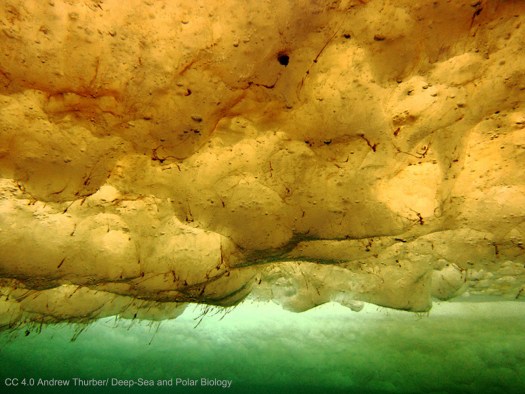
Have you ever wondered how animals that live near Earth’s North and South Poles survive? What do they eat, and how can any kind of food chain exist? The answer to this is ice algae.

Unlike most plants, algae do not have flowers, roots, stems, leaves, or vascular tissue. However, ice algae, like most plants, provide the starting point for a food chain. In this case, it is a food chain in very cold places. Tiny krill, penguins, seals, polar bears, and blue whales all depend on ice algae to survive. In 2016 Dr. Thomas Brown of the Scottish Association for Marine Science studied polar bears and found that 86% of the polar bears’ nutrition came from a food chain that originated with ice algae.

Ice algae have chlorophyll so they can use whatever light is available for photosynthesis. There are a variety of types of algae that live in different conditions. Some live on the surface of the ocean, some on the floor of the ocean, and some in or on the ice itself. Ice algae produce fatty acids which supply nutritional value for animals that live in what would otherwise be a nutritional void. Because there is ice algae, animal life is abundant under, in, and around the ice at both poles.

God has provided interesting food chains all over the planet. As we study global warming and its effect on life in places like the polar seas, we see more of His handiwork and learn why we need to take care of it. The admonition of Genesis 2:15 to “take care of the garden to dress it and keep it” applies as much to us today as it did to Adam and Eve.
–John N. Clayton © 2019

Data from National Wildlife, February/March 2019, pages 14-16.