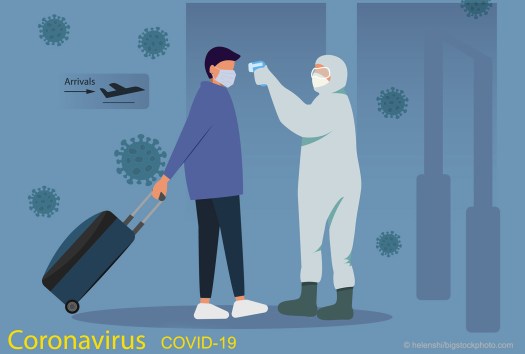
Viral Diseases and Christians

Coronavirus- Viral Diseases and Christians

Listening to the media, you might conclude that we have a new threat to our survival in the COVID-19 virus, but that is not the case. Viral diseases have been around from the earliest days of human existence. Recorded history tells us that in 430 BC, a virus took root in Athens and killed two-thirds of the city’s population. Seventy-five million people died from the Black Death in the 14th century. One hundred million people died from the Spanish flu of 1918, and 500 million people were infected. In modern times entire native populations have been wiped out by virus infections. We have all heard of HIV, MERS, SARS, Ebola, H5N1, Nipah, and Zika virus epidemics and their massive numbers of victims.

Scientists studying each of these diseases have determined that they came to humans from animals. HIV originated in chimpanzees. MERS came from camels. SARS originated from bats and civet cats. We can trace COVID-19 to bats and soldierfish. The massive concern about the current coronavirus is that there are far more humans to contract and spread the virus than at any time in the past. Also, we are more concentrated in cities, are more mobile, and have close interaction regularly with animals. In the past 50 years, more than 300 pathogens have emerged. With the use of more animals as pets and as food, there is an increase in the diseases they bring to humans.

From a historical standpoint, the biblical injunctions about hygiene and animal husbandry avoided much of the viral disease problem. The identification of clean and unclean animals reduced human interaction with animals that carry disease. The elaborate rituals of washing and handling animals used as food not only had an aesthetic appeal but reduced the opportunities for disease transmission. The acts of quarantine for anyone showing symptoms eliminated the spreading of disease from one person to another. Pandemics in an isolated farming population was not likely.

As the human population increased, and cities became population centers, the incidence rate of viral diseases increased. Advancing science and technology gave brought the ability to control some diseases. Selfishness, greed, carelessness, and poor hygiene provide easy ways for viruses to spread. Instead of following God’s rules for cleanliness and the preparation of food, humans have employed destructive methods. This is especially true in cultures that have no connection to God’s instructions. It is no accident that the coronavirus for COVID-19 originated in China and in a food market there where food handling and animal managing is limited. It is also no accident that many of the viruses that have decimated human populations were spread because of sexual practices that ignore God’s instructions for sexual relationships.

This virus is not a tool of punishment forged by God. There are good viruses and harmful viruses. Using the intelligence God gave us and following His commands, we can eventually eliminate the effects of the bad ones. Meanwhile, Christians can help those who are infected. We can also work to improve the lifestyles of our friends and neighbors to reduce the spread of viral diseases.

— John N. Clayton © 2020

Data from The Week, March 6, 2020, page 11.

Advancement of Euthanasia

Advancement of Euthanasia

One of the spin offs of the approval of abortion has been the advancement of euthanasia. In virtually every country that has approved abortion, there has been an eventual acceptance of euthanasia, allowing a doctor to administer fatal drugs to a patient.

Abortion was instituted in Portugal in 2007, and in February 2020, Portugal’s parliament approved euthanasia for terminally ill people. Portugal now joins six other countries in sanctioning euthanasia – Belgium, Canada, Colombia, Luxembourg, the Netherlands, and Switzerland. In the United States, medically assisted suicide is permitted in which patients administer the lethal drug themselves.

The issues involved in the advancement of euthanasia are very complex. No one wants a loved one to continue suffering when eventual recovery does not seem to be possible. I have a family member who is in that situation. Prostate and Bone cancer have progressed to brain cancer, and the burden to family caregivers, the expense, and the level of pain present are all huge issues. In the progress of the disease, who would decide to administer euthanasia? The patient may not be able to make it. Family members may not want the emotional strain of making the decision, and who would trust the decision to the state? Other factors include when did the patient realize they were going to die? How important is closure for those left behind, especially children? Can doctors be wrong about a terminal diagnosis?

First Corinthians 3:16-17 tells us that the Holy Spirit dwells in us. The context of that passage and others is that God uses His children to reach out through His Spirit to help others. Paul, in Philippians 1:20-30, talks about being ready to die. He wrote, “For I am in a strait between the two, having a desire to depart and to be with Christ which is far better. Nevertheless, to abide in the flesh is more needful for you.” He talks about how he can help others and, for that reason, wants to continue to live.

One of the banners carried by protesters in Portugal says, “Euthanasia doesn’t end suffering, it ends life.” That is so very true. It isn’t the end of suffering for family, for friends, for those you have tried to teach, for those considering their own lives. In this day, there is no reason for physical suffering because medical science has ways to stop the physical pain. Ending life prematurely will generate pain for others. How long will it be after euthanasia is accepted before the state will determine who should survive and who should be euthanized?

The fundamental factor in the advancement of euthanasia centers around the value of a human being. If we consider humans to be special and created in the image of God, then human life is sacrosanct. Animal life does not have that same image of God, and survival of the fittest is in control in the animal world. If humans are just animals, then killing a human is no more of a problem than killing a bug. In that case, inconvenient or unfit humans, like all other animals, can just be eliminated. This is not a trivial issue, but one that deserves thoughtful attention.

— John N. Clayton © 2020

Data from Associated Press, 2/21/20.

COVID-19 and the Origin of Disease

COVID-19 and the Origin of Disease

As I write this in Mid-February of 2020, over 2000 people have died from the coronavirus known as SARS-COV-2 or COVID-19. The cause of the virus has been the subject of many television shows, research papers, and religious rants. Scientific evidence concerning the virus is pretty clear, but the media has spread wild claims by nutritionists, religionists, and holistic practitioners that have misled many people. It is essential to separate the snake oil sellers from valid research and holistic claims from valid medical treatment. What is the origin of disease?

There are always religious extremists who will say that diseases like the Coronavirus are God’s punishment for sinful human beings. That claim violates the nature of God, and it is unsupported by the evidence. James 1:17 tells us that God is the giver of every “good and perfect” gift, and verse 13 clearly indicates that He does not tempt us with evil. Jesus never sent disease or punishment on any human being–not even Judas. By the same token, God does not prevent the natural consequences of sin or bad choices. Judas chose to destroy himself, but God did not strike him dead. It would be contrary to God’s nature to send a disease that would kill innocent people for any reason, and children and older adults are dying from this coronavirus.

So what is the origin of disease and the COVID-19 virus? Virtually all of the infectious diseases that humans experience are transmitted to humans from animals. HIV came into the human population from monkeys, and the SARs group of viruses came from animals. Many viral agents cause no problems for an animal, but when they are transmitted to humans, the virus runs wild and can kill. HIV causes no problems in monkeys, but when it gets into the human body, the result can be death. The coronavirus started in Wuhan, China, and appears to have begun in the Huanan Seafood Wholesale Market. Eating animals that are carrying the virus or keeping animals with the virus as pets make it easy for humans to become infected.

The Bible was written long before people understood bacteria, viruses, or the importance of personal hygiene. Despite that, it advised hygiene practices and ways of securing and preparing food that minimized the chance of epidemics like the one we are experiencing now. It appears that animals in China carried the virus, and due to Chinese diets and food preparation methods, it got a foothold in humans. COVID-19 creates an acute respiratory syndrome disease that quickly spreads from human to human and especially threatens people with weak respiratory systems.

The origin of disease is not a punishment from God. God did not send HIV to punish homosexuals, and He didn’t send COVID-19 to punish the Chinese for their government’s atheistic stance. At the same time, God’s love is demonstrated through His people. As everyone else is fleeing the Hubei province, Christian medical missionaries are moving in to provide help and treatment to those who are suffering.

— John N. Clayton © 2020

Data from Associated Press release 2/20/20.

Magnitude of Hate and the Love of Christ

Auschwitz Entrance - Magnitude of Hate and the Love of Christ

Jesus taught many unique ideas. Perhaps the most unique and astounding are his teachings about how to deal with those who differ from you. One of the major problems with atheistic evolution is the “survival of the fittest” motivation. That philosophy justifies acting superior to those who are different from you and destroying them because they are less fit than you. People have used that excuse to justify slavery. We have to contrast the magnitude of hate and the love of Christ.

When the liberation of Auschwitz occurred on January 27, 1945, (75 years ago), the world saw the result of “survival of the fittest” when applied to humans. It is hard to comprehend that Nazis murdered 1,100,000 people at Auschwitz during World War II. Russian liberators told of battle-hardened soldiers vomiting when they saw the magnitude of human tragedy in that Nazi death camp. Can you get your mind around over a million people being slaughtered in one human-controlled camp?

Try as we can to comprehend the magnitude of hate and the love of Christ, we find that His teachings are also beyond the ability of most people to understand. Consider the words of Jesus: “Love your enemies, bless them that curse you, do good to them that hate you, and pray for them which despitefully use you and persecute you” (Matthew 5:44). Jesus not only taught this radical concept, but he lived it. When Peter took out his sword and started to defend Jesus against those who would crucify him, Jesus not only told Peter to put the sword away but healed the man Peter had attacked. (See Matthew 26:51-54, Luke 22:49-51, and John 18:10-11.)

Sadly, people who claim to be Christians will leave the Bible behind and embrace “survival of the fittest” to justify doing violence to others. As the world veers away from faith in Christ, we can only anticipate more violence and more killings. The magnitude of hate and the love of Christ are in sharp contrast. The one thing that can change the trend is to reach out to the world with the teachings of Christ. I don’t mean what human tradition has done in the name of Christianity, but what Jesus actually taught.

— John N. Clayton © 2020

Whom or What Do You Worship?

Whom or What Do You Worship?

Whom or What Do You Worship? For many people, the immediate reaction is to say something like, “I don’t worship anything. I am a self-made person.” A more degrading answer might be, “Worship is for sissies, and I don’t need that junk.” Webster’s dictionary defines worship as “rendering of homage to something or someone” or “rendering religious reverence to something or someone.” Worship is not confined to an activity done in a church building. Some people worship nature, some worship an experience, others worship celestial objects or animals, or even their job or their mate. God doesn’t need our worship. Worship is for our benefit, not God’s.

From a biblical perspective, there is an easy answer to why we do these things. God created us in His image, and God is a Spirit (Genesis 1:26-27 and John 4:24). We all have a spiritual component which is a part of our makeup. Romans 8:16 tells us, “The Spirit himself bears witness with our spirit that we are children of God.” Atheists have this spiritual makeup, and they express it in their obsessions in life. I have known atheists who worshipped sex or their material possessions or an activity like fishing. They would render homage to the object of their worship that would shame any preacher.

What is unique about Christian worship is that it can be controlled and directed to productive uses. Jesus warned his followers to avoid worshiping “the traditions of the elders” (See Mark 7:1-8). Paul reflected on the same idea in Colossians 2:8 warning about making philosophy the object of one’s worship. He goes on in verses 16-23 about making religious rules an object of worship. In Romans 1:25, Paul talks about “worshipping the things made instead of the maker.” Thus we must ask, “Whom or what do you worship?”

How we express the spiritual drive that is built into all of us is essential and within our control. To establish meaningful worship, 1 Timothy 4:12-13 and Hebrews 10:24-25 encourage reading and learning. James 1:27 points out that pure religion and worship comes in meeting the needs of those less fortunate than ourselves. Our worship as Christians is not just a Sunday morning thing. Worship is a continual activity. Hebrews 13:15-16 talks about worship through voices. James 5:13 talks about personal prayer, and in Matthew 6:5-15, Jesus talks about private prayer worship as a part of daily life. Even giving is an act of worship, expressed in Hebrews 13:16, 2 Corinthians 9:7, and Acts 20:35.

Worship with the wrong attitude can be destructive, even for Churches. In 1 Corinthians 11:17-22, Paul says the worship of that congregation did more harm than good. Those with no relationship to God are likely to find whatever they worship is disappointing and unfulfilling. Learning to look to a higher power is widely recognized as a technique to help us find satisfaction and overcome problems in life. Ephesians 2:18 tells us that Christians have access to the Father. Worship in private and in corporate service can be a tool to bring us great satisfaction and solutions to the major problems of life.

Whom or what do you worship? Other worship alternatives don’t benefit the worshipper or anyone else in such profound ways as when we worship God.

— John N. Clayton © 2020

Jesus Christ an Agent of Change

Jesus Christ an Agent of Change for the New Year 2020

We are about to begin the third decade of the 21st century, and we can sum up the message of the century with the word “change.” We tend to fight change. I have an older friend who says that he has seen a lot of changes in America and he’s been opposed to every one of them. He is also an atheist. When I pointed out to him that Jesus Christ was an agent of change and Christianity is a religion of change, he asked me to explain that. Let me point out five reasons.

#1) The Bible we use is the NEW Testament. Jesus used that term repeatedly using the Greek word “kaimos” meaning new, fresh, recent. (See Matthew 26:28, Mark 14:24 and Luke 22:20).

#2) Newness means giving up old ways that either didn’t work or have quit working. Jesus Christ was an agent of change as He consistently gave new and better answers to old ways. In Mark 10:4, some Pharisees asked Jesus about the law of Moses, which allowed a man to divorce his wife for virtually any reason. This made women the property of their husbands. Jesus gave a new perspective on this whole issue by saying, “A man shall leave his father and mother and cleave to his wife and the two of them shall become one, so then they are not two but one. What, therefore, God has joined together, let no man tear asunder.” This is not a sexual reference, and it made women partners, not property, and radically changed the view of women to a new and critical role. (See Genesis 2:24.)

#3) Newness in Christianity knocked down old prejudices and racial issues, making the walls that divide people non-existent. Galatians 3:28 expresses this new concept beautifully, saying, “There is neither Jew nor Greek, there is neither bond nor free, there is neither male nor female for you are all one in Christ Jesus.” All of this newness was very hard for the religious and political establishment of Jesus’ day to accept, and it is still hard for many today.

#4) Newness involves changing. Christianity is not legalistic and is not run by a bunch of laws. Paul says it well in 2 Corinthians 3:6: “Christ has made us ministers of the New Testament, not of the letter, but of the Spirit: for the letter kills but the Spirit gives life.” Hebrews 10:20 talks about Christianity being a new a living way and Hebrews 8:8-12 puts to rest animal sacrifice and other ineffective practices of the past.

#5) Jesus Christ is an agent of change because He has given us a new commandment that replaces the old ways. John tells about it in 2 John 5. Over and over, Jesus talked about love in a way peculiar to Christ, using the Greek word “agapao to describe how the new way of life should function. All of Matthew 5 – 7 emphasizes this new way of living.

People rejected the newness that Jesus brought then, and people fight it now. The fact remains that Jesus Christ is an agent of change, and in Him, all things are made new. (See 2 Corinthians 5:17 and Ephesians 4:24.) As you celebrate the start of a new year, let us urge you to become a new person. Be born again and live in the newness that “looks for new heavens and a new earth” ( 2 Peter 3:13). Ultimately we look forward to the joy of having the best new existence that we can imagine. (See Revelation 21:4-5.) HAPPY NEW YEAR !!

— John N. Clayton © 2019

Playing God With DNA Doesn’t Work

Playing God With DNA Doesn't Work

One of the promises of modern genetics is that in the future, we will create “designer babies.” The idea is that if you produce a group of embryos and then look at the DNA of each of them, you can select which embryo you want to become your child. The other embryos would be destroyed. The process is called “preimplantation genetic diagnosis (PGD).” You might call it playing God with DNA.

With PGD, the embryos are created through in vitro fertilization. Technicians remove a single cell from each embryo and test it for single-gene variants which cause cystic fibrosis, Tay-Sachs, or other diseases. Many diseases such as diabetes may result from variants in hundreds or thousands of genes. The risk for heart disease may involve millions of gene variants.

Medical scientists are working to establish a polygenic score, which would indicate intelligence, height, and other traits by examining the DNA. They call these factors “enhancements.” The problem is that those traits may also be the result of multiple genetic variants. Playing God by trying to select the attributes for a “designer baby” can be not only immoral but dangerous.

A group of researchers published a study in the journal Cell on November 21, 2019, in which they attempted to learn how reliable polygenic scores would be for determining height or IQ. The research indicates that the DNA genetic predictions about those enhancements are unreliable and insignificant at best. Among other problems is that “differences in diet, lifestyle, exposure to pollution, culture, undiscovered genetic variants, and other unknown factors can influence how complex traits develop.”

The original use of polygenic scores was to help people know if a lethal or disruptive disease was a part of their heredity. Being able to repair the DNA or choosing not to have children is an option that would be useful to couples. Embryo selection for non-medical traits such as height, intelligence, or gender is a whole different question.

An article on this study in ScienceNews.org quoted Dr. Nicholas Katsanis, who is a human geneticist at the Lurie Children’s Hospital of Chicago. Dr. Katsanis said, “The idea that we’re going to do genetic screening for anything other than medically actionable items is the definition of eugenics. That we’re even contemplating this is disturbing.”

We agree that humans playing God in areas like this is immoral and likely to be disastrous at worst and disappointing at best.

— John N. Clayton © 2019

Earth’s Twilight and What It Means

Earth's Twilight

The part of Earth’s atmosphere we live in, fly airplanes in, and which contains over 90% of our oxygen is called the troposphere. It is much thinner than you may realize. Earth’s diameter is about 8,000 miles, and the thickness of the troposphere is much less than eight miles, making it one one-thousandth of the diameter of Earth. Our air is like an onion skin around our planet. Earth’s twilight daily reminds of the thin blanket that protects us.

You might wonder if the thin nature of our atmosphere is not a risk to us. The truth is that our troposphere is a uniquely designed structure, and if it were any different, life could not exist on this planet. The troposphere has to be…

…thin enough to allow enough light in for the photosynthetic processes of plants, but thick enough to burn up hunks of rock from space as they are pulled in by Earth’s gravity.

…thick enough to provide oxygen to breathe, but not so thick as to create pressures that would cause oxygen toxemia.

…thick enough to trap enough of the Sun’s heat to keep us warm, but thin enough to not overheat us.

…thick enough to refract and scatter dangerous radiation away from us, but thin enough to allow critical wavelengths to reach Earth’s surface for biological purposes.

…thick enough to allow water to exist as a liquid, but not so thick that other gases liquefy or dissolve in water,


These are just a sampling of the critical elements involved in the design of the troposphere. There are additional layers above the troposphere that do other things to support life on this planet. As science has examined the atmospheres of other planets within our solar system, we see that they are very different. The acid air and greenhouse effect of the atmosphere of Venus has turned it into a hellish environment. We do not have the ultraviolet light that bathes and sterilizes Mars because our ozone layer filters out much of that destructive component of the Sun’s light.

Each day as we watch Earth’s twilight come, we should be reminded of the incredible wisdom built into the structure of our atmosphere. As the sky turns from blue to a brief green, to yellow, to orange, and then red, we are seeing the longer wavelengths which we don’t see in the daylight because they are mixed in our atmosphere. Our air keeps X -rays away from our planet. Its density allows flight and keeps the lakes and oceans from evaporating. Its low density allows it to move and carry warmth and moisture from one area of our planet to another so that life can exist from the equator to the poles. Earth’s twilight is a daily reminder of the care and design built into our planet because of God’s love and wisdom.

— John N. Clayton © 2019

Seeker of Truth or Thomas the Doubter

Seeker of Truth or Thomas the Doubter

People often refer to him as “Doubting Thomas.” That label is inaccurate and unfair. Identifying the apostle as Thomas the doubter fails to understand his real nature. When Jesus’ life was in danger, it was Thomas who said, “Let us go die with Him” (John 11: 16). At that time, Thomas was the one full of commitment who was willing to die for his convictions about Jesus. One has to wonder why it was not Peter who was labeled as “the doubter” due to his triple denial of Christ. What we can learn from Thomas is how doubt can help a person to become a seeker of truth.

Doubt has to be confronted. When the other disciples came to Thomas with the outrageous claim that they had seen Jesus alive after his crucifixion, what do you think his reaction should have been? What would your response be? Many false Christs had risen in the world even in that day. There was good reason to question the claims. As a matter of fact, the first witnesses of Jesus’ resurrection were the women in Luke 24, and no one even among the apostles believed them.

The kind of doubt that Thomas had was a healthy skepticism. He did not back off, soft soap, or withdraw from the situation, but he openly and honestly expressed his doubt. Most people in today’s world do not explore their doubts. When they have doubts about God, Christ, the Church, or some doctrinal issue, they tend to bury their concerns. The load of unaddressed doubt can create physical illness, and it can kill us spiritually. Thomas the doubter shared his doubt with his fellow disciples and did not withdraw but became a seeker of truth.

In today’ s world, people who have doubts usually leave the Church. Keeping quiet and walking away seems like the easy way out, but it leads to stress, ignorance, isolation, and a failure to grow and mature in the faith. Thomas could have walked away. Instead, the Bible tells us that a week later, when the disciples were together, “Thomas was with them” (John 20:26). He continued to study, grow, and learn and did not discard the lessons and learning of the past.

Thomas maintained his relationships with his fellow disciples and was willing to respond to the evidence presented to him. I have often wondered if Thomas actually put his finger into the nail prints and the wound in Jesus’ side. Or was the fact that his search for evidence had been responded to enough to motivate him to say, “My Lord and my God!” Those words are not just an acceptance of evidence. They are a realization that the evidence he was seeing was going to change his life. The Bible does not tell us what happened to Thomas, but secular history says he went to India and died there teaching people in that area of the world about Jesus.

We do not know all that took place between the time that Thomas shared his doubts with his fellow disciples, and when Jesus appeared to him. It is difficult not to believe that the others tried to convince him. I think God gave us the story of Thomas the doubter and seeker of truth to let us know that doubt is a normal part of maturing as a Christian.

Unlike Thomas, we have multiple ways of resolving our doubts. Today we have evidence from history, science, scripture, and thousands of years of testimony. The purpose of the DOES GOD EXIST? ministry is to assist any seeker of truth in resolving their doubts. This website, as well as DoesGodExist.org and DoesGodExist.tv, are sources of help if you are a seeker of truth. We do not have all the answers, but sharing with others and learning from them goes a long way toward building dynamic faith.

— John N. Clayton © 2019

Atheist Experiments and Failures

Atheist Experiments and Failures

One of the least publicized aspects of atheism is the question of what has happened when atheist beliefs are incorporated on a practical level. In short, does atheism work when applied to the real world and real people? Some atheist experiments have tested that idea.

A good example is the story of Liberal, Missouri, which was founded in 1880 by an atheist named George Walser. Walser was a lawyer, and he bought 2000 acres of land in southwest Missouri to start an experimental community. He advertised across the country for atheists to come and live in a town without a church “where unbelievers could bring up their children without religious training.” He said in Liberal there would be “neither God, Hell, Church, nor Saloon.” Supporters of Walser published a boast that Liberal “is the only town of its size in the United States without a priest, preacher, church, saloon, God, Jesus, hell, or devil.”

Similar atheist experiments have been tried elsewhere, such as in France in the late 18th century. The government issued a declaration that God did not exist and condemned any public worship, including observance of any Sabbath. Atheist-based political systems exist today, including several communist states such as North Korea, and China.

In the case of Liberal, Missouri, the crime level, violence, and abuse became so bad that people left the town. They made written statements such as, “I’ll never live in another town that does not have a church.” Today Liberal has a population of less than 800, and there are five churches in town. Walser became a believer and wrote a book titled The Life and Teachings of Jesus. He called himself “a converted infidel who had searched for hope through materialism, atheism, agnosticism, and spiritualism, but found none.” Atheism fails all tests of practical application. Atheist experiments such as Liberal, Missouri are testimonies to what happens when God is excluded from human activities.

The Psalmist said it best “The fool has said in his heart ‘there is no God. Corrupt are they, and have done abominable iniquity: there is none that does good. God looked down from heaven upon the children of men, to see if there were any that did understand, that seek God. Every one of them is gone back: they are altogether become filthy; there is none that does good, no, not one.” Psalms 53:1-3.

As an atheist in my earlier days, I would have vociferously argued against that statement. Looking back at my life as an atheist and at the atheists who shared my belief system, I have to say the Psalmist was correct.

— John N. Clayton © 2019