DNA Barcodes Support Biblical Record

DNA Barcodes Support Biblical Record
Nearly every day the newspaper has an article that announces some new research on DNA. One of the recent applications of DNA research is to classify living things. Classification is an old issue, going back to Adam and Eve. In Genesis 2:19-20 God brought all kinds of living organisms before Adam so that he could name them. In 1 Kings 4:33 Solomon wrestled with the issue as well. Our current system of naming living things was brought into existence by Carl Linnaeus in the 1700s, but it is gradually being replaced by what is called DNA barcodes.

You can compare DNA barcodes to the barcodes we see when we shop for merchandise. Instead of bars, DNA barcodes are a string of DNA nucleotides. In 2003 scientists began to identify species by these nucleotides. Mitochondria are rod-shaped organelles that can be considered the power generators of the cell. They convert oxygen and nutrients into adenosine triphosphate (ATP), the chemical energy that powers the cell’s metabolic activities. There is one gene named cytochrome c oxidase subunit 1 (COX1) which is found in mitochondria. It is passed only from mother to offspring. The mixing of traits from the father and mother does not happen in this mitochondria, so the DNA nucleotides in mitochondria make it ideal to use in identifying species.

Studies by M.Y. Stoeckle and D.S. Thaler have involved analyzing the DNA barcodes from five million individual organisms which represent 100,000 different species. What they found was that barcode variations within a species vary by small amounts, and there are huge gaps between the species. What that means historically is that each species is essentially an island not connected to other species. If all species came from a common ancestor, you would not see this, but you would see a river from island to island.

The biblical record is very consistent in identifying the groupings of living things. In our materials, we have referred to these “islands” as being “trees in the forest of life.” First Corinthians 15:39 identifies these “islands” or “trees” in this way: “There is one kind of flesh of men, another flesh of beasts (mammals), another flesh of birds and another flesh of fish.” This same grouping is used consistently in the Bible with Genesis 1 & 2 in describing the creation of life, Genesis 7:14 describing what Noah took on the Ark, and 1 Kings 4:33.

There are many more trees or islands than the Bible describes, and they contain living things that may vary enormously. A major debate in science is whether the dinosaurs were birds or reptiles. DNA barcodes may answer that question, but the implications for the biblical record are not significant. The single “tree of evolution” which has been popular for a very long time does not fit the DNA bar code evidence, but the biblical system does. New research is leading to new understandings both scientifically and biblically. It is an exciting time to be alive and to learn from new scientific tools how accurate the biblical record is and how wise God has been in His creation techniques.
–John N. Clayton © 2019

For further information, go to this website: https://micro.magnet.fsu.edu/cells/mitochondria/mitochondria.html

Too Much Water on Earth?

Too Much Water on Earth?
“God goofed when He made so much water and so little land!” I recently heard a real estate salesman say that in a sales pitch to sell expensive lots. If you have taken a long intercontinental trip by plane or ship, you might tend to agree. Water covers roughly 75% of the surface of our planet. With our huge growth in human population, land suitable for human occupation is becoming scarce. Is there too much water on Earth? The answer to that question is a resounding “NO!!!” Every living cell depends on water, but the properties of water combined with its distribution and abundance cause its importance to go far beyond that fact.

Water is highly reflective. Ocean water reflects much of the light energy from the Sun back into space, so Earth’s surface does not become overheated. This is especially important because most of our surface water is in the Southern Hemisphere. When Earth’s orbit brings it closest to the Sun, the Southern Hemisphere faces the Sun. There is a massive potential for solar energy to overheat the land. Since most of Earth’s land area is in the Northern Hemisphere and most of the surface water is in the Southern Hemisphere, overheating doesn’t happen. This designed distribution of the land masses combined with the reflectivity of water protects us from overheating. We do not have too much water on Earth.

Water is a unique substance in terms of thermodynamic values. It is the standard frame of reference for specific heat and has a value of 1 calorie/gram. Water’s freezing and boiling points are zero and 100 degrees Celsius, which is a minimal difference in temperature compared to other substances. Water also has a high specific heat which means it can store the energy it absorbs better than other materials. Water’s heat of vaporization is 539.6 calories per gram, which is huge. The heat of vaporization is the amount of energy required to change water from the liquid state to the vapor state without changing its temperature. The capacity of water to store heat radically controls the climate. Water absorbs energy from the Sun and carries it in various ocean currents around the world. We don’t have too much water on Earth because it moderates the climates along all coasts of our planet. Planets and moons with no surface water experience violent storms and enormous variations in temperature.

Because water is a polar molecule, it can dissolve virtually all salts and many chemicals essential for life. The polar nature of the water molecule also allows it to be a condensation nucleus for the production of rain. As the oceans warm in tropical areas, the rate of water evaporation increases. As the water vapor cools, it needs something on which to condense. We all know that when the humidity is high, water condenses on our windows, our grass, and virtually any other exposed surface. To make rain, the water condenses on particles in the atmosphere. On land, the particles would be dust. Over the oceans, the particles are salt which is also a polar molecule and provides the ideal structure to make rain.

These simplified explanations should help us see that there is not too much water on Earth. We need all of that water to make life on Earth possible. Our climates, our movement of heat, the production of rain and snow, and the very formation of life itself all depend on water.

Genesis 1:2 tells us that God established water as one of the building blocks that allowed the Earth to support life. Verses 9-10 tell us that the “waters were gathered together into one place” and that those waters “were called seas, and God saw that it was good.” Proverbs 8:24 finds wisdom speaking of God’s creation. Wisdom tells us that water was created before there were mountains, hills, or dust. It has taken science thousands of years to understand why there is so much water. Today we now know that it is not only good, but it is vital to our existence.
–John N. Clayton © 2019

Ice Algae – Designed Polar Grass

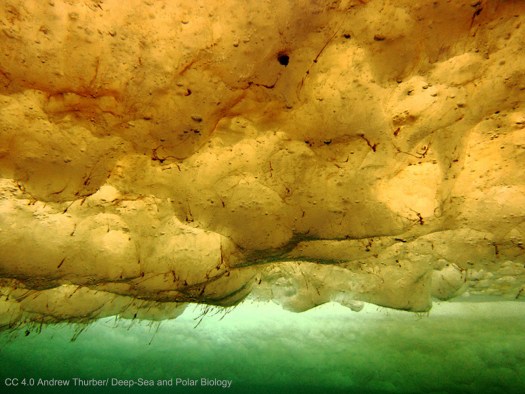
Ice Algae
Have you ever wondered how animals that live near Earth’s North and South Poles survive? What do they eat, and how can any kind of food chain exist? The answer to this is ice algae.

Unlike most plants, algae do not have flowers, roots, stems, leaves, or vascular tissue. However, ice algae, like most plants, provide the starting point for a food chain. In this case, it is a food chain in very cold places. Tiny krill, penguins, seals, polar bears, and blue whales all depend on ice algae to survive. In 2016 Dr. Thomas Brown of the Scottish Association for Marine Science studied polar bears and found that 86% of the polar bears’ nutrition came from a food chain that originated with ice algae.

Ice algae have chlorophyll so they can use whatever light is available for photosynthesis. There are a variety of types of algae that live in different conditions. Some live on the surface of the ocean, some on the floor of the ocean, and some in or on the ice itself. Ice algae produce fatty acids which supply nutritional value for animals that live in what would otherwise be a nutritional void. Because there is ice algae, animal life is abundant under, in, and around the ice at both poles.

God has provided interesting food chains all over the planet. As we study global warming and its effect on life in places like the polar seas, we see more of His handiwork and learn why we need to take care of it. The admonition of Genesis 2:15 to “take care of the garden to dress it and keep it” applies as much to us today as it did to Adam and Eve.
–John N. Clayton © 2019

Data from National Wildlife, February/March 2019, pages 14-16.


Holy Kiss Greeting Benefits

Holy Kiss Hugging
On at least five occasions the Bible encourages Christians to greet one another with a holy kiss. (See Romans 16:16, 1 Corinthians 16:20, 2 Corinthians 13:12, 1 Thessalonians 5:26 and 1 Peter 5:14.)

The Greek word used for kiss here is “philema.” It refers to a token of friendship as opposed to a kiss with sexual purposes. The holy kiss was a standard greeting in the world of Jesus’ day, but other greetings and salutations have the same emotional effect.

Some people think that a kiss or a hug is a way to spread cold germs from one person to another. The Carnegie Mellon Institute has been conducting studies as to the collateral effects of a kiss or a hug. They are seeking to learn what physiological or psychological value there might be. They concluded that this activity protects the participants from a common cold by alleviating stress and by bolstering the immune system. Carnegie Mellon Institute’s Michael Murphy reported the results of the study. He said, “A warm hug on the same day as an argument can boost positive feelings and reduce bad ones.”

Most of the things God calls us to do as we interact with each other have a practical value in dealing with life. Read the Sermon on the Mount in Matthew 5-7 if you want to see more ways to make life better. A holy kiss or a hug should be easy, but the things Jesus presented in the Sermon on the Mount are much more difficult.
–John N. Clayton © 2019

Reference: Saturday Evening Post, January/February 2019, page 67.

Another Blood Moon

Another Blood Moon
This past Sunday night the Western Hemisphere experienced another blood moon. We often hear the phrase “blood moon” applied to total lunar eclipses. That’s because the Moon takes on an orange or red glow when the eclipse becomes total. It has nothing to do with blood and nothing to do with Bible prophecy. Lunar eclipses are natural phenomena which occur when the Sun, Moon, and Earth are in perfect alignment. Earth’s shadow falls across the Moon and gives it an eerie, orange glow.

I took this picture at about midnight local time when the temperature was hovering close to zero degrees Fahrenheit. Because of the cold, I didn’t get a good focus and didn’t stay outside very long. Numerous other people took better photos and posted them on the web. They all look similar since we were all seeing the same view. Our Moon always keeps the same face toward us. Some people refer to the back side of the Moon as “the dark side of the Moon.” However, there is no dark side. The Sun shines on the back side each time the monthly “new moon” occurs. The Moon is in tidal lock with Earth keeping the same side facing us year-round.

For those of us who live in North America, this will be the last total lunar eclipse for a while. We will not see another blood moon until May 16, 2022. (Asia, Australia, and the Pacific will see another blood moon on May 26, 2021.) Perhaps this will give us a little break from those who try to convince us that lunar eclipses are a prophetic sign. The only sign we see in total lunar eclipses is that the solar system God created is still working in the way He designed it to work. Days, months, seasons, and years (Genesis 1:14) continue as they will until God decides it is time to bring this present world to a close. And nobody knows when that will be.

Last July we posted an explanation of why the red color and what causes lunar eclipses. We encourage you to read that post by clicking HERE.
–Roland Earnst © 2019

Are Science and Faith Enemies?

Are Science and Faith Enemies?
Fifty-nine percent of the American public says that science and religion are often in conflict according to Pew Research in a survey conducted in 2015. Are science and faith enemies?

The report said that “Some 73% of adults who seldom or never attend religious services say science and religion are often in conflict, while half of adults who attend religious services at least weekly say the same.” The interesting thing is that just half of adults who attend religious services at least weekly say science and religion are often in conflict. Apparently, the people who are not religious see a conflict between science and faith more than religious people do. Perhaps that is the reason they reject faith in God. They have been told that science rules out the possibility that God exists. That is not true.

The point of the DOES GOD EXIST? program is to show that science and faith are friends, not enemies. The problem is that both believers and unbelievers would rather throw stones than resolve issues. Both sides have become entrenched in their own doctrines and refuse to follow the facts wherever they lead. There are Christians who build museums and insist that the universe cannot possibly be more than 10,000 (or even 6,000) years old. Some scientists write best-selling books saying that the existence of God has been disproven by evolution. Both cannot be right. However, but both could be wrong.

Are science and faith enemies? We say, “Absolutely not!” We suggest that the supposed conflicts between science and faith in God (and the Bible) have often been caused by bad science, or bad theology, or both. There has been a lot of both.
–Roland Earnst © 2019

Reference: http://www.pewresearch.org/fact-tank/2015/10/22/5-facts-about-the-interplay-between-religion-and-science/

Surrogate Motherhood and Abortion Find Common Ground

Surrogate Motherhood and Abortion vs Loving Family
Surrogate motherhood is becoming more common. In a surrogacy contract, a woman agrees to allow someone to rent her body to have their child. The parents do that because of an issue that the mother cannot carry the baby, or because they just don’t want to go through the inconvenience of a pregnancy and birth. We have read of movie actresses who do this to avoid having to be off screen for 9 ½ months. Some fertility specialists are selling surrogacy as a part of their offering.

The January/February 2019 issue of Citizen magazine (page 13-15) reported the case of a surrogacy contract running into difficulty. The surrogate mother had agreed to deliver twins–a boy and a girl. A male embryo and a female embryo were implanted into her body. At that point, complications arose. The female embryo failed to implant, and the male embryo split into male twins. The surrogate mother developed pre-eclampsia, and her organs began to shut down forcing delivery of the baby boys ten weeks early. This caused the boys to battle for their lives in the hospital’s neonatal intensive care unit. The couple who had paid to have a boy and a girl became hostile because they weren’t getting what they had paid for. The couple were not interested in the boys, but the surrogate mother bonded with the twins. When they were placed in the neonatal unit, she was left “with a deep sense of emptiness, anxiety, and regret.” She is now advocating for a ban on surrogate motherhood.

The Supreme Court has refused to hear two cases on surrogacy issues. In both cases, the surrogate mothers wanted to keep the children. In one case the woman was carrying triplets for a single man who wished to abort at least one due to financial concerns. The other was a mother who learned that the couple she was working for had strong racial prejudices. In both cases, the surrogates lost. There are no national laws that deal with surrogacy, and every state is different. A documentary last fall titled “Big Fertility: It’s All About the Money” pointed out that the practice of surrogate motherhood exploits low-income women and families. We would suggest that surrogacy is wrong on a moral basis.

Like some other modern issues, the Bible doesn’t address surrogacy. The fact that the Bible does not condemn something doesn’t mean we can’t judge whether it is compatible with God’s will. The connection between mother and child during the pregnancy is unique. As the parent of three adopted children, I can tell you that the love we have as a family is massive. However, the relationship between my wife and my two girls was not the same as their relationship with their children born naturally. Data shows that babies bond with their birth mothers during the pregnancy.

Abortion advocates maintain that a baby is merely an extension of the mother’s body. So she has the right to exterminate the baby because it is just an unwanted part of her body. Surrogate motherhood assumes that the baby is a singular physical entity that can be engaged or terminated at the will of the adults involved, for any reason.

The Bible tells us that humans are uniquely created in the image of God. The baby possesses a soul and is fully human. Luke 1:41-44 tells us that when Elizabeth saw Mary who was pregnant with Jesus, the unborn John leaped for joy in Elizabeth’s womb. The significance of motherhood is emphasized all through the Bible. Paul wrote in 1 Timothy 2:15 that women “shall be saved in childbearing.” That doesn’t mean that women must have babies to be saved, but that the role of being a mother is sacred and unique.
–John N. Clayton © 2019

James Watson’s Racial Remarks

James Watson's Racial Remarks
One of the most famous scientists in recent history is James Watson. Watson along with Francis Crick discovered the double-helix structure of DNA, and they received a Nobel Prize for their work. Even though he is 90 years old, Watson has been highly sought after as a speaker. James Watson’s racial remarks have changed things.

In early January of 2019, Watson was interviewed in a PBS documentary titled “American Masters: Decoding Genetics.” In that interview, he said that “genes are responsible for inferior intelligence among blacks.” There are so many problems with this claim that it is hard to know where to start. There are valuable lessons to be learned as well.

The claim that blacks have inferior intelligence is a very ignorant statement. I have a degree in psychometry which is the study of tests and how they are constructed and used. I.Q. tests are loaded with cultural bias, and there are many different types of I.Q. In my early days working under David Segal at Indiana University, I studied the Stanford-Benet I.Q. test and the Otis I.Q. test. As a personal demonstration of the problems with I.Q., my foster son Tim would consistently score 40-50 on the Stanford-Benet test, and yet he would score 90-100 on the Otis. The Otis was a test based on verbal skills. Because we read to Tim regularly during his childhood years, he had average verbal skills. The Stanford-Benet was not verbal but was based on reasoning. Tim was and is mentally challenged in those areas.

Many blacks do score lower on I.Q. tests that were written by upper-class whites in New England. On an I.Q. test written by a black author raised in a profoundly racist geographic area, blacks have better scores than whites. Unbiased testing does not support Watson’s assumption that blacks have inferior intelligence.

Another issue is that there are different kinds of intelligence. Koko, the gorilla trained by Penny Patterson, could use the sign language of the deaf. His I.Q. score was in the 90s, close to normal human values, on a test that measured literary capability. On a test that measured scientific reasoning, the scores were far lower. That test measured a different kind of intelligence.

Because of James Watson’s racial remarks, the laboratory he once led stripped him of honorary titles. The Cold Spring Harbor Laboratory immediately printed a statement saying Watson’s comments were “reprehensible and completely without a scientific basis and were a misuse of science to justify prejudice.”

The Bible describes humans as created in the image of God, and condemns all attempts to separate humans on any criteria. “There is neither Jew nor Greek, there is neither bond nor free, there is neither male nor female, for we are all one in Christ Jesus” (Galatians 3:28). Because a man is an expert in one field of study does not mean his opinions should be held superior to others. Watson is an expert on DNA. He is not an expert on racial origins or how our understanding of the function of DNA impacts areas as nebulous as intelligence. James Watson’s racial remarks make that clear.
–John N. Clayton © 2019

German Religious Tax

German Religious Tax
In Germany, when you fill out your tax forms for 2019, you are required to mark what religion you belong to. The state then collects a tax which is about 9% of the person’s income tax and distributes the money to the relevant church or synagogue. If you refuse the German religious tax, you will be denied access to church schools or day care centers, and you can even be denied communion or burial services.

The problem with this arrangement is that many religious groups do not register as public corporations, and groups such as Islam or the Church of Christ don’t have a national church system. The founder of a liberal mosque in Berlin, Seyran Ates, wants to establish a “democratic Islamic Council” but conservative Muslims want no part of such an idea. Groups like the Church of Christ which do not have a national board or assembly are opposed to any solution on very much the same idea.

The German religious tax is not biblical. Jesus told His followers to render to Caesar the things that are Caesar’s and to God the things that are God’s (Matthew 22:21). However, the Bible also makes giving a personal decision that is between the giver and God (2 Corinthians 9:7). When those guidelines are not followed, the chaos that results will eventually destroy religious freedom.
–John N. Clayton © 2019

Amoeba Can Solve TSP

Amoeba Can Solve TSP
A famous challenge in computer science is called “The Traveling Salesman Problem,” or TSP for sort. Scientists in Tokyo have found that a one-celled amoeba can solve TSP.

The problem goes like this:
Suppose you are a traveling salesperson going from city to city to sell your goods. You want to maximize your efficiency to make as much money in as little time as possible. You want to find the shortest path that will let you hit every city on your route one time and return you to the starting point.

There is no simple mathematical formula to find the best route. The only way to solve the problem is to calculate the length of each possible route and see which is the shortest. The problem gets exponentially harder as more cities are added to the route. With four cities there are only three different routes to consider, but with six cities there are 360 different routes. If you had ten cities or more, the number of routes could be in the millions. With an increase in the number of cities, the number of routes increases logarithmically.

The traveling salesman problem is one of a broad class of problems computer scientists call “NP-hard.” (NP stands for nondeterministic polynomial time. People involved in hacking encrypted systems and mining cryptocurrency are interested in this sort of problem.)

At Keio University in Tokyo, scientists have discovered that an amoeba can solve TSP, with the help of some human ingenuity. They used a single-cell slime mold amoeba known as Physarum polycephalum which moves toward food and away from light. The scientists built a chamber filled with channels and placed some food at the end of each channel. The channels represent a city on the salesman’s route. The amoeba would extend tendrils into the channels to get the food. As it reached the food, a light would go on in that channel so that the amoeba would not go back to the same “city.”

The advantage is that that the amoeba doesn’t have to calculate every individual path as most computer algorithms do. Instead, the amoeba just reacts passively to the conditions and figures out the best possible arrangement by itself. What this means is that for the amoeba, adding more cities (channels) only increases the time linearly rather than logarithmically.

The lead study author Masashi Aono said, “The mechanism by which the amoeba maintains the quality of the approximate solution, that is, the short route length, remains a mystery.” If researchers can figure out how the amoeba can solve TSP, it could speed up our ability to solve all kinds of challenging computational problems.

This design feature in one of God’s simplest creatures is another demonstration of how we can know there is a God through the things He has made” (Romans 1:19-23).
–John N. Clayton and Roland Earnst © 2019

Reference- https://www.sciencealert.com/an-amoeba-has-solved-an-exponentially-complex-problem-in-linear-time