Apologetics Is Not Apologizing For Faith

Apologetics Is Not Apologizing For Faith

In his book “On Guard,” William Lane Craig tells about a remark a woman made to him when she learned he teaches Christian apologetics. She remarked indignantly, “I’ll never apologize for my faith.” I have had similar experiences several times. In a society where we see a significant denial of God’s existence and the credibility of the Bible, apologetics is not apologizing for our faith.

The word” apologetics” may sound like “to apologize,” but it is not telling someone you are sorry that you are a Christian. “Apologetics” comes from the Greek word apologia, which means defense, as in a court of law. Craig says that Christian apologetics involves making a case for the truth of the Christian faith.

Many Christian preachers and Church members feel that there is no reason to be involved in apologetics. In their view, giving evidence in apologetics weakens faith. “If you have faith, you don’t need evidence” is a statement I frequently hear. The fact is that the Bible account shows that Christ and the apostles used apologetics. Examples of Jesus using evidence are when He appealed to miracles and fulfilled prophecy to prove that what He said was true. Read Luke 24:25-27 and John 14:11 to see this. When Jesus dealt with “Doubting Thomas,” His method was to show him the evidence.

When Peter gave his sermon in Acts 2, he appealed to the miracles of Christ in verse 22. In verses 25-31, he appealed to fulfilled prophecy, followed in verse 32 by using the resurrection of Christ. The apostles showed that apologetics is not apologizing when they used the handiwork of God to prove His existence (Acts 14:17). Romans 1:20 finds Paul referring to the evidence seen in the natural world. Paul also used eyewitness testimony of the resurrection of Christ in 1 Corinthians 15:3-8.

The world has entered what scholars are calling “the post-Christian era.” As a result, Christianity is becoming a minority belief system worldwide. In Europe, the number of Christians compared to the general population is very small – estimated to be under 25% and going down. In the United States, statistics show it is under 40%.

Apologetics is not apologizing, and the need for it is massive. This apologetics ministry believes that science is a tool to show the nature and actions of God and is not an enemy of faith. That message is biblical and logical. It is the purpose of this website. We hope you will see the need for apologetics in today’s society.

— John N. Clayton © 2022

Evolution Has Multiple Meanings

Evolution Has Multiple Meanings

Yesterday, I mentioned that I sometimes get people to think by saying that I believe in evolution. For some, the word only brings to mind the concept of “man from monkey.” However, evolution has multiple meanings. We looked at three of them yesterday, and none of the definitions say anything about the existence of God. So here are two more evolution concepts.

#4. MICROEVOLUTIONARY CHANGE. These are changes in a biological population over time, usually in response to environmental factors. We see this in viruses evolving to become resistant to drugs. Humans have created new breeds of dogs and cattle through microevolution. In the Bible, Jacob used microevolution in dealing with Laban’s flocks. (See Genesis 30:31-42.) Microevolution, change within a species, is the basis of modern agriculture.

#5. MACROEVOLUTION. This is a process of change from common descent. The key word is “process” and describes how, over time, it can lead to a new species. In microbiology, a microbe may get its DNA mixed up with the DNA of another microbe and produce a new species. Farmers in California can tell you about insects that evolved with the ability to cause damage to crops. Some plants have changed to the point where they are no longer fertile with the original plant from which they came. Fish have also speciated.

Is macroevolution a tool God uses to produce the massive numbers of new species in the world today? To suggest that macroevolution happens only by chance requires more faith than believing that God built a system allowing new plants and animals to exist on a changing Earth.

So, we see that evolution has multiple meanings. But, no matter what definition we use, it simply describes how God has operated and continues to operate. So, when I say that I believe in evolution, you must know what I mean by that. As we noted yesterday, everyone believes in some form of evolution, but that does not disprove God’s existence.

— John N. Clayton © 2022

I Believe in Evolution

I Believe in Evolution

I have, on occasion, made the statement that I believe in evolution. My purpose for saying that is to get people to think. What does “evolution” mean? For many people, the statement means “man from monkey,” and that is as far as they go. There are at least five ways in which people use the word” evolution.” None of them have anything to do with the existence of God. Think about the ways people use the word “evolution.”

#1. ANY CHANGE OVER TIME. We talk about stars evolving from blue hot stars to red dwarfs. We speak about an athletic program evolving. This is simply change over time and has no relevance to our faith.

#2. CULTURAL EVOLUTION. A cultural group may change radically over time due to many things. America has evolved from a country made mostly of immigrants to a country made of people born in this country. Our nation has evolved, and even our vocabulary recognizes this. When I was a kid, America was perceived as a “melting pot” where we could all be one and leave our ethnicity behind. That has evolved into a pluralistic society where people determine their ancestry and try to retain it. That evolution has brought enormous political implications,

#3. PROGRESSIVE EVOLUTIONARY REVELATION. Our understanding of the atom has evolved in my lifetime. My chemistry class in high school and college taught me that the atom had a nucleus with electrons orbiting it in concentric circles around that core. Now, when I teach chemistry, I talk about orbitals and electrons moving in figure eights and cloverleaf patterns in various numbers. Knowledge can change understanding, and that is evolutionary revelation. The Bible uses evolutionary revelation, with the Old Testament introducing the nature and operation of God and progressively revealing the nature of Jesus Christ and the future of believers.

So, when I say that I believe in evolution, you must know what I mean by that. If anyone says they do or don’t believe in evolution, ask them to define what they mean by “evolution.” The truth is that everyone believes in some form of evolution. Tomorrow, we will look at the two remaining primary uses of the word.

— John N. Clayton © 2022

Attitude Toward the Existence of God

Attitude Toward the Existence of God

One of our readers sent us a quote that contains a great piece of advice we want to share with you. The statement was made by preacher and author Chuck Swindall. It has been quoted many times on the internet and elsewhere, but we see it as relating to a person’s attitude toward the existence of God:

“The longer I live, the more I realize the impact of attitude on life. Attitude, to me, is more important than facts. It is more important than the past, than education, than money, than circumstances, than failures, than successes, than what other people think or say or do. It is more important than appearance, giftedness or skill. It will make or break a company…a church…a home. The remarkable thing is we have a choice every day regarding the attitude we will embrace for that day. We cannot change our past…We cannot change the fact that people will act in a certain way. We cannot change the inevitable. The only thing we do is play on the one string we have, and that is our attitude….I am convinced that life is 10 percent what happens to me and 90 percent how to react to it. And so it is with you. We are in charge of our attitudes.”

As Jesus talked to the people of His day, He frequently said, “how do you think” or “what do you think.” He wanted them to look at what they believed and why. The parable Jesus told of the Pharisee and the Tax Collector in Luke 18:9-14 dealt specifically with attitude and how it affects how we think and act. A person’s attitude toward the existence of God determines whether or not they are willing to examine the evidence. Furthermore, believing in God’s existence and accepting His love through Jesus Christ can change our attitude toward others and toward life itself. How is your attitude?

Faith and Evidence Go Together

Faith and Evidence Go Together

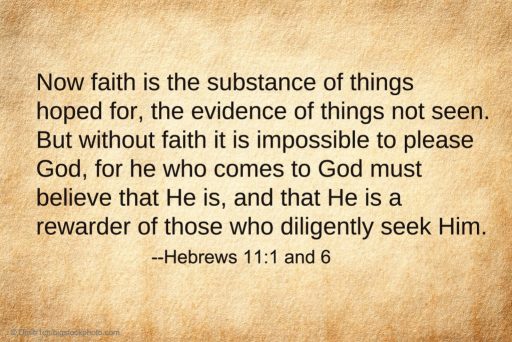
We get mail from people who suggest that if you accept science and evidence, you have demeaned God. “You just have to have faith,” one person wrote, “and saying that you need evidence devalues God.” I take strong exception to this claim on many levels, but my main objections are that it contradicts the Bible and eliminates evangelism in today’s world. Hebrews 11, “the faith chapter,” describes the faith of heroes of the Old Testament, including Abel, Enoch, Noah, Abraham, Sarah, Isaac, Jacob, Joseph, Moses, and Rahab. Let’s consider the connection between their faith and evidence.

For example, how did Moses get his faith? Did he come out of a vacuum and just have faith? Remember that his mother raised him and taught him about his people. What about the evidence of the burning bush and the staff that became a snake? Remember his discussions with God that gave him the courage to confront Pharaoh. What about the plagues in Egypt, the crossing of the Red Sea, the brass serpent, and receiving the Ten Commandments on Mount Sinai? Were those not evidence?

Also, read the story of Abraham and notice how many times God reassured him and how much evidence he saw before that near-sacrifice of Isaac. Using Hebrews 11 to justify violating the teachings of the New Testament is not only unwise, but it is also a violation of the teachings of the apostles. Faith and evidence are closely tied together in the New Testament.

For example, 1 Peter 3:15 tells Christians to “be ready to give an answer for the hope that is within us to anyone who asks.” Romans 1:20 tells us we can “know there is a God through the things He has made.” Jesus set the example with Thomas, who at one time had been the strongest of the apostles (See John 11:16) but saw his faith collapse at the death of Christ. How did Jesus deal with this incredible failing in Thomas? Did He condemn him or cast him off as a weakling? Read John 20:24-29 and see how Jesus encouraged Thomas to examine the evidence.

Someone might refer to Acts 2-3, where people, in less than a day, gave their lives to God.
Realize that God had been preparing that “soil” for thousands of years, and Jesus had been planting and nurturing it for three years. Today the voices of atheism, agnosticism, skepticism, materialism, and paganism are louder than ever. We cannot withdraw into our cocoon of church buildings and not do what God has called us to do.

Read Acts 17 and see how Paul dealt with the philosophers and skeptics of his day. He didn’t call them to blind faith. Instead, he gave them evidence of “the God in whom we live and move and have our being.” Faith and evidence go together. We must use evidence as Jesus and the Apostles did, or our numbers will continue to shrink as we lose our children and grandchildren to Satan.

— John N. Clayton © 2022

Cryonic Eternal Life

Cryonic Eternal Life

One of the byproducts of naturalism is the desire to achieve immortality. If you believe this life is all there is to your existence, the logical thing is to try to make this life eternal. One way to do that could be to have your body frozen when you die until science can find a way to make you live forever. Organizations such as the Cryonics Institute in Michigan are offering cryonic eternal life.

When you pay the fee for cryonic eternal life, technicians will prepare your body. When you are declared dead, technicians cool the body with ice water and keep the tissues oxygenated using CPR and an oxygen mask. Then, they fly the iced body to a laboratory and connect it to a heart-lung bypass machine that circulates the blood. Next, they pump in a solution to act as an antifreeze to prevent cell tissues from being destroyed by ice crystals. Finally, they cool the body to minus 320 degrees F in a tank of liquid nitrogen.

The idea is that when medical science advances and finds a cure for whatever caused the person’s death, they can revive the body, reverse the aging process, and give the person another shot at life. This is obviously a very theoretical idea. However, Shannon Tessier, a cryobiologist at Harvard University, points out that when scientists attempt to freeze a sample of human tissue, “the tissue is completely obliterated, the cell membrane is completely destroyed.”

Atheists have responded to our material by saying that they are going to be cryonically treated at death so they can live forever. However, it is obvious that the technology to make that possible is a very long way off and probably will never happen. More to the point, the only reason to do this would be a desperate attempt by people opposed to God’s plan to bypass the biblical injunction “it is appointed unto men once to die, but after this the judgment” (Hebrews 9:27).

Even if the proposed ideal of cryonic eternal life became real, think of the problems it would cause. Population issues would be astronomical, and all of the limitations placed upon us by our physical situation would still be present. How much greater would it be to accept a better eternal existence that God offers for free through Jesus Christ.

— John N. Clayton © 2022

Reference: Discover magazine March/April 2022, page10.

What Does Your Faith Do For You?

What Does Your Faith Do For You?

No matter who you are, you live your life based on faith. I don’t mean just religious faith, but belief in things that are the foundation of how you live and make decisions. We must determine whether that faith is justified no matter what we put our faith in. So what does your faith do for you?

In our age, many people have rejected faith in God, but what has replaced that faith? The longer I live, the more times I have found my faith in something or someone was not justified. People I have had faith in have let me down. When the object of their faith crashes, including stock markets and marriages, some people take their own lives.

We all must ask if the things we have faith in relieve our fearfulness. It is hard not to be fearful when we see the political chaos in America and war in the world. If we have faith in the dollar, the effect of inflation can challenge that faith. Faith in a person can sometimes be ill-advised because people are prone to failure. Sometimes a marriage ends in divorce because faith in a person’s mate is destroyed by behaviors.

What does your faith do for you? The history of Israel was disastrous, and Deuteronomy 32:16-20 indicates it was because they failed to have faith in God. Jesus talked about the power of faith in Matthew 17:16-20 when He said that faith the size of a tiny seed could move the mountains we face in life. In Mark 4:34-41, when Jesus calmed the sea, He asked His followers why they were fearful. “How is it that you have no faith?” He asked.

If we base our faith on people or emotions, we are likely to fail. Instead, we must build our faith on evidence. A study of Thomas’ faith in John 11:16 and 20:24-28 shows that he based his faith on evidence. The purpose of this site is to help searchers find faith. I don’t mean just emotional faith but faith based on the evidence of God’s creation and design in all aspects of life.

No philosophy or belief system other than Christianity can produce stability in life and the ability to do things you never thought would be possible. Hebrews 11 gives us a picture of the role faith played in the lives of biblical people. Let me ask, “What do you place your faith in, and what does your faith do for you?”

— John N. Clayton © 2022

Teachings of Mohammad and Jesus Christ

Teachings of Mohammad and Jesus Christ - Bible and Quran

One of the ongoing struggles in the world today is the conflict between the followers of Mohammad and the followers of Jesus Christ. When science forced me to realize there is a God, I had no compelling reason to believe that the God who created time, space, and matter/energy was the God of the Bible. Looking for answers, I examined the teachings of Mohammad and Jesus Christ.

I got a copy of the Koran translated into English by N. J. Dawood, a Muslim, and published by Penguin classics. My Muslim friends have told me that no English translation is valid, but recent events in Pakistan have shown that my reading was the same as the mobs in Pakistan.

In addition to some scientific errors, the Koran has teachings that denigrate women. (See Women 4:34 and the Confederate Tribes 33:51-52.) It also commands violence. For example, The Spoils 8:37-41 commands Muslims to “make war on the Christians and Jews.” In Repentance 9:4-7, 9:14, and 9:122-125, Mohammad says to “make war on the Christians and Jews who dwell among you.” Let me hasten to say that my Muslim acquaintances are as disturbed as I am with these teachings and would never participate in them. The problem is with the teachings of Mohammad, not what all Muslims do.

However, recent events in Pakistan have shown that Muslims in that part of the world follow those teachings of Mohammad. On February 14, 2022, the Associated Press reported that a mob stoned a man named Mushtaq Ahmed, whom the accused of burning a Koran. When police tried to intervene, they were stoned and injured, and Amed was killed.

In a separate incident, a couple with four children in Punjab, Pakistan, were accused of sending written text messages criticizing Mohammad. Neither of them can read or write, but the mob tortured the husband and threatened his wife with sexual assault. They put the couple in prison for seven years and gave their four children to relatives.

As a man convinced that God exists, I could not embrace a book that taught things I knew were destructive and untrue. When I read the teachings of Jesus Christ, I saw a plea for peace, love, and non-violence. He elevated women and refused to return evil for evil. I saw the striking contrast between the teachings of Mohammad and Jesus Christ.

If you have doubts about the teachings of Christ and Mohammad, I would encourage you to get a copy of the Koran and read all of it. Then read Matthew through at least chapter seven. Compare the teachings of Mohammad and Jesus Christ. I am thankful that most Muslims I know do not accept Mohammad’s call for violence, his embracing of polygamy, or the abuse of women. Although there are many good things in the Koran, it also calls for a cultural dependence on violence and servitude. It fails to deal with what can change the world and make it a better place.

We have a chart listing difficult passages in the Koran, which you can read or download HERE.

— John N. Clayton © 2022

Reference: Associated Press for 2/14/22 reported in the South Bend Tribune, page 8 A.

Some Form Of Life Can Exist Anywhere?

Some Form Of Life Can Exist Anywhere?
Mount Shackleton in Antarctica

We read the media reports about efforts to find life on Mars, on various moons in our solar system, or planets orbiting other stars in our galaxy. These reports often give the impression that some form of life can exist anywhere we look in the cosmos. For example, on Earth, we find life in sea vents on the ocean floor and geysers in Yellowstone National Park, leading people to suggest that some form of life can exist anywhere. Add to that the presence of organic molecules in asteroids, and they say that life is out there if we just look in the right places and in the right way.

Journal of Geophysical Research Biogeosciences published a study of 204 soil samples taken from mountains near the Shackleton Glacier in Antarctica. Scientists had predicted that this soil would contain microbes, as is true of soil samples all over the Earth. Instead, they found that 20% of the soil samples, those taken from the higher and dryer locations, had no detectable microbial life. The study seems to indicate that extreme cold and dry conditions can render an area devoid of life. Noah Fierer, one of the scientists involved with the study, said that this might be the first time scientists have found soils that did not support microbial life anywhere on Earth.

The idea that some form of life can exist anywhere in every kind of environment is an evolutionary assumption that is apparently incorrect. We know that extreme cold and dry conditions exist on Mars and many moons in our solar system. Assuming there is life elsewhere because it is so abundant on Earth and some bacteria do well in extreme conditions does not mean there is no limit to where life can exist. 

We have said many times that there might be life elsewhere in the cosmos, but if there is, God created it. This is not a biblical or apologetic issue, but these new discoveries indicate that there are limits to the environments where life can survive. 

— John N. Clayton © 2021

References: Science News for August 28, 2021, and Journal of Geophysical Research Biogeosciences

Trusting God in Difficult Times

Trusting God in Difficult Times

For the past two days, we have looked at one of the struggles everyone faces– trusting God in difficult times. Of course, the atheist will claim that a loving, caring, just God would not allow innocent people to suffer terrible disasters in their lives. However, most of us have had a “why me?” experience where a problem afflicts us that we feel is unfair and which we beg God to remove – and frequently, He doesn’t.

Life often presents situations that require trusting God in difficult times. I am not suggesting that I know all the answers, but I see three reasons why we sometimes fail to trust God. First, we looked at how faulty thinking and reasoning can erode our trust in God. Secondly, we saw that not having a reason to live and thus seeing no value in the problems we face contributes to our lack of trust in God. We want to look at a third reason today:

REASON # 3 – We fail to trust God because we think that everything must have an answer that we can understand. Someone said, “If I can understand the thinking of God, then God isn’t God.” My experience in dealing with people who are immersed in a problem indicates that they don’t want a theological or philosophical answer to their problem. What they want is to be free of the problem. After many years of dealing with this issue, I have learned that the best thing I can say is, “I don’t know the reason, but I care.”

Deuteronomy 29:29 says, “The secret things belong to the Lord our God..” In the book of Job, God never reveals to Job the answer to why his problems exist. It is evident that there is a war going on between good and evil in this world. I don’t understand all that is involved, but just looking around, we can see the struggle. I can give theological answers to questions about this war, but you don’t care about theology or philosophy if you are hurting. You want to have a solution to your pain.

After God speaks, Job concludes, “I have heard of you by the hearing of my ear, but now my eye sees you” (Job 42:5). Job came to realize that he is not smart enough or powerful enough to understand it all. Neither are we.

Trusting God in difficult times is our choice to make or not. However, learning to trust God fills our lives with purpose and direction. The promise of Acts 2:38 and John 14:26-27 is enough to make my life worth living, even with its pain and frustrations.

— John N. Clayton © 2021