Did Pharoah Have Horses?

Did Pharoah Have Horses?

Biblical minimalists and skeptics are always looking for ways to discredit the Bible and support their claim that it is a useless collection of ancient myths. For example, skeptics claimed that the mention of horses in passages like Genesis 47:17, Exodus 9:3, and 14:9-23 could not be accurate because horses had not been domesticated at that time. So, did Pharoah have horses or not?

Previous studies had shown that domesticated horses arrived in Mesopotamia around 2000 BC, so they considered any claim of horses before that time to be in error. Recently, researchers from the Jaques Monod Institute in Paris led by paleogeneticist Eva-Maria Geigl have laid that claim to rest.

Sumerian scribes wrote about “kungas”–a type of horse in the equid family, but unlike today’s domesticated horses. Researchers had not studied these animals until recently when they sequenced the genomes of kunga skeletons found in Syria. They discovered that kungas were a hybrid of an extinct wild ass called a “hemippe” and a female domesticated donkey. Dr. Geigl explained that the ancient Mesopotamians deliberately hybridized these animals to create “fast, strong equids that they could train to carry soldiers into battle.”

This is another case where skeptics have taken erroneous understandings of the practices of ancient people. The use of equids by people at the time of Joseph and the Egyptians was accurate. Breeding animals for specific purposes involved high levels of understanding, and this is “the earliest known evidence of animal hybridization.”

Did Pharoah have horses? Yes, he did, but they may have been different from modern horses. The historical accuracy of the Bible continues to be verified by discoveries using new techniques that science makes available.

— John N. Clayton © 2022

Reference: Archaeology Magazine for May 2022 page 12 and archaeology.org.

Attitude Toward the Existence of God

Attitude Toward the Existence of God

One of our readers sent us a quote that contains a great piece of advice we want to share with you. The statement was made by preacher and author Chuck Swindall. It has been quoted many times on the internet and elsewhere, but we see it as relating to a person’s attitude toward the existence of God:

“The longer I live, the more I realize the impact of attitude on life. Attitude, to me, is more important than facts. It is more important than the past, than education, than money, than circumstances, than failures, than successes, than what other people think or say or do. It is more important than appearance, giftedness or skill. It will make or break a company…a church…a home. The remarkable thing is we have a choice every day regarding the attitude we will embrace for that day. We cannot change our past…We cannot change the fact that people will act in a certain way. We cannot change the inevitable. The only thing we do is play on the one string we have, and that is our attitude….I am convinced that life is 10 percent what happens to me and 90 percent how to react to it. And so it is with you. We are in charge of our attitudes.”

As Jesus talked to the people of His day, He frequently said, “how do you think” or “what do you think.” He wanted them to look at what they believed and why. The parable Jesus told of the Pharisee and the Tax Collector in Luke 18:9-14 dealt specifically with attitude and how it affects how we think and act. A person’s attitude toward the existence of God determines whether or not they are willing to examine the evidence. Furthermore, believing in God’s existence and accepting His love through Jesus Christ can change our attitude toward others and toward life itself. How is your attitude?

What Is Written?

What Is Written? Bible and U.S. Constitution

Thayer Salisbury is a missionary in Africa, and he has some words of wisdom for those of us who live in the United States. He permitted us to reprint them here:

What Is Written?
In Luke 10:26, Jesus asks a young man, “What is written in the Law? How do you read it?” He does not ask him, “What would you like?” or “What would you enjoy?” or “What year is it?”

We do not get all the news from the States. Living where we do, we get little of it. But we have been hearing a lot recently about a Supreme Court ruling that was “leaked” to the press before the justices had completed working on it. The reaction would be ridiculous if it were not so very wrong. Some claim that most Americans disagree with the draft ruling. Others claim that the majority agree with the draft ruling. Both positions are irrelevant and wrong.

It is not the court’s job to please the majority but simply to read the law. The question is not, “What do people think?” The question is, “What do our founding documents say?” No government official takes an oath to uphold what the majority wants. The oath is to “preserve, protect and defend the constitution.” The court is supposed to be specially insulated from public opinion so that they can more honestly respond to the question, “What does the constitution say?” That is their job. That is their only job.

About three weeks ago, I heard someone at a church conference defend a certain position by saying, “It is 2022. It isn’t the 1970s anymore.” I cannot imagine a more foolish thing to say. There is only one positive thing I can say for that person, “At least he knows what year it is.” The negatives are all too obvious.

The question is not, “What year is it?” The question is, “What is the correct position for a Christian on the matter at hand?” To find that answer, we must turn to the scriptures, not to the calendar.

As Jesus pointed the rich young man to the scriptures, so must we. When it comes to Christian teaching, it does not matter what I like. It does not matter what you like. It does not matter what month or year it happens to be. All that matters is what the scriptures teach.

We used to hear people say, “God said it. I believe it. That settles it.” I disagree with that claim. If God said it, it does not matter whether you or I believe it or not.
God said it. That settles it.

— Thayer Salisbury © 2022

Reference: AfricaThayer

How Do Plants Communicate?

How Do Plants Communicate?
Mycorrhizal Network allows Plants to Communicate

People communicate with each other through spoken and written words and actions. We also know that animals communicate by using sounds and movements. However, we may not be aware that plants talk to each other. They don’t do it by speech, writing, sounds, or movements. Since they are stationary and silent, how do plants communicate?

Plants are continuously engaging with other plants in their environment, mostly underground. For example, the roots of most plants host fungi, and working together, the plant roots and the fungi create underground structures called mycorrhizae. These mycorrhizae resemble a web system surrounding the plant’s roots, helping the plant absorb nutrients such as nitrogen and phosphorus in a symbiotic relationship. As the mycorrhizae help the roots absorb essential nutrients and water, the plant uses photosynthesis to produce sugars which it shares with the fungi.

But how do plants communicate? The mycorrhizae can connect multiple plants into a network through which they can share energy and information. This web creates a fine-tuned community-wide sharing system. Through this communication channel, plants can pass defensive chemicals to protect against insects. When pests such as aphids attack a plant, it can send a message to its neighbors so they can preemptively activate defense responses. In this way, mycorrhizae enable a system of cooperation between plants.

However, when resources such as light or nutrients are scarce, a plant can limit its mycorrhizae connections and avoid making new ones. Then when resources are good, they can restore their sharing network and even make new connections. When the plants connected in the mycorrhizae network are closely related, they share more than if their neighbors are not close relatives. Trees use these fungal networks to communicate and share but also sometimes to sabotage their rivals. Plants determine when to share and when to maintain their independence.

As we investigate the question, “How do plants communicate?” we realize that they behave as humans often do, putting their own interests first. Yet, sharing and working together is part of God’s design for life, and humans should always follow the example set by Jesus in His life and teaching. (See Matthew 5:38-48 and 25:31-46.)

— Roland Earnst © 2022

Reference: The Conversation

Faith and Evidence Go Together

Faith and Evidence Go Together

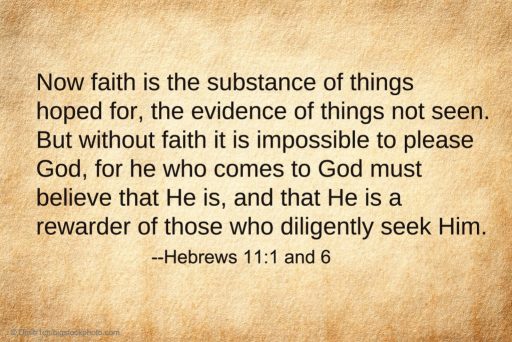
We get mail from people who suggest that if you accept science and evidence, you have demeaned God. “You just have to have faith,” one person wrote, “and saying that you need evidence devalues God.” I take strong exception to this claim on many levels, but my main objections are that it contradicts the Bible and eliminates evangelism in today’s world. Hebrews 11, “the faith chapter,” describes the faith of heroes of the Old Testament, including Abel, Enoch, Noah, Abraham, Sarah, Isaac, Jacob, Joseph, Moses, and Rahab. Let’s consider the connection between their faith and evidence.

For example, how did Moses get his faith? Did he come out of a vacuum and just have faith? Remember that his mother raised him and taught him about his people. What about the evidence of the burning bush and the staff that became a snake? Remember his discussions with God that gave him the courage to confront Pharaoh. What about the plagues in Egypt, the crossing of the Red Sea, the brass serpent, and receiving the Ten Commandments on Mount Sinai? Were those not evidence?

Also, read the story of Abraham and notice how many times God reassured him and how much evidence he saw before that near-sacrifice of Isaac. Using Hebrews 11 to justify violating the teachings of the New Testament is not only unwise, but it is also a violation of the teachings of the apostles. Faith and evidence are closely tied together in the New Testament.

For example, 1 Peter 3:15 tells Christians to “be ready to give an answer for the hope that is within us to anyone who asks.” Romans 1:20 tells us we can “know there is a God through the things He has made.” Jesus set the example with Thomas, who at one time had been the strongest of the apostles (See John 11:16) but saw his faith collapse at the death of Christ. How did Jesus deal with this incredible failing in Thomas? Did He condemn him or cast him off as a weakling? Read John 20:24-29 and see how Jesus encouraged Thomas to examine the evidence.

Someone might refer to Acts 2-3, where people, in less than a day, gave their lives to God.
Realize that God had been preparing that “soil” for thousands of years, and Jesus had been planting and nurturing it for three years. Today the voices of atheism, agnosticism, skepticism, materialism, and paganism are louder than ever. We cannot withdraw into our cocoon of church buildings and not do what God has called us to do.

Read Acts 17 and see how Paul dealt with the philosophers and skeptics of his day. He didn’t call them to blind faith. Instead, he gave them evidence of “the God in whom we live and move and have our being.” Faith and evidence go together. We must use evidence as Jesus and the Apostles did, or our numbers will continue to shrink as we lose our children and grandchildren to Satan.

— John N. Clayton © 2022

The Event to Remember

The Event to Remember - Empty Tomb

Today, we think once more of the event to remember which we described in this post from five years ago.

Early on the first day of the week, some women came to the tomb where the lifeless body of Jesus had been placed. It was empty. It had been opened–not by any human hands but by an angel. It wasn’t opened to let Jesus out. The tomb was opened so that people might see that it was empty. The followers of Jesus were not expecting him to be alive again. At first, they couldn’t believe it. Powerful people tried to find the body or to convince the public that it had been stolen. But they could not.

Now, over 2000 years later, there are still those who try to deny the resurrection. The evidence is there. The friends of Jesus were not expecting the resurrection, but after they had seen him alive, they spent the rest of their lives telling others about it. Even when they were tortured and killed for preaching the resurrection, not one of them ever recanted. Without a body, the powerful enemies of Jesus could not disprove the resurrection.

In 1 Corinthians 15:3-7, written only a few years after the resurrection of Jesus, the Apostle Paul recorded what scholars believe was an oral tradition of the resurrection appearances dating back to the very time of the resurrection. If it had not been true, this tradition and Paul’s record of it would have been debunked by the eyewitnesses who were still around. It was true, and the resurrection of Jesus Christ is the most solidly attested event of ancient history. The world will never be the same because of the day when Jesus Christ conquered death.
–Roland Earnst © 2017

Waiting for the New Day

Waiting for the New Day - Joseph's Tomb

As we are waiting for the new day, we want to share this post from five years ago.

Joseph of Arimathea was a wealthy man who had a new tomb carved into a stone hillside. This was not a pauper’s grave. Only the rich and powerful could afford such a burial place, and it was soon to become a temporarily borrowed tomb.

The first man to use it was not a wealthy man. He grew up as the son of a carpenter and had no home to call His own. He had a small group of friends who deserted Him at the last minute. His thousands of admirers quickly sought to get rid of Him when He didn’t overthrow the Romans as they expected.

A few days after they greeted Him with shouts of praise and honor, they were begging the Romans to put him to death. His lifeless body was placed in a rich man’s tomb because the rich man named Joseph stepped out of the shadows and loaned his tomb to Jesus. “Loaned” is the appropriate word, because Jesus would not need it for very long. This was a temporarily borrowed tomb. A miracle was about to happen!
–Roland Earnst © 2017

Meek or Weak – What’s the Difference?

Meek or Weak – What’s the Difference?

Jesus said, “Blessed are the meek, for they will inherit the earth” (Matthew 5:5). A regular challenge to Christianity is that it’s a group of weak people. Those who make this challenge don’t understand the difference between being meek or weak. These words are not synonyms but very different concepts.

The word translated as “meek” is “praus” in Greek. According to a Greek dictionary, it means “power under control as in a soothing medicine, a gentle breeze, a broken colt horse.” Nelson’s Bible Dictionary explains, “Meekness is an attitude of humility toward God and gentleness toward men, springing from a recognition that God is in control. It is strength and courage under control, coupled with kindness.”

The current crisis in Ukraine is because a very weak man (Putin) has control of the Russian military. He follows other weak men, such as Hitler, in bringing pain and suffering to innocent humans while he sits in comfort far away from where his weakness is being displayed. He is an example of power that is not under control.

We see the classic example of meekness in Jesus Christ. Christ shows His meekness in a plea to all of humanity, “Come to me all of you who are weary and burdened, and I will give you rest. Take my yoke upon you and learn from me, for I am meek and humble in heart, and you will find rest for your souls. For my yoke is easy and my burden is light” (Matthew 11:28-30).

The yoke Jesus calls us to take on is being kind, gentle, fair, forgiving, and peaceful. It is not giving up power but putting it under God’s control. Those who are weak don’t know how to live except by violence and abuse. When Jesus was on Earth, no one accused Him of being weak. Instead, people said, “What is this, for with authority and power He commands … and the fame of Him went out into every place in the country around” (Luke 4:36-7).

Considering meek or weak persons, the Bible contains stories about meek heroes and weak people. For example, Abraham meekly gives his nephew Lot the first choice in dividing the land given to him. Lot takes advantage of Abraham’s strength to support his own weakness (Genesis 13:7-9). Joseph shows meekness in dealing with his treacherous brothers (Genesis 45:3-5). Saul, in his weakness, could not handle David’s success (1 Samuel 18:7-9). Simon wanted Paul’s power and tried to buy it (Acts 8:9-24). Governor Felix was too weak to handle the truth (Acts 24:24-27). King Agrippa was too weak to become a Christian (Acts 26:27-29).

Jesus showed meekness in the extreme by how He faced death. John 10:17-18 quotes Jesus saying that no one could take His life from Him, but He had the power to lay it down. When Peter demonstrated weakness by taking out a sword and slashing away at his enemies, Jesus told him to put the sword away. He said, “Don’t you think I could pray to my Father and He would give me more than twelve legions of angels?” (Matthew 26:50-54). As a Christian, I am weak only when I don’t have the strength to measure up to the meekness that being a Christian requires.

I will never reach the meekness of great Christians of the past. I marvel at Paul, who changed from being an opponent of Christ to one of the meekest men who ever lived. I have not always shown meekness and have sometimes been very weak. Even Paul struggled with the challenge of being a Christian. Read Romans 7:14-8:2. The yoke Jesus offers is easy because God helps us. He is looking to save and not condemn us.

— John N. Clayton © 2022

Separation of Church and State

Separation of Church and State - Orthodox Patriarch Kirill
Orthodox Patriarch Kirill

The teachings of Jesus Christ show incredible intelligence and wisdom of design, including the separation of church and state. In Matthew 22:15-21, Jesus responded to a question about this issue by saying, “Give to Caesar what is Caesar’s and to God what is God’s.” Romans 13:1-7 instructs Christians to submit to and honor local authority, but there is no command for the Church to get involved in political activity. The Roman government was one of the most brutal and abusive political systems to ever exist on this planet, but Christians did not attempt to change it politically.

The Russian war on Ukraine has shown the consequences when churches get involved in politics. The Russian Orthodox Church has 260 million adherents, half of them living in Ukraine and half in Russia. The Russian leader of the Orthodox Church is Patriarch Kirill, who has supported Putin’s brutal invasion of Ukraine. As a result, 350 Russian Orthodox priests have rebelled against Kirill, and the Orthodox Churches in Ukraine have left the control of Kirill to form the Ukrainian Orthodox Church.

The fundamental problem is that the Orthodox Church has moved away from the Bible as a source of authority, replacing it with human patriarchs who dictate doctrine and follow traditions. Relying on human wisdom and politics instead of God’s Word has resulted in the Orthodox Church’s present situation.

Jesus taught a message of peace, love, and service to fellow human beings no matter their politics or national identity. When humans depend on human values instead of God’s Word, the result is conflict at all levels. The situation in Ukraine is a lesson for Christians throughout the world. Jesus said, “My kingdom is not of this world” (John 18:36). The separation of church and state is not only biblical but essential to the well-being of the followers of Jesus.

— John N. Clayton © 2022

Reference: The Week for April 1, 2022, page 14.

The Hardest Words to Say

The Hardest Words to Say

The “Does God Exist?” ministry is about life. We maintain that a successful life full of meaning and value is a life lived according to what God has told us in His Word. Our secular world tries to tell us that believing in God and following the Bible and its teaching are foolish and irrelevant to life. However, the evidence doesn’t support that view. Avoiding the things that bring heartache, misery, alienation, and frustration is often a matter of speaking a few of the hardest words to say.

One of the things that we fail to say is the simple phrase “I love you.” The Bible tells us that God is love, and 1 Corinthians 13 devotes a whole chapter to emphasizing the importance of love. It is difficult for us to express love because it puts us at risk. The biblical concept of love uses the word “agape,” a self-sacrificing kind of love. Being able to say “I love you” is essential for family relationships. Saying it to a child when there is a conflict or to a spouse when there is disagreement is vital to a rich relationship. Saying “I love you” with agape sincerity shows that we value the person and is fundamental to building and enriching relationships.

Another phrase that is hard for us to say is, “I have sinned.” No one likes to admit they were wrong. We want to blame others when we make a mistake. This started with Adam saying, “the woman you gave me, she gave it to me” (Genesis 3:12). Eve carried it on with “the snake deceived me” (Genesis 3:13). We also try to distance ourselves from the situation, as Cain did with “am I my brother’s keeper?” (Genesis 4:9). Admitting sin is difficult because it means we are imperfect and needy, shattering our claim of independence.

The Christian system advocates admitting our mistakes. James 5:16 tells us to “Confess your faults to one another.” A marriage in which one partner can never admit they made a mistake is a marriage that misses the joy and love God intends for it to have. When was the last time you admitted to your mate or your children that you have made a mistake or told them “I love you”? God expects us to be humble enough to speak words that enrich our relationships, even though they may be the hardest words to say.

— John N. Clayton © 2022