Majesty in Miniature

Majesty In Miniature

“Majesty in Miniature” is the title of an interesting article in the July 2017 issue of National Geographic (pages 99-118). The article is about the amazing hummingbirds.

Scientists have had a hard time getting data as they try to understand how hummingbirds do what they do. The birds fly at speeds up to 35 mph (56 kph) and they have a “reverse gear.” Their metabolic rate is the highest of any vertebrate on the planet. For every minute they are in flight, they drink more than 12 ounces (355 ml) of water. They consume more than their body weight of nectar every day. Their tongues lap up to 15 times a second. Proportionally their brain is one of the largest in the animal kingdom making up 4.2% of their body weight. It is only with the advent of high-speed cameras and advanced wind tunnels that some of the mysteries of the majesty in miniature have been answered.

Hummingbird brains have a large hippocampus which allows them to remember locations. Their brain has a large lentiformis mesencephali motion sensor which gives the bird stabilization when flying. It has a small arm wing which allows wrist motion to control a larger area of the wing leading to a more powerful upstroke. When a hummingbird hovers, it rotates its wings between the upstrokes and the downstrokes making a figure eight motion. This motion creates vortexes that allow both the downstroke and the upstroke to provide lift. Birds such as pigeons push down to propel forward, but there is no lift in the upstroke. The design of the hummingbird wing gives it the unique ability to get lift out of both strokes.

The design of all of these features defies any chance explanation. Nearly everything the hummingbird does is unique to that species. We don’t see birds with some of these characteristics, and yet all of them are essential to the hummingbird’s survival. Indeed this bird is majesty in miniature, and a testimony to God’s wisdom and design. He has equipped all creatures to live in their particular, unique environment.
–John N. Clayton © 2017
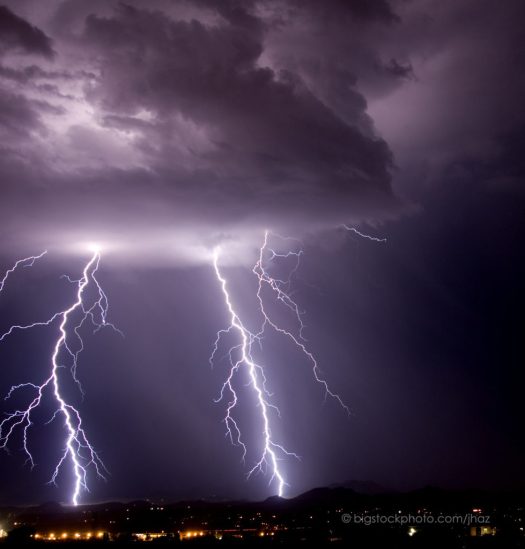
We Need Lightning to Survive on Earth

We Need Lightning
Most of us have had some experience with lightning. The chances are that our experiences have been terrifying and destructive, and we may view lightning as a bad thing. You may wonder if we need lightning. The short answer is, “Yes.” Lightning is a good thing, and there are many things we are still learning about it.

Lightning helps produce the nitrates and other nitrogen compounds that are needed by all living things on Earth. The process is called “nitrogen fixation, ” and it is vital to our very existence. Water droplets in the air carry an electric charge. That charge can accumulate to dangerous levels unless there is a way to neutralize it. That’s where lightning comes in.

One of my favorite demonstrations as a physics teacher was to get a very small flow of water going from a faucet and then bring a charged rod up to the column of water. The stream of water will bend in response to the charge. That is because the polar nature of the water molecule allows it to have electrical properties. Because of water’s electrical property, lightning is generated to release nitrogen from the air and deposit it in the crust of the Earth as nitrates and other nitrogen compounds that plants need to grow. The plants then feed and protect the animals and us.

Low Earth orbit satellites and high flying airplanes have recently made us aware of other properties of lightning. We have learned that red sprites occur and they have been photographed above large thunderstorms. Other upper atmosphere lightning phenomena include blue jets and terrestrial gamma flashes. Scientists are studying the highly complex nature of lightning to understand how the system works.

The Bible makes many comments about lightning. It tells us that lightning is made with water (rain) even though people at that time totally ascribed lightning to supernatural causes. (See Jeremiah 10:13 and 51:16). Lightning is referred to as a tool of God. (See Job 28:26; 36:30; 37:3, 11, 15; 38:24, 25, 35.)

We are just beginning to understand the design of Earth’s atmosphere and why we need lightning. It continues to be obvious that the more we know of the creation, the closer we get to understanding the power and wisdom of the Creator.
–John N. Clayton © 2017

World’s Largest Snake- TITANOBOA

World's Largest Snake
It was the world’s largest snake. Fortunately, it is extinct. The computer-generated picture shows what it might have been like if a human had ever confronted a Titanoboa (Titanoboa cerrejonensis).

One thing that many creationists and evolutionists forget is the fact that Earth’s climate in the past was much different from what it is today. To produce animals of massive size, Earth’s climate would have to be much warmer. The temperatures would have been so high that mammals could hardly survive. Cold-blooded (ectothermic) animals in tropical areas today tend to be larger than ectothermic animals found farther from the equator.

While giving lectures in Colombia, South America, we learned about the snake named Titanoboa. Fossils of more than two-dozen of these snakes were discovered in coal mines in northern Colombia. The name means “titanic boa,” and that seems fitting because it measured 48 feet (14.6 m) long and would have weighed 2500 pounds (1,135 kg). For a snake of that size to live, the climate must have averaged 90 degrees F (32 degrees C). It is difficult to comprehend how any mammal, especially humans, could survive in such temperatures.

Why would God have given this planet such an extreme climate? It was needed to support the world’s largest snake, other huge animals, and the massive vegetation they required. What was the purpose of those animals and plants? That environment made possible the coal, petroleum, and other resources that would later be needed by humans to support an advanced civilization. This is one more indication that the prehistory of the Earth had conditions uniquely designed by God to prepare the planet for human habitation.
–John N. Clayton © 2017

Human Evolution “The Road to Homo Sapiens”

Human Evolution “The Road to Homo Sapiens”

Around 1970, Time-Life Books published a mural of human evolution, “The Road to Homo Sapiens.” It became a monstrous success. It was a foldout in a book titled Early Man. It was also laminated and sent to teachers in public schools. This mural became the basis of several movies and even cartoons. What most people don’t realize is that it was quite inaccurate. The artists who made the drawing created the impression that it was a chronological sequence of human history. Actually, the dates were misrepresented, and the illustrations were pretty much fictional. In spite of that fact, much of the American public accepted “pliopithecus-to-modern-man” as a proven fact.

Half-a-century later, the picture is much more complicated and highly contested. Recently in Europe, scientists found older fossils of what were considered to be the earliest ancestors of modern humans. Others found fossils of a group of small-brained individuals apparently ritualistically buried in a cave complex in southern Africa. This find violated the theory that there is a relationship between brain size and human-like activities. Discovered in Indonesia is a very small hominid that supports the view that there is no relationship between brain size and humanism. Names like Homo floresiensis or Hobbits, and Homo naledi or Naledi, and Graecopithecus fill the literature today.

Debates rage among the leading anthropologists about whether brains became larger as Homo species evolved, or whether brain size came first and increased physical size came later, or whether brain size has nothing to do with evolution at all. Interestingly, some of the great geniuses of the past 100 years had very small brains.

The primary source of problems here is the failure to have a good definition of, “What is a human?” The biblical account defines humans as those beings created in the image of God. That does not refer to brain size or any physical characteristic. In reality, we have no idea what Adam looked like, how big his brain was, or any other physical characteristic.

The Bible tells us that “God formed the man of the dust of the ground, and breathed into his nostrils the breath of life; and the man became a living being” (Genesis 2:7). The Hebrew word yatsar is translated “formed.” It is a term used to refer to someone shaping pottery from clay. It’s different from the Hebrew word bara, which is used in Genesis 1:27 to indicate how humans were created in God’s image. Bara is a word used only in reference to what God can do, and that is what makes us unique. You can form a man out of plastic and put clothes on him and put him in a department store window. The body may resemble a man, but it does not have the breath of life, and it does not have a soul.

The fossil record shows us that many creatures in the past may have had some resemblance to humans. The same could be said today. You can visit a zoo and see gorillas, chimpanzees, orangutans, baboons, spider monkeys, Japanese snow monkeys, and others. The fact that there are some common features does not mean we are related.

The anthropological definition of humans deals only with physical characteristics. From the standpoint of human evolution, the road to homo sapiens is very bumpy indeed. The biblical definition of beings created in the image of God gives humans a special identification and a unique role in the world. It’s a role that has eternal significance and should also help us function in a constructive way in the affairs of this life. Humans can act like animals, but no animal can be human. Only humans are uniquely created in God’s image, now and for eternity.

–John N. Clayton © 2017

References: Science News June 10, 2017, page 6, The Week, June 23, 2017, page 20, Science News June 24, 2017, page 9.

South America Apologetic Outreach (Part 2)

South America Apologetic Outreach
Yesterday I started to describe what we found on our South America apologetic outreach during our recent lectureships in Colombia. As we spoke with people on the street, both men and women told me that they know the “Church” is a fake. They cite the failure of the Catholic Church to improve the standard of living of “common people” in countries like Colombia in spite of the enormous wealth the church holds. Several of them had suffered abuse at the hands of a church leader, and their expressions of pain were suppressed only by the church’s control.

The Colombian young people had seen the conflict between what they learned from television and on their computers and the traditions of the Catholic Church. At the same time, I was warned that if my lessons contained material in opposition to Catholic teaching, I would experience chastisement. At one point while our group was singing in the plaza, a Catholic priest came out of the church building and took one of our handouts. It seemed obvious that he was taking notes, and I gave him a business card for “Does God Exist?’ We have not heard from him as yet.

Atheists have taken note of all of this. Richard Dawkins has challenged the Catholic Church to a series of debates In December of 2017 at three universities in Colombia. Father Gerardo Remolina, a Vatican-trained scholar, has accepted Dawkin’s challenge. We hope to monitor these debates. Also, Dawkins has offered a competition to the young people of Colombia. He challenged them to watch the BBC program “Beautiful Minds” and write a five-page paper on why the life of an atheist is the best way to live. Dawkins will choose ten winners, and he will give them a personal tour of the British Museum.

In our lectureships in Ecuador and Colombia, we found intense interest in our approach. Young South Americans are rejecting Roman Catholicism. They are resenting the abuse, hypocrisy, and lack of constructive use of the Roman Catholic Church’s great wealth. They no longer are willing to live by an irrational faith based on tradition. Being told to THINK, to study the evidence for themselves and to believe that science and faith are friends and not enemies is a message they are eager to hear and accept.

We were blessed in our presentations in Ecuador and Colombia with two men who have lived in those countries for much of their lives and could translate our material accurately. We now have our videos subtitled in Spanish, and we hope to expand the outreach of our booklets and children’s material by translating them into Spanish. Unfortunately, we are a very small voice in a very large mission area. Dawkins and his associates are making their main thrust to reach university students, and those are the people who will control the moral and financial future of these countries. Already the Health Minister of Colombia, who is an atheist, has vowed to make abortion legal in his term. He states his atheist belief as the reason for that goal.

People in Ecuador and Colombia are eager to establish a meaningful relationship with God. They have seen the violence and murderous actions of drug warlords and the cartels who deny the teachings and principles of Jesus Christ. They have also experienced the apathy, abuse, and politics of organized religion through the Catholic Church. The need is great for a South America apologetic outreach. The people are anxious to learn a new way of living guided by God. The fields are ripe for harvest, but the laborers are few.
–John N. Clayton © 2017

South America Apologetic Outreach

South America Apologetic Outreach
Zipaquira Salt Cathedral, Colombia

Several years ago I was invited to do a lectureship in Quito, Ecuador, with Joshua Marcum and his coworkers in that large South American city. In July of 2017, I had another opportunity for a South America apologetic outreach in the area of Chia and Zipaquira, Colombia, just outside of Bogota, the capital. This effort was an outreach to the general population with two congregations of the Church of Christ involved and with an American team of workers led by Jimmy Pinzon and the Olive Street Church of Christ in Peoria, Arizona.

Roman Catholicism has dominated South America since the time of the Spanish explorers. You can read about the tightness of that control in history books, but when you travel these countries you comprehend how extensive the control is and the effect it has had on the people. These two South American lectureships were followed up with evangelistic efforts. They have clearly shown the need for material dealing with the existence of God, the validity of the Bible, and the importance of the Church as it is presented in the Bible.

One day we visited what is probably the #1 tourist attraction in Colombia called “The Salt Cathedral.” When we visited this huge salt deposit, I expected to see the same kind if thing that we had seen in Hutchinson, Kansas. We could see how the Kansas deposit was formed, and how the mine could be used in modern times to store electronic data. As we entered the Salt Cathedral, we found that Catholicism ruled the mine. The “Stations of the Cross” were carved into rooms and there were huge statues, carvings, and icons. Some rooms had prayer benches and placards about the Virgin Mary and Catholic saints. The main cathedral area had space and facilities for many worshipers including all of the altars and devices that are used in Catholic worship. Between the rooms were shops that sold statues of Catholic traditions, prayer beads, crosses, icons, and statues of Mary and Christ. The mine was a massive tool to promote Catholicism.

As we walked through the mine, we saw some young people who were mocking those who came to worship and making fun of the statements in the displays. Because most of the visitors spoke only Spanish, it was difficult to dialogue about why they were ridiculing the Catholic teachings presented in the mine. On one occasion, I heard a young man arguing with his girlfriend in English. He told me young people were fed up with Catholicism and the sexual abuse it had tolerated and the fairy-tale atmosphere of the mine, When I told him about my ministry and the fact that science supports faith in the God of the Bible, he was incredulous. We are still communicating with him through email, but I believe he reflected the feelings of many young people in Colombia.

One of the ways we advertised our lectures in Colombia was by singing as a group in the La Estacion Square in Zipaquira and the Comunerar Square. The Plaza at Comunerar is in front of a huge Roman Catholic Church. All kinds of vendors surrounded the square selling just about anything you could think of, most of which were related to Roman Catholicism. Jimmy’s group, my daughter Wendy, and I would sing in English well-known hymns like Amazing Grace. People would stop and listen. Some of them were testing their English, some were interested in the message, and some were just curious. The missionaries handed out flyers about my presentations and invited the people to come. We met many people who were disenchanted with Catholicism. Many had children who laughed at their faith and made fun of Catholicism just as we had seen in the mine.

In both Ecuador and Colombia, we have seen the need for a South America apologetic outreach teaching people the evidence for the existence of God and the validity of the Bible. People did not want to hear about “church” because to them that was a rehash of Roman Catholicism. Pray for the people of that great country as they are hungry to know how they and their children could believe in God, and how they could bring God into their lives. We will share more of our experience in Colombia in tomorrow’s post.
–John N. Clayton © 2017

Dark Matter and Black Holes

Dark Matter and Black Holes
Dark matter is the glue that holds our universe together. We have discussed a variety of ways that dark matter is critical to the existence of our solar system and of galaxies in general. We have also reported on unsuccessful experiments to try to find that mysterious dark matter. We have discussed the concept of WIMPS (Weakly Interacting Massive Particles) and the idea of attempting to see dark matter by smashing protons together. Now scientists think there may be a connection between dark matter and black holes.

A new study reported in Scientific American (July 2017, page 39-) reports that primordial black holes are now appearing to be the cause of dark matter. The computer model shows that when the creation process usually called “the big bang” took place, seeds of primordial black holes were produced. Those black holes could cause all of the phenomena that we observe and attribute to dark matter. This would be a much simpler cause of the dark matter than previous models would indicate. Dark matter would be a bi-product of the creation process.

From an apologetic standpoint, this is very interesting. God’s power is so great that when He applied that power in the creation process, massive numbers of primordial black holes were produced. If this hypothesis is correct, it tells us something of the power of God and explains the structure we see in the cosmos. It will be interesting to see if future research will confirm or deny this new observation.

The authors of the research document into dark matter and black holes are Juan Garcia-Bellido and Sebastien Clesse.
The Scientific American article is here.
The scientific document is available here.
–John N. Clayton © 2017

270-Degree Triangle and God

Looking for a 270-Degree Triangle
Everyone knows that if you add the three angles of a triangle, the total equals 180 degrees. So how can you have a 270-degree triangle? This question can be applied to the much tougher challenge of understanding what God is.

Many of the struggles people have in understanding God are rooted in our inability to understand how God functions and what is the nature of God. Questions we hear are like: “What race is God?” “What sex is God?” “How can God hear the prayers of many different people in many different places all at once?” “Who created God?” “Why does God allow awful things to happen?” These questions are a reflection of our inability to understand God’s nature.

The Bible gives us many pictures of God’s nature. So what does the Bible say God is like? All of the biblical descriptions portray God as a being who exists outside of time and space. Since God is not limited by the dimensions that restrict us, then the rules that are inviolable in our dimensions create no barriers for God.

To illustrate, I suggest that you take a flat sheet of paper and draw a triangle that has three right angles of 90 degrees for a 270-degree triangle. You may reply, “It is not possible. Triangles have 180 degrees. Don’t you know the rules of Euclidian geometry?” I then suggest that you visualize this. On a globe of the Earth, start at the North Pole and draw a line down the Prime Meridian to the Equator. Then to make the first 90° angle, go west along the Equator to 90° west longitude. From that point make a second 90° angle by going straight north to the North Pole. That line will be perpendicular to the first line creating a third 90° angle. By changing from the two-dimensional paper to the three-dimensional globe, the impossible becomes possible.

Let’s apply that to our understanding of God. How do we, stuck here in our limited dimensions, have the power to comprehend God who is not limited to our dimensions? The answer is, of course, that we cannot! To answer the most profound questions about God, we have to be willing to enlarge our understanding of the nature of God. We must accept the fact that God is not limited to our dimensions. When we do that, we realize that the questions we asked earlier are meaningless. They come from the fact that we cannot see all of the dimensions of God’s existence. A 270-degree triangle is possible when it is not limited to two dimensions. For a dimensionless God, all limitations are gone.

For more on this see “A Help in Understanding What God Is.”
–John N. Clayton and Roland Earnst © 2017

Galactic Collision Is Coming!

Andromeda Galaxy on Galactic Collision Course
Andromeda Galaxy

A skeptic remarked to me, “If a wise God created the universe, it would have been designed better. Our Milky Way galaxy and the Andromeda galaxy are on a galactic collision course. They are going to smash into each other and tear each other apart. That’s the end of life on Earth. You’re God must not be very smart.” What could I say? Yes, it’s true that astronomers have determined that there will be a galactic collision of the Milky Way and Andromeda galaxies resulting in the destruction of both. But there is more to the story.

Recently I read an article about scientists who are studying two black holes that appear to be orbiting each other 750 million light-years from Earth. The scientists are watching them to see what will happen when two black holes collide as they spin into each other. The reason for the scientists’ curiosity is they want to know what will happen when the black holes in the center of the Milky Way and Andromeda come together. (It seems that most galaxies have black holes in their center.) Of course, the center of the galaxies will not meet until long after the outer spirals have destroyed each other, and Earth as well. Still, the scientists want to know what will happen when black holes collide. Will they swallow each other and become a super-super-massive black hole? Will they disappear? Who knows?

The scientists have been watching those distant orbiting black holes for about 12 years now. How much longer will they have to wait to find the answer? They estimate that those black holes orbit each other every 24,000 years. How many orbits will it take for them to converge in a catastrophic explosion of energy? At this point, it’s anyone’s guess. The bottom line is that it’s going to take a lot longer than 12 years, or even 12 hundred, or 12 thousand, or maybe even 12 million. The scientists working on the project will not be around to learn the answer.

Let’s get back to the expected Milky Way-Andromeda catastrophy. When will it happen? Oh, let’s say in a billion years or so. We have many more important things to worry about than the coming galactic train-wreck. So why was the skeptic saying that there can’t be an all-wise, loving, and powerful God because our two galaxies may be destroyed in a billion years? That’s a very weak excuse for not believing in God. The point is that God never intended for this universe and our planet to last forever. He even told us so. (See 2 Peter 3:10-12.) God had a specific plan in mind to give us a chance to learn to love and serve him and to grow toward becoming the people he called us to be. There is a much better universe coming. (You can read about it in Revelation 21.) There is no need to worry about a galactic collision. In the new universe: There will be no more death or mourning or crying or pain, for the old order of things has passed away” (Revelation 21:4).
–Roland Earnst © 2017

Bogota, Colombia–Faith Challenges

Bogota, Colombia
Bolivar Plaza, Bogota, Colombia

As you read this, your author is in Bogota, Colombia, South America, presenting lectures at a university and in town meetings.

What has happened in Colombia is going on in many areas of South America. For years the Roman Catholic Church has dominated the country, and recent moral problems with some priests and Catholic leaders have disillusioned many Colombians. The result is that belief in God has dropped considerably and Colombia’s health minister has announced he is an atheist and is vowing to implement legal abortion.

Atheists are bringing in atheistic professor Richard Dawkins to challenge the Catholic Church to debate in Bogota in December of this year. The Catholic Church has accepted the challenge and an ordained priest of 50 years experience named Gerardo Remolina will oppose Dawkins. Remolina has written a book titled God and Religion, Illusion or Reality. He is the vice-chancellor of Bogota’s Catholic Javeriana Pontifical University and is the academic dean of the Faculty of Social Sciences. Tickets for the debate have already gone on sale.

The atheists are also sponsoring a national essay contest in which students are being asked to watch the BBC documentary entitled Beautiful Minds and then write a five-page essay on Dawkins’ godless belief system. The top ten students will then be invited to travel to London to visit the Natural History Museum, with a tour guided by Dawkins himself. You can read more about the Dawkins challenge on ColombiaReports.com.

During our trip we are presenting programs on the existence of God in Chia, a northern suburb of Bogota, Colombia, on June 30 and July 1.
–John N. Clayton © 2017